Published by Katarzyna GĘBCZYK, Andrzej Ł. CHOJNACKI, Łukasz GRĄKOWSKI, Kornelia BANASIK Kielce, University of Technology, Department of Power Engineering Basics
Abstract. The article presents the results of the analysis of the costs of losses at distributors and consumers of electricity, caused by failures of medium voltage overhead and cable power lines operated by domestic distribution companies. The components of failure costs were analyzed. Average values, standard deviations and confidence intervals for the mean value were also determined: The non-parametric verification of the costs analyzed was also carried out.
Streszczenie. W artykule przedstawiono wyniki analizy kosztów strat u dystrybutorów oraz odbiorców energii elektrycznej, spowodowanych awariami napowietrznych i kablowych linii elektroenergetycznych średniego napięcia eksploatowanych w krajowych spółkach dystrybucyjnych. Analizie poddano składniki kosztów awarii. Wyznaczono wartości średnie, odchylenia standardowe oraz przedziały ufności dla średniej. Dokonano także weryfikacji nieparametrycznej analizowanych kosztów. (Analiza porównawcza kosztów awarii linii napowietrznych i kablowych średniego napięcia)
Keywords: overhead MV lines, cable MV lines, reliability, power industry
Słowa kluczowe: linie napowietrzne średniego napięcia, linie kablowe średniego napięcia, niezawodność, energetyka
Introduction
Over the last several dozen of years, in connection with, among others, Poland’s accession to the European Union, the interest in the problem of reliability of power systems has increased. The reason for this is the fact that even the shortest interruption results in dissatisfaction of electricity consumers and material losses. Correct and reliable operation of medium voltage grids is possible with reliable operation of individual network devices.
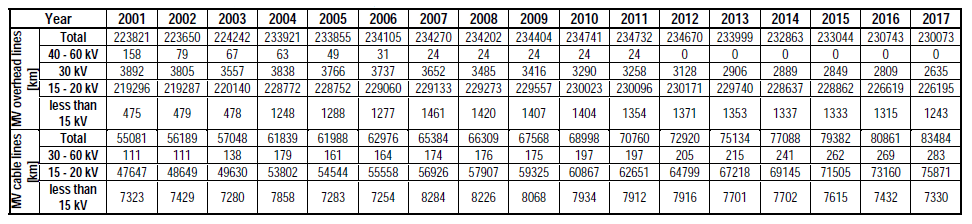
High reliability of operation of medium voltage lines allows to reduce the time of interruptions in power supply to customers, and thus to minimize the costs of losses resulting from the lack of power supply to customers. Medium voltage power lines are one of the most important elements of distribution networks. They enable the transmission of electricity at the most advantageous voltage values from the technical and economic point of view. Table 1 presents the lengths of medium voltage overhead and cable lines operated in the Polish power system in the years 2001 – 2017.
There have recently been many publications and studies indicating the need to quickly replace medium and low voltage overhead power lines with cable lines. Such actions are supposed to significantly increase the continuity of supply to customers from the commercial power grid. However, there are a number of doubts as to whether such measures are technically and economically justified. The technical aspect is discussed, among others, in publications [8, 9]. In this article the Authors deal with the economic part of this issue. They analyzed the costs of removing overhead and cable line failures, as well as the losses caused by the unreliability of these lines to the municipal electricity consumers.
The comments and conclusions contained in the article are of a debatable nature and in the intention of the Authors should provoke a polemic among all entities interested in the problem of continuity of electricity supply to consumers, whether the plans for universal cabling of Polish distribution networks are fully justified from the point of view of the cost of unreliability of these lines. In the case of cable lines, only lines with cross-linked polyethylene insulated cables were analyzed, as such cables are used in the execution of new investments. The article presents the results of a detailed statistical analysis of the individual components of the total unreliability costs of medium voltage overhead and cable lines incurred by energy distributors. Research was also carried out into the costs of losses incurred by municipal electricity consumers as a result of power cuts. The analysis was performed on the basis of economic and financial data of a power company and reliability data from observations in a large Polish distribution company, recorded over a period of 15 years. 1950 cases of medium voltage overhead line failures and 1350 cases of medium voltage cable line failures were considered. On this basis, average values of analyzed costs, standard deviations, confidence intervals for the mean value as well as minimum and maximum values were determined. Non-parametric verification was also carried out. Theoretical distributions of probability density of costs of losses at energy consumers and distributors were determined. All the analyses were carried out at the level of significance α = 0.05
Table 1. Lengths of medium voltage overhead and cable lines operated in the Polish power system [1]
The average value from sample t̄a was estimated using the method of the highest reliability, based on the formula [10]:

where: ¯Ka – mean value from the sample; K̇i – center of i-th class of the frequency distribution; ni – number of failures in the i-th class of the frequency distribution; n – total number of failures; k – number of classes of the frequency distribution.
The confidence interval for the mean is determined according to the formula [4, 10]:

where: ¯Ka – mean value from the sample; ua – value of a random variable U with a standardized normal distribution, determined for a given confidence coefficient 1-α from the normal distribution table; s – standard deviation from the sample calculated according to the formula:

Cost characteristics of losses in electricity distributors and consumers
The costs of losses incurred by electricity distributors are primarily related to the removal of failures and loss of profit due to non-delivery of electricity to consumers. These costs, together with the operating costs, reduce the company’s profit. The costs of removal of failures are the sum of at least a few components. These are mainly [4, 6]:
• costs of purchasing new equipment and materials;
• operating costs of construction equipment, cable laboratory, etc.;
• operating costs of fitters and other persons involved in repairing breakdowns;
• costs of travel to the site of failure.
The cost of purchasing new equipment and materials is very diverse. Its value depends on the extent of the failure and the damaged device (component). The costs of equipment operation result from the fact that during the location of the failure or directly in the phase of its removal, specialist construction or power equipment is used, such as cranes, excavators, manlifts, drilling rigs, long-load trailers, cable laboratories and others. The cost of operation of each of these devices increases the total cost of equipment operation. Regardless of whether specialist equipment is used, a group of fitters from the distribution company must always arrive at the location of the failure. This entails the cost of travel of a power emergency service car. Removing failures in power systems involves considerable human labor input. This labor results both from the need to operate specialist equipment and from the need to perform many tasks manually or only with simple fitting tools. The work of the workers removing the failure involves remuneration that must be provided to them. Labor costs are the higher the more time it takes to remove the failure and the more people work on it.
As a result of a failure of power equipment, consumers do not receive electricity. The result is a loss of profit for the distribution and trade companies. The costs of lost profit can be determined on the basis of the formula [4, 7]:

where: kjuz – unit profit loss indicator in PLN/MWh, ΔA – amount of electricity not delivered to consumers as a result of failure, determined on the basis of the active power load diagram P = f(t) of a given network.
Ultimately, the total cost of losses at the distributor can be determined from the formula [4, 7]:

where: Kaw – cost of failure, Kmiu – cost of purchase of new materials and equipment, Ksprz – cost of equipment operation, Kpm – cost of fitters’ labor, Kd – cost of emergency service and construction equipment’s travel to the site of failure, Kuz – cost of lost profit.
In the next part of the article the results of a detailed statistical analysis of the costs occurring in the formula (5), in case of medium voltage overhead and cable line failures are presented.
Costs of losses at electricity distributors in case of medium voltage overhead and cable line failures
1. Costs of purchasing new materials and equipment
On the basis of empirical data, statistical parameters characterizing the costs of purchase of materials Kmiu in case of medium voltage overhead and cable line failures were determined. The values obtained are shown in Table 2.
Table 2. Statistical indicators characterizing the costs of purchase of materials in case of medium voltage overhead and cable line failures

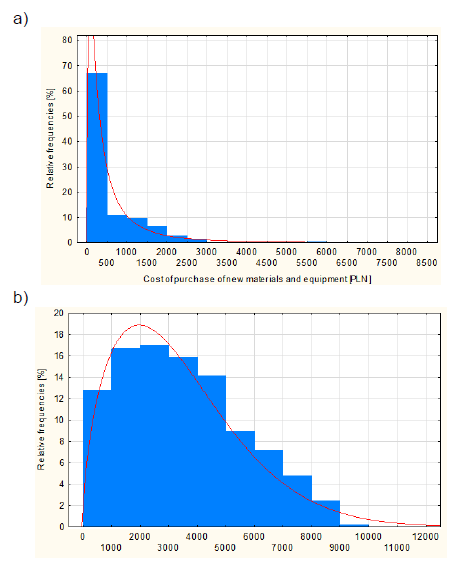
A correspondence analysis of the empirical distribution of the costs of purchase of new equipment and materials with the selected theoretical model was carried out. A hypothesis was put forward that the theoretical distribution of probability density of the cost of purchase of equipment and materials in the event of failure of medium voltage overhead lines is a log-normal distribution of the following form [6, 17, 18]:

where: m – expected value of the log Kmiu random variable, σ – standard deviation of the log Kmiu random variable.
The values of distribution parameters (6) determined using the Statistica package for MV overhead lines are: m = 5.7900, σ = 1.2763.
A hypothesis was put forward that the theoretical distribution of probability density of the cost of purchase of equipment and materials in the event of failure of medium voltage cable lines is a Weibull distribution of the following form [6, 17, 18]:

where: b – scale parameter, v – shape parameter. The values of distribution parameters (7) determined using the Statistica package for MV cable lines are: m = 3798.99, v = 1.5608.
Empirical and theoretical functions of probability density of purchase costs of materials and equipment are presented in Figure 1.
2. Equipment operation costs
On the basis of empirical data, statistical parameters characterizing the costs of equipment operation Ksprz in case of removing medium voltage overhead and cable line failures were determined. The values obtained are shown in Table 3.
Table 3. Statistical indicators characterizing the costs of equipment operation in removing failures of medium voltage overhead and cable lines

A correspondence analysis of the empirical distribution of the costs of equipment operation with the selected theoretical model was carried out. On the basis of empirical data, a hypothesis was assumed that the theoretical distributions of probability densities of equipment operation costs in the removal of medium voltage overhead and cable line failures are log-normal distributions.
The values of distribution parameters (6) determined using the Statistica package are for MV overhead lines: m = 6.2504, σ = 0.8577 and for MV cable lines: m = 7.3038, σ = 1.1267.
Empirical and theoretical functions of probability density of equipment operation costs are presented in Figure 2.

3. Fitters’ labor costs
On the basis of empirical data, statistical parameters characterizing the costs of labor of fitters and other people in removing medium voltage overhead and cable line failures were determined. The obtained results are presented in Table 4.
Table 4. Statistical indicators characterizing the costs of fitters’ labor in removing failures of medium voltage overhead and cable lines

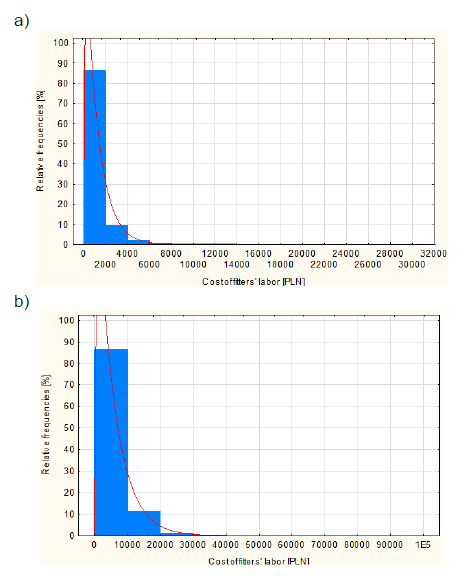
On the basis of empirical data, a hypothesis on the exponential distribution of the costs of fitters’ labor for the removal of medium voltage overhead and cable line failures was assumed. The function of probability density of exponential distribution is determined by the formula:

The value of the coefficient λ is in this case equal to the reciprocal of the mean value from the sample:

Determined values of distribution parameters are in case of MV overhead line failure λ = 852.4·10-6, and in case of MV cable line failure λ = 185.6·10-6.
Empirical and theoretical functions of probability density of fitters’ labor costs in case of removal of MV overhead and cable line failures are presented in Figure 3.
4. Costs of travel to the site of failure
On the basis of empirical data, statistical parameters characterizing the costs of travel to the site of failure in case of removing medium voltage overhead and cable line failures were determined. The obtained results are presented in Table 5.
Table 5. Statistical indicators characterizing the costs of travel to the site of failure in case of removing medium voltage overhead and cable line failures

On the basis of empirical data, a hypothesis was assumed that the theoretical distributions of the probability densities of the costs of travel to the site of failure in case of overhead and cable line failures are Weibull distributions.
The values of distribution parameters (7) determined using the Statistica package are for MV overhead lines: b = 79.2174, v = 1.2094 and for MV cable lines: b = 69.3839, v = 1.5756.
Empirical and theoretical functions of probability density of the value of the cost of travel to the site of failure of MV overhead and cable lines are presented in Figure 4.

5. Costs of lost profit
On the basis of empirical data concerning the amount of electricity not delivered to consumers, statistical parameters characterizing the costs of lost profit as a result of failures of medium voltage overhead and cable lines were determined. The obtained results are presented in Table 6.
Table 6. Statistical indicators characterizing the costs of lost profit in case of medium voltage overhead and cable line failures

On the basis of empirical data, a hypothesis on the exponential distribution of the costs of lost profit for the removal of medium voltage overhead and cable line failures was assumed. Determined values of distribution parameters for failure of MV overhead lines are λ = 0.0021, and for failure of MV cable lines: λ = 0.0066.
Empirical and theoretical functions of probability density of lost profit costs in case of MV overhead and cable line failures are presented in Figure 5.

6. Total costs of losses for electricity distributors
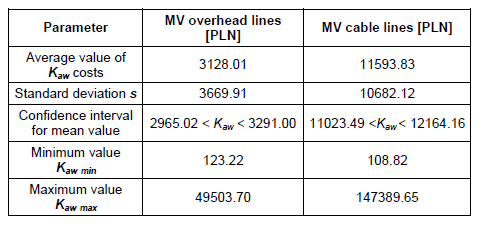
On the basis of empirical data, statistical parameters characterizing the total cost of losses for distributors as a result of medium voltage overhead and cable line failures were determined. The obtained results are presented in Table 7.
Table 7. Statistical indicators characterizing the total cost of losses for energy distributors in case of medium voltage overhead and cable line failures
On the basis of empirical data, a hypothesis on lognormal distribution of costs of losses at energy distributors in case of medium voltage overhead and cable lines failures was assumed. Determined values of distribution parameters for MV overhead lines are: m = 7.7179, σ = 0.7678 and for MV cable lines: m = 8.9634, σ = 1.0226.
Empirical and theoretical functions of probability density of costs of losses at distributors in case of MV overhead and cable line failures are presented in Figure 6.

Costs of losses at household consumers caused by discontinuity of power supply
The cost of losses at municipal power consumers can be estimated on the basis of the formula:

where: kA – economic equivalent of undelivered electricity in PLN/kWh, ΔA – amount of electricity undelivered to consumers as a result of a failure in kWh.
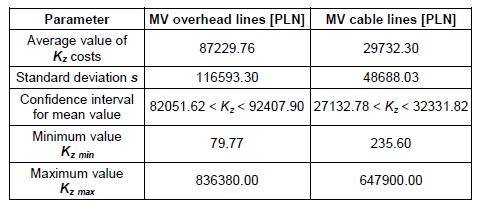
On the basis of the conducted analyses and calculations, the authors of the publication [3] obtained the value of the unit economic equivalent of undelivered electricity kA = 21.48 PLN/kW·h. Based on the above indicator and empirical data from the operation of medium voltage lines, statistical parameters characterizing the costs of losses at energy consumers in case of medium voltage overhead and cable line failures were determined. The issue of the costs of losses at municipal consumers is described in more detail in publications [5, 6, 12]. The statistical indicators obtained in the analysis are presented in Table 8.
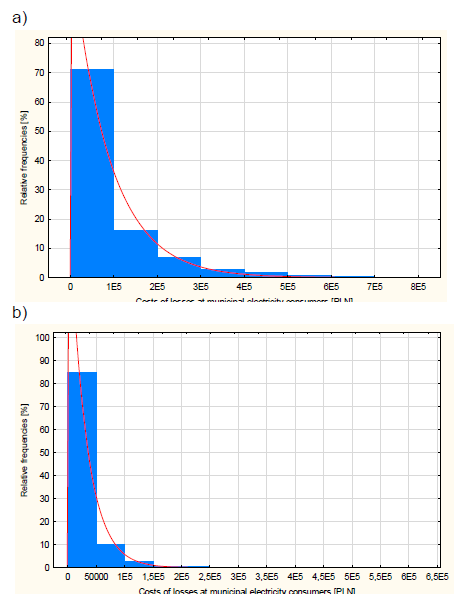
On the basis of empirical data, a hypothesis on the exponential distribution of costs of losses at energy consumers in case of medium voltage overhead and cable lines failures was assumed. Determined values of distribution parameters for failure of MV overhead lines are λ = 11.5·10-6, and for MV cable lines: λ = 33.6·10-6.
Table 8. Statistical indicators characterizing the costs of losses for energy consumers in case of medium voltage overhead and cable line failures
Empirical and theoretical functions of probability density of costs of losses at consumers in case of medium voltage overhead and cable line failures are presented in Figure 7.
Conclusions
Table 9 presents the results of statistical analysis of average costs of unreliability of medium voltage overhead and cable lines.
Table 9. Average values of costs of losses at energy distributors resulting from medium voltage overhead and cable line failures

Figure 8 shows the share of individual components in the total cost of failure. Analyzing the parameters obtained as a result of the analysis, characterizing the costs of losses at distributors due to medium voltage overhead and cable line failures, it should be noted that the average costs of removing failures are higher for cable lines. In the case of removing cable line failures, compared to removing overhead line failures, the costs of equipment operation, fitters’ labor and travel to the site of failure are higher.
The largest part in the total costs are the costs of fitters’ labor and the costs of equipment operation. The share of fitters’ labor costs is about 37.50% in case of overhead line failures and about 46.47% in case of cable line failures. The share of equipment operation costs, in turn, is about 25.13% of medium voltage overhead line failure costs and 21.67% of cable line failure costs.
The cost of travel of power emergency service and mechanical equipment to the site of failure is similar for both overhead and cable lines.

In field networks, i.e. overhead lines, the share of lost profit costs is higher and amounts to approximately 15.03% of all the failure removal costs. For urban networks, i.e. cable lines, the share of lost profit costs is about 1.31%. This is due to the longer duration of supply interruptions in rural areas, which results in a higher value of electricity not supplied to consumers, which in turn determines the lost profit costs. This time also affects the average costs of losses at household consumers caused by discontinuity of power supply. In case of failures of MV overhead lines they are greater and amount to 87.229,76 PLN, and in case of failure of cable lines 29.732,30 PLN.
The total average cost of losses at energy distributors per one failure is PLN 3.128.01 for medium voltage overhead lines and PLN 11.593.83 for medium voltage cable lines. The total costs incurred by the electricity distributor during the considered 15-year period, i.e. in 1950 cases of overhead line failures, amounted to PLN 6.084.897, and in 1350 cases of cable line failures – PLN 15.824.984. This results in annual unreliability costs of PLN 405.659,80 for overhead lines and PLN 1.054.998,93 for cable lines.
According to the authors, the decision on the widespread cabling of MV distribution networks is advantageous for consumers, because it will result in shorter power supply interruption times and ultimately lower costs of losses caused by discontinuity of power supply. For distribution companies, however, this entails more than doubling the cost of unreliability related losses. Therefore, it seems pointless to replace further overhead lines with cable lines only in order to achieve the assumed network cabling index and to improve the SAIDI and SAIFI indexes. Even in the case of lower intensity of damage, cable lines generate (due to high costs of removing a single failure) much higher total unreliability costs compared to overhead lines. The only aspect of the economic and financial analysis in favor of cabling distribution networks is the cost of losses at municipal electricity consumers. These costs, for consumers supplied from overhead lines, are almost three times higher than for consumers supplied from cable networks. However, it should be taken into account that such a situation results primarily from the possibility of reserving the power supply to consumers, which possibility is much greater in urban networks, where cable lines prevail, than in field networks, where overhead lines prevail.
REFERENCES
[1] Agencja Rynku Energii S.A., Statystyka Elektroenergetyki Polskiej 200 – 2017, Warszawa 2001 – 2018
[2] Banasik K., Chojnacki A. Ł., Effects of unreliability of electricity distribution systems for municipal customers in urban and rural areas, Przegląd elektrotechniczny Nr 05/2019, p. 179-183
[3] Banasik K., Chojnacki A. Ł., Skutki gospodarcze niedostarczenia energii elektrycznej do odbiorców komunalnobytowych. Przegląd Elektrotechniczny Nr 3/2018, p. 181-187
[4] Chojnacki A. Ł., Analiza niezawodności eksploatacyjnej elektroenergetycznych sieci dystrybucyjnych. Wydawnictwo Politechniki Świętokrzyskiej, Kielce 2013
[5] Chojnacki A. Ł., Analiza skutków gospodarczych niedostarczenia energii elektrycznej do odbiorców indywidualnych. Wiadomości elektrotechniczne Nr 09/2009, p. 3-9
[6] Chojnacki A. Ł., Chojnacka K. J.: Niezawodność elektroenergetycznych sieci dystrybucyjnych. Wydawnictwo Politechniki Świętokrzyskiej, Kielce 2018
[7] Chojnacki A. Ł., Koszty strat u dystrybutorów oraz odbiorców energii elektrycznej spowodowane zawodnością układów uziomowych eksploatowanych w stacjach elektroenergetycznych SN/nn. INPE Informacje o normach i przepisach elektrycznych Nr 194-195 listopad-grudzień 2015, p. 46-58
[8] Chojnacki A. Ł., Analiza wskaźników oraz właściwości niezawodnościowych elektroenergetycznych linii napowietrznych i kablowych średniego napięcia. Wybór optymalnego wariantu linii w kontekście zapewnienia ciągłości zasilania odbiorców. XXII Konferencja Naukowo-Techniczna Bezpieczeństwo Elektryczne ELSAF 2019, Karpacz, 24-27.09.2019, p. 141-152
[9] Chojnacki A. Ł., Kablowanie sieci dystrybucyjnych średniego i niskiego napięcia jako metoda zwiększania niezawodności zasilania odbiorców energią elektryczną. XXII Konferencja Naukowo-Techniczna Bezpieczeństwo Elektryczne ELSAF 2019, Karpacz, 24-27.09.2019, p. 153-163
[10] Greń J., Modele i zadania statystyki matematycznej. PWN, Warszawa, 1982
[11] Horak J., Popczyk J., Eksploatacja elektroenergetycznych linii
rozdzielczych. Warszawa, WNT 1985
[12] Kowalski Z., Niezawodność zasilania odbiorców energii elektrycznej. Wydawnictwo Politechniki Łódzkiej, Łódź, 1992
[13] Kujszczyk S. i in., Elektroenergetyczne sieci rozdzielcze. Warszawa, PWN 1994
[14] Lesiński S., Niezawodność urządzeń elektrycznych. Wydawnictwo Politechniki Łódzkiej, Łódź, 1989
[15] Paska J., Niezawodność systemów elektroenergetycznych. Oficyna Wydawnicza Politechniki Warszawskiej, Warszawa, 2005
[16] Popczyk J., Modele probabilistyczne w sieciach elektroenergetycznych. Warszawa, WNT 1991
[17] Sozański J., Niezawodność i jakość pracy systemu elektroenergetycznego. Warszawa, WNT 1990
[18] Sozański J., Niezawodność zasilania energią elektryczną. WNT, Warszawa 1982
[19] Wróblewski Z., Siwak P., Trwałość eksploatacyjna elektroenergetycznych linii kablowych średnich napięć. Wiadomości Elektrotechniczne Nr 9/2007, p. 74-76
Authors: M.Sc. Eng. Katarzyna Gębczyk, Prof. PhD Eng. Andrzej Ł. Chojnacki, M.Sc. Eng. Łukasz Grąkowski, M.Sc. Eng. Kornelia Banasik, Kielce University of Technology, Faculty of Electrical Engineering, Automatic Control and Computer Science, Department of Energy Basics, Poland, kgebczyk@tu.kielce.pl, a.chojnacki@tu.kielce.pl, lgrakowski@tu.kielce.pl, k.banasik@tu.kielce.pl
Source & Publisher Item Identifier: PRZEGLĄD ELEKTROTECHNICZNY, ISSN 0033-2097, R. 96 NR 10/2020. doi:10.15199/48.2020.10.14
 Power Quality Blog