Published by Juliya MALOGULKO, Svyatoslav VYSHNEVSKY , Iryna KOTYLKO, Natalia SOBCHUK, Vinnitsa National Technical University
Abstract. The article analyzes the pace of increase in the generation of photovoltaic stations in the context of the combined electricity system of Ukraine and the energy supply company of PJSC “Vinnytsyaoblenergo”. An analysis of existing regulatory documents regulating the work of photovoltaic stations has been carried out. Within the framework of the considered documents, the criteria for assessing the reliability of the operation of electric networks, namely, the length of long breaks in electric power supply of consumers of electric energy SAIDI are defined. The interconnection of the change of reliability indices of electric networks operation with the increase in the number and installed capacity of renewable energy sources, in particular photovoltaic stations (PV), is shown. In order to increase the reliability of power supply, a method of its renewal has been proposed, due to the joint use of generation of small hydroelectric power stations and PV stations.
Streszczenie. W artykule analizowano kombinowany system energetyczny na Ukrainie zawierający ogniwa fotowoltaiczne. Na podstawie dokumentacji analizowano niezawodność systemu biorąc pod uwagę przerswy w dostawie energii. Zaproponowano poprawę przez dołączenie małych elektrowni wodnych. Wpływ rozproszonych źródeł energii na niezawodność sieci elektrycznej
Keywords: dispersed energy sources, photovoltaic stations, local electric systems, small hydroelectric power stations.
Słowa kluczowe: rozproszone źródła energii, ogniwa fotowoltaiczne, niezawodność
Introduction
In 2015, our state was one of the first to ratify the Paris Climate Agreements, thus confirming its intentions and commitments to integrate into the EU energy system and carry out energy reforms in the framework of the requirements of the Third Energy Package, which includes, among other things, the creation of favorable conditions for the introduction of new energy generating capacities renewable energy sources (RES).
The National Renewable Energy Action Plan for the period up to 2020 stipulates that the share of renewable energy generation in final energy consumption should reach 11% [1].
Nowadays, Ukraine demonstrates the highest pace of signing agreements for future accession of RES, but it poses great risks to the outdated energy network [2]. The key is that, according to official information of SRFEU, in I quarter. In 2018, 159.4 MW were put into operation, generating capacities – 54 objects of the electric power industry (2.4 times exceeding the capacity put into operation for the same period in 2017). At the same time, the objects of wind electric station (WES) and photovoltaic (PV) make up 92% of the installed capacities, and the average unit capacity of the electric energy objects introduced at that time is 3 MW. The installed capacity of WES and PV in Ukraine as of mid-2018 is 1353 MW (512 and 841 MW respectively), which has almost no effect on the balance of power. Their deviations from the planned generation are offset by maneuvering power.
In 2017, the number of technical specifications and contracts signed with Ukrenergo for joining high-voltage networks of green energy facilities, compared with 2016, increased by more than 30 times the power indicator. This is a crazy pace and this tendency persists.
According to Ukrenergo, contracts for joining by 2025 to networks of green energy installations with a capacity of 7426 MW (WES – 4200 MW, and PV – 3226 MW, excluding large hydroelectric power stations) have already been signed. However, the united energy system (UES) can only accept up to 3,000 MW of solar and wind power plants without the risk of unbalance and serious changes in its structure.
The system operator in his research stresses that PV and WES in terms of stability [3-6] of electricity supply are unreliable. Deviations from scheduled charts over the course of the day amount to more than 450 MW at a set power of 1217 MW. One more specific feature of the installation of renewable energy sources is their uneven distribution throughout Ukraine. Thus, the presence of one powerful source of up to 3 MW or several less powerful ones up to 0.5 MW connected to one substation of the distribution electric network (DEN), makes it possible to consider DEN as a local electrical system (LES). And for the local electrical system, there are not yet clear legislative acts that will require the operation of renewable energy sources.
Particularly acute for distributive electrical networks is the question of reliability and uninterrupted power supply. According to the Resolution of the National Commission for State Regulation in the Fields of Energy and Utilities (SRFEU) dated June 12, 2018 “On Approving the Procedure for Ensuring Quality Standards for Electricity Supply and Providing Compensation to Consumers for Failure”, [7] determined indicative, qualitatively characterizing the level of reliability of work DEN But, taking into account the pace of increasing the generation capacity of RES, in particular PV, it is expedient to carry out an analysis of changes in the determined indicators in terms of its growth.
Aim of the research – The purpose of the article is to assess the influence of photovoltaic generation on the reliability of the operation of electric networks and develop a method for its improvement.
Main materials of the research
In accordance with the IEEE 1366-2012 [8] and the SRFEU Resolution “On Approval of the Targets of Reliability (Continuity) Electricity Supply for 2018” [9], the main indicators of the reliability of operation of electric networks, including those with renewable energy sources, are quantified and qualitative breaks in electricity supply.
Classification of interruptions in electrical supply according to DSTU EN 50160: 2014:
a) scheduled, when the consumer is informed in advance about them;
b) Emergencies caused by long-term or short-term short circuits that are most often the result of external events, equipment failure or third-party interference in its operation Random breaks are classified as:
1) long interruptions (longer than three minutes);
2) short-term interruptions (including up to three minutes).
– System Average Interruption Duration Index
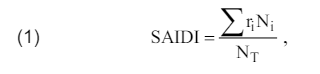
Where ri – the time of restoration of electricity, Ni – the number of breaks in the electricity supply of consumers in the reporting period, NT – the total number of consumers in the electrical network.
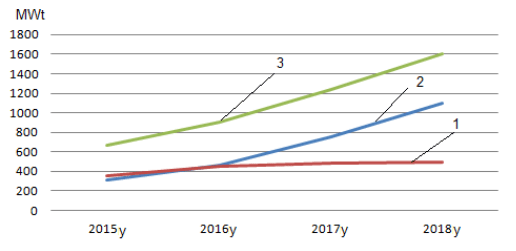
Increasing the share of generating renewable energy sources, for example, only those with the largest increase in power, namely wind and photovoltaic stations, are analyzed (Fig. 1).
At the beginning of 2015, the total installed capacity of the PV was 315 MW. Over the past four years, their capacity has increased more than 3 times and at the end of 2018 – 1100 MW. It should be noted that the PV are unevenly located on the territory of Ukraine, and in their turn, it is quite difficult to assess their impact on the reliability of electricity supply networks.
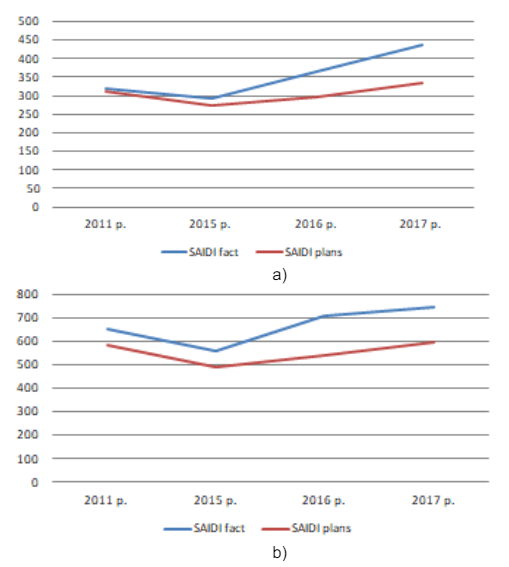
In fig. 2 shows the SAIDI change for 2011, 2015-2018, the average for the UES for urban and rural electric networks.
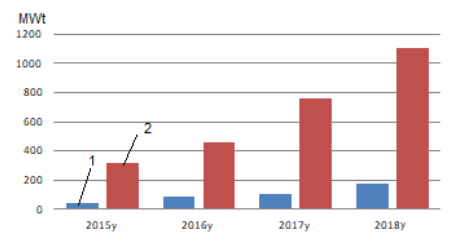
Based on statistical data, an increase in the generation capacity of renewable energy sources, the active introduction of which into electricity networks began to increase in 2015, may be the reason for prolonged electric power interruptions (SAIDI) electricity networks. The pace of increase in the generation of RES in the section of each power supply company is analyzed, among others Vinnytsyaoblenergo company has been allocated (Fig. 3), since here, starting from 2015, the growth of power generation capacity of the PV was the largest. Only the generation of PV is analyzed, because the wind potential for this region is insignificant. Consequently, the generation capacity in early 2015 was 41.3 MW and increased almost four times in the next three years – at the end of 2018, the power plant is 180 MW. However, the effect of the PV on the reliability of the networks here is significantly different from the impact on the network of the IEC as a whole (see Figure 4).
Simultaneous improvement of the level of technical equipment of the networks, as observed in Vinnytsyaoblenergo, together with the development of the PV, allows us to reveal their potential in view of the possibility of ensuring compliance with the indicator of the length of long interruptions in electricity supply in urban and rural electric networks (Fig. 4).
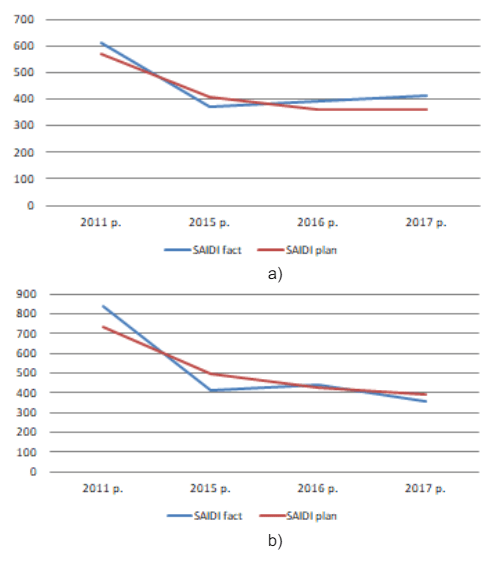
The analysis of dependencies in Figures 2 and 4 allows us to conclude that it is possible to estimate and achieve the maximum effect from the implementation of renewable energy sources in view of the possibility of providing normative indicators of reliability (continuity) of electricity supply, taking into account the technical condition of the electricity network to which they are joining.
Thus, there is a whole range of tasks facing the industry experts to improve these indicators. Taking into account the rapid growth of electricity generation from distributed energy sources, it is expedient to use them jointly, in the context of a partial restoration of power supply to network demands. However, the use of such an approach is impossible without the coordination with relay protection systems and emergency automation of distribution networks 6-10kV. The connection of distributed generation objects to the DEN leads to a change in the main characteristics of the power system, on the basis of which the generally accepted concept of building relay protection (RP) was formed. At the level of the distribution network, multilateral power of the site of damage becomes possible, there are new, previously not typical types of disturbances and accidents, characteristics of electromagnetic and electromechanical transients are changing.
The problem of constructing RP significantly expands and complicates and, in the integrated approach, includes the solution of two groups of tasks:
– connected with the provision of the necessary technical perfection of RH of distribution electrical networks in which such stations are operated;
– associated with the creation of relay protection and automatics (RPA), which is installed at the point joining RES to the electrical network.
One of the ways to reduce the number and duration of failures in electricity supply is the possibility of joint use of different types of RES, namely, photovoltaic and small hydroelectric power stations in the tasks of partial recovery of consumers in the absence of electricity supply from centralized electricity supply networks. Another advantage of the joint use of such RES is to reduce the losses of the PV owners from the lack of electric power in the absence of tension on bus stations. These include the assurance of reliability of electric power supply to consumers maintenance of voltage levels within permissible limits, optimization of power flows in order to reduce losses, as well as maintenance of balance reliability in LES with combined electric supply from local and centralized sources of energy [11]. Determining the priority of solving problems arising in LES, note the balance reliability as the reliability of LES when its calculation model is determined by the balance of consumption and generation of electric energy, with the external supply being taken into account. The successful solution of other problems depends on the methods and means used to ensure the balance reliability. Technical and economic indices of LES depend on the balance of its active and reactive power [12]. The optimization of LES and EPS’s joint operation is considered in a number of research works [13]. Therefore, scheduling of the generation of photovoltaic stations is very important for maintenance of normal operating modes of the power system.
In the new economic conditions, photovoltaic power stations of direct transformation of energy are more and more widely used. Their use, in addition to making a profit from electricity sales, allows, under certain conditions, to unload the electricity networks and improve the quality of electricity [14].
Modeling Of Electrical Supply Restoration In Local Electrical Systems After Loss Of Centralized Power
For the calculation of the regime parameters of the fragment of the scheme of the Yampil DEN, the source information about the Galzhbievska photovoltaic plant was analyzed:
– put into operation – 2013;
– Installed power – 1381 kW;
– Estimated annual generation – 1515 MWh;
– type of Multi-Si modules.
Generation at this power plant takes place using SMA circular inverters, as well as multicrystalline silicon modules. This configuration ensures the optimal operation of the PV. The solar panels generate DC power, then through the inverters it enters 3 KTPs: KTP 0.4/10-630 kVA, 0.4/10- 1000kVA and 0.4 / 10-250 kVA.
The normal scheme of power output by the power plant implies that the electricity generated by the PV through the KTP of 0.4 / 10 – 630 kVA and 0.4 / 10 – 1000 by the line 27- 23 is supplied to the network connected to the substation Yampil 110 / 10kV. The model contains PV, consisting of 380 parallel connected strings of 15 photovoltaic modules per each type of panels – monocrystal (YL235P-29b). At the output of the inverter, a 0.4 / 10 kV transformer and a transformer 10 kV three-phase switch is installed. Another possibility of this model is that the generation of a photovoltaic station changes during simulation time, since the main parameters influencing the PV output, namely the level of solar insolation and the ambient temperature, therefore, the simulation of these parameters is presented in the form of a schedule that changes during the day.
The length of the feeder lines 15 of the 110/10 “Yampil” is 18 km. This feeder contains: 37 knots, 16 transformer substations, Galzhbievskaya PV and Galjbievska sHPP. Synchronous hydrogenerator with a power of 667 kVA, at the output of which is a voltage of 10 kV. The power network is represented in the form of four feeders and a centralized power source in the form of a 110/10 kV Yampil substation.
The total power of the transformer substations from which consumers feed is 2 149 kW. (Fig. 5), were considered.
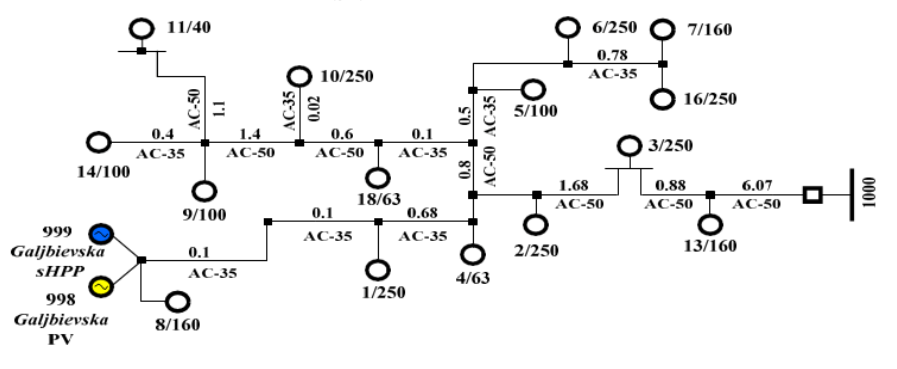
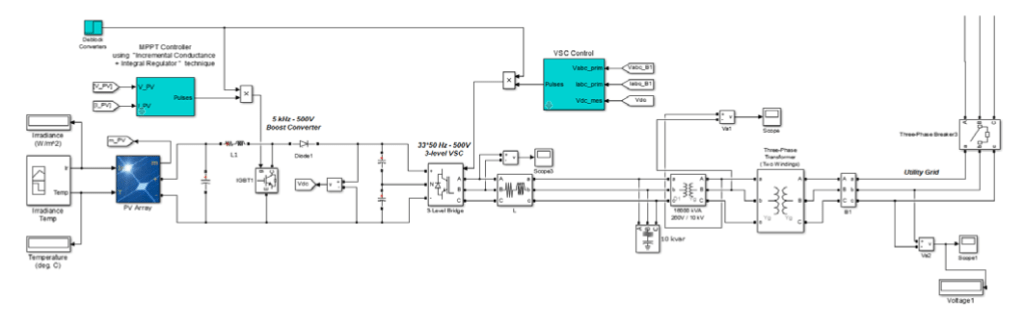
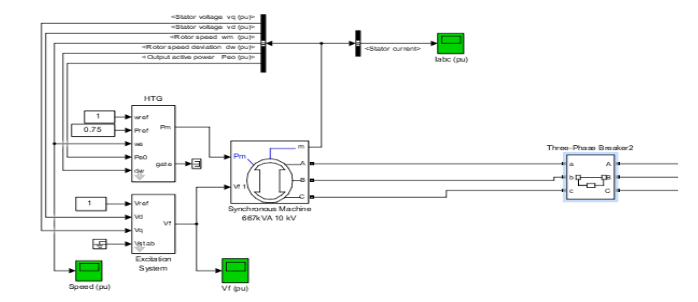
After analyzing the technical condition of the equipment of the electric networks, it was established that the most damaged element is the power lines. The computer model which showed in Figure 5, we divided for two computer mode (fig.6) – is a model of Galjbievska photovoltaic station and Figure 7 – is a model of small hydro power plant, which can supplying power to the photoelectric station bus. Due to the loss of centralized power supply from a centralized substation, consider two cases of restoration of electricity supply:
1. The combined use of a photoelectric and small hydroelectric power plant to restore consumers electricity supply.
2. Duration of the transition process, which will take place at the voltage supply to the PV bus from sHPP. In the framework of this work, the following modes of work are investigated and modeled:
1. The sinusoidal analysis of the voltage curve in paralleloperated photovoltaic and hydroelectric power plants at the power output of the common bus and in the absence of power supply from the 110 / 10kV Yampil 110 substation, it should be noted that the part of the load did not lose electricity due to the combined generation of the PV plant and sHPP (Fig. 8)
2. The next possible version of power supply for LES users, it is advisable to consider the mode of operation of the electrical grid, in which the running PV plant voltage is applied after the launch of a small hydroelectric power plant (Fig. 9).
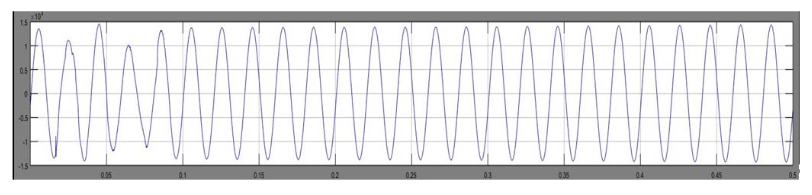
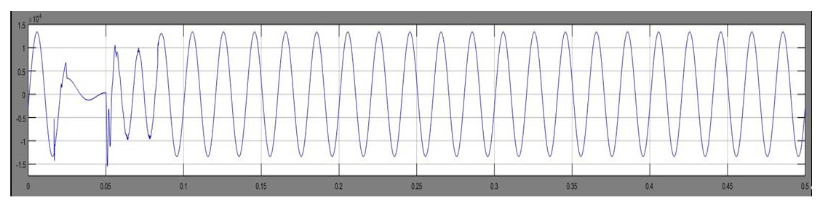
The results of simulation, on restoring the electricity supply of LES demands, by means of water drainage by a small hydroelectric power plant in order to supply voltage to the bus of a photovoltaic station, shows a slight distortion of the voltage curve.
The main idea of the work, is the implementation of mathematical modeling of the possibility of restoring the power supply of consumers of the electrical network that lost centralized power. Given the dependence of the photovoltaic power station’s operation on the electrical network, it can not function independently without supplying voltage. Proceeding from this, as a voltage source, hydroelectric power stations of low power are considered.
Conclusions
To increase the technical and economic efficiency of joint operation of distributed power sources and distribution electric networks, it is necessary to solve a number of tasks, which will allow to increase electricity generation of RES, reduce electricity losses in distribution electric networks, improve the quality and reliability of electricity supply to consumers.
In order to efficiently exploit distributed energy sources and their integrated use in power grids, especially in the sense of improving the reliability of power supply, it is necessary to develop a method for restoring consumer power supply, with the loss of centralized power supply. In the context of the transition from the wholesale electricity market of a single buyer to balancing and to electricity supply under bilateral agreements, in recent years and in perspective in Ukraine, there is a tendency of transition from purely centralized electricity to combined, when the number of local power sources is increasing. Moreover, the share of the latter in the energy balance of power systems is increasing. Local power sources, operating directly in the grids of 10-6-0.38 kV, include both traditional sources of low power and alternatives.
The results of simulation of the possibility of restoring electricity supply to LES users in the event of a loss of centralized power show high potential for the use of RES in this direction. In particular, RES may be a significant time to maintain the power of consumers while ensuring a standard for the quality of electric energy and the cost- effectiveness of the operation of electricity grids
REFERENCES
[1] Derzhavna tsilʹova ekonomichna prohrama enerhoefektyvnosti i rozvytku sfery vyrobnytstva enerhonosiyiv z vidnovlyuvanykh dzherel enerhiyi ta alʹternatyvnykh vydiv palyva na 2010-2020 roky// Zatverdzhena postanovoyu Kabinetu Ministriv Ukrayiny vid 01.03.2010 r. № 243 [Elektronnyy resurs] // Rezhym dostupu: http://zakon2.rada.gov.ua/laws/show/243-2010-%D0%BF
[2] Zvit pro rezulʹtaty diyalʹnosti u 2017 rotsi [Elektronnyy resurs] // Zatverdzheno postanovoyu SRFEU vid 23 bereznya 2018 roku № 360. Rezhym dostupu do resursu – URL: http://www.nerc.gov.ua/data/filearch/Catalog3/Richnyi_zvit_SRFEU_2017.pdf
[3] Lezhniuk P. D. Otsinyuvannya vplyvu na yakistʹ funktsionuvannya lokalʹnoyi elektrychnoyi systemy vidnovlyuvanykh dzherel elektroenerhiyi / P. D. Lezhniuk, V. O. Komar, D. S. Sobchuk // Visnyk Kharkivsʹkoho natsionalʹnoho tekhnichnoho universytetu silʹsʹkoho hospodarstva imeni Petra Vasylenka. Problemy enerhozabespechennya ta enerhozberezhennya APK Ukrayiny. – Kharkiv : KHNTUS·H, 2013.Vypusk 141. S. 8–10.
[4] Kulyk V. V. Optymalʹne keruvannya rozoseredzhenymy dzherelamy elektroenerhiyi z asynkhronnymy heneratoramy zasobamy Smart Grid [Elektronnyy resurs] / V. V. Kulyk, T. YE. Mahas, YU. V. Malohulko // Naukovi pratsi VNTU. – 2011. – №4.– S. 1–6. – Rezhym dostupu do resursu : http://praci.vntu.edu.ua/article/view/1404/999.
[5] Kyrylenko O. V. Power Engineering of Sustainable Development: Challenges and Construction Paths / O. V. Kirilenko, AV Prachevnik // Proceedings of the Institute of Electrodynamics of the National Academy of Sciences of Ukraine. Special issue. 2010. 10-16.
[6] Kyrylenko O. V. Tekhnichni aspekty vprovadzhennya dzherel rozpodilenoyi heneratsiyi v elektrychnykh merezhakh / O. V. Kyrylenko, V. V. Pavlovsʹkyy, L. M. Lukʺyanenko // Tekhnichna elektrodynamika. 2011. № 1. S. 46–53.
[7] Pro zatverdzhennya Poryadku zabezpechennya standartiv yakosti elektropostachannya ta nadannya kompensatsiy spozhyvacham za yikh nedotrymannya// Zatverdzhena postanovoyu Kabinetu Ministriv Ukrayiny vid 12.06.2018 r. № 375 [Elektronnyy resurs] // Rezhym dostupu: http://zakon.rada.gov.ua/laws/show/v0375874-18
[8] IEEE Guide for Electric Power Distribution Reliability Indices,” in IEEE Std 1366-2012 (Revision of IEEE Std 1366-2003) , vol., no., pp.1-43, 31 May 2012 doi: 10.1109/IEEESTD.2012.6209381
[9] Pro zatverdzhennya tsilʹovykh pokaznykiv nadiynosti (bezperervnosti) elektropostachannya na 2018 rik // Zatverdzhena postanovoyu Kabinetu Ministriv Ukrayiny vid 14.06.2018 r. № 392 [Elektronnyy resurs] // Rezhym dostupu: http://www.nerc.gov.ua/index.php?id=32667
[10] Lezhnyuk P.D. Vozobnovlyayemyye istochniki energii v raspredelitel’nykh elektricheskikh setyakh: Monografiya / P.D. Lezhnyuk., A.A. Koval’chuk, A.V. Nikitorovich, V.V. Kulik. – Vinnitsa, 2014. – 204 s.
[11] Q. Jiang, G. Geng, C. Guo, and Y. Cao, “An efficient implementation of automatic differentiation in interior point optimal power flow,” IEEE Trans. Power Syst., vol. 25, no. 1, pp. 147–155, Feb. 2010.
[12] Kulyk V.V. Operational control of the flow of reactive power in the distribution of electrical dispersed generation // Proceedings of the Institute of Electrodynamics National Academy of Sciences. Collected Works. Special-start you. – 2013. – P. 151-158.
[13] Seyed Mohammad Hossein Nabavi, Somayeh Hajforoosh, Mohammad A.S. Masoum, “Placement and Sizing of Distributed Generation Units for Congestion Management and Improvement of Voltage Profile using Particle Swarm Optimization”, IEEE Transactions on Power Systems, 2011.
[14] C. L. T. Borges and D. M. Falcao, “Optimal distributed generation allocation for reliability, losses, and voltage improvement”, Int. J. Elect Power Energy Syst., vol. 28, no. 6, pp. 413–420, Jul. 2006.
Authors: Docent Juliya Malogulko, Vinnitsa National Technical University, Khmelnytsky Hwy, 95, 21021 Vinnitsa, Ukraine E-mail: juliya_malogulko@ukr.net. Docent Svyatoslav Vyshnevsky, Vinnitsa National Technical University, Khmelnytsky Hwy, 95, 21021 Vinnitsa, Ukraine E-mail: svyato.vish.ua@gmail.com., Iryna Kotylko, Vinnytsia National Technical University, Khmelnytsky Hwy, 95, 21021 Vinnitsa, Ukraine, E-mail: i.kotylko@gmail.com., Docent, Natalia Sobchuk, Vinnytsia National Technical University, Khmelnytsky Hwy, 95, 21021 Vinnitsa, Ukraine, E-mail: natashasobchuk37@gmail.com.
Source & Publisher Item Identifier: PRZEGLĄD ELEKTROTECHNICZNY, ISSN 0033-2097, R. 96 NR 10/2020. doi:10.15199/48.2020.10.22

