Published by Wisam Mohamed Najem1, Shaker M. Khudher2, Omar Sh. Alyozbaky3, Department of Electrical Engineering, College of Engineering, University of Mosul, Iraq (1,2,3)
ORCID: 1.0000‐0002‐9611‐6416; 2.0000‐0003‐3158‐7900; 3.0000‐0002‐9735‐1469
Abstract. Electric vehicles partner with clean energy to prevent carbon emissions attributed to internal combustion engine-powered traditional vehicles, gas-based power plants, and other environmental pollution sources. At the same time, using electric vehicles adversely affects power infrastructure; hence, analytical research is crucial to assess such effects. This paper is based on several scenarios comprising a rising number of vehicles connected to the electrical system. The adverse effects of electric vehicle charging stations connected to the electrical infrastructure were diagnosed. MATLAB/Simulink was used for simulation and modelling to highlight any effects. Vehicle charging points and their impact on the electrical system’s total harmonic distortion were studied; a single-vehicle connected to the system added 2.44% to the THD, which increased to 12.69% when twelve vehicles were connected simultaneously. Moreover, charging operations breached the recommended voltage standards; a 0.95 P.U. voltage was recorded. Additionally, charging station integration reduced the power factor of the electrical system; this phenomenon was assessed.
Streszczenie. Pojazdy elektryczne współpracują z czystą energią, aby zapobiegać emisjom dwutlenku węgla przypisywanym tradycyjnym pojazdom napędzanym silnikami spalinowymi, elektrowniom gazowym i innym źródłom zanieczyszczenia środowiska. Jednocześnie korzystanie z pojazdów elektrycznych niekorzystnie wpływa na infrastrukturę energetyczną; stąd kluczowe znaczenie dla oceny takich efektów mają badania analityczne. Niniejszy artykuł opiera się na kilku scenariuszach obejmujących rosnącą liczbę pojazdów podłączonych do systemu elektrycznego. Zdiagnozowano niekorzystne skutki stacji ładowania pojazdów elektrycznych podłączonych do infrastruktury elektrycznej. MATLAB/Simulink został wykorzystany do symulacji i modelowania w celu podkreślenia wszelkich efektów. Zbadano punkty ładowania pojazdów i ich wpływ na całkowite zniekształcenia harmoniczne układu elektrycznego; pojedynczy pojazd podłączony do systemu dodał 2,44% do THD, które wzrosło do 12,69%, gdy dwanaście pojazdów było jednocześnie podłączonych. Ponadto operacje ładowania naruszyły zalecane normy napięcia; 0,95 j.m. rejestrowano napięcie. Dodatkowo integracja stacji ładowania zmniejszyła współczynnik mocy systemu elektrycznego; zjawisko to zostało ocenione. (Wpływ integracji stacji ładowania pojazdów elektrycznych na wydajność systemu zasilania)
Keywords: Charging station; Electric Vehicles; Total Harmonic Distortion; Power System
Słowa kluczowe: Stacja ładowania; Pojazdy elektryczne; Całkowite zniekształcenia harmoniczne; System zasilania
Introduction
Presently, the transportation sector primarily relies on fossil fuels. It is a major emitter that significantly increases global [1]–[3] fuel-based vehicles at the individual level consume more than 50% of the energy used by the overall transportation system, causing significant emissions [4]. Hence, several nations have had a policy shift that focuses on newer technologies. Such shift includes electric vehicles entirely powered by batteries, hence designated battery-powered vehicles (Battery electric vehicles) or hybrid electric vehicles (Hybrid electric vehicles) that cause relatively less pollution and emissions [5]–[7]. Sectoral developments indicate that electric vehicle adoption will increase due to novel vehicle charging technologies and advancements in battery manufacturing, e.g., lithium batteries that can be charged numerous times [8]. Electric vehicles are powered by batteries recharged by power electronic devices that converting an alternating current to direct current [9].
Electric vehicles are advantageous from an environmental perspective because of lesser pollution and emission; moreover, these vehicles are moveable energy storage systems [10], [11]. However, the electrical system is adversely affected when such vehicles are connected for recharging. For instance, more electric vehicles charging from the network increase energy demand [12], [13]; these vehicles’ circuits are non-linear electrical loads that introduce harmonics in the electrical system, leading to decreased power factor [14], [15], higher voltage deviations [16], [17], and faster cable and transformer ageing [18]. An increase in total harmonic distortion reduces power quality due to suddenly voltage changes [19], causing improper functioning of protection relays [20], [21].
This research assesses the consequences of electric vehicle charging on the power infrastructure and discusses changes to voltage characteristics, power factor, and total harmonic distortion. This paper is structured as specified: the first section comprises an introduction, followed by the electric vehicle charging station configuration in section two. Research criticality is presented in section three, followed by system simulation, modelling, and analysis in section four. Lastly, section five presents the conclusions.
Vehicle charger configuration
Hybrid and battery-powered electric vehicles rely on rechargeable batteries as critical energy sources. Battery charging differs based on vehicle and battery types. Several researchers have expressed interest in devising advanced battery charging technologies. Battery chargers can be integrated with the vehicle (on-board charger), or external chargers can be used (off-board charger) [22]. Batteries are charged at specific voltages that can be produced using single- or three-phase rectifier diode-based configurations [23] and thyristor or IGBT-based controlled rectifiers [24].
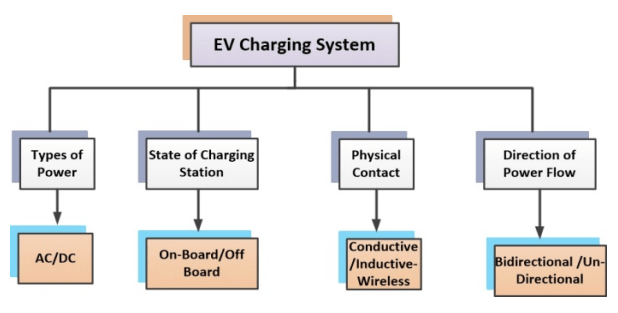
Power transfer direction is commonly used to classify electric vehicle charging stations, indicating whether the power electronics on the charger and electric vehicle can transfer current unidirectional or bidirectional. Unidirectional chargers may use diodes (valves); non-directional chargers have a straightforward and uncomplicated operation.
Bidirectional chargers require sophisticated control mechanisms that allow charging and discharging modes, helping the power system; however, such operations might cause battery deterioration [25]. Fig. 2, depicts charging station topology for directional and non-directional systems.

This study intends to assess the consequences of integrating electric vehicles with the electrical infrastructure, considering the rapid increase in electric vehicles. Hence, it is critical to assess the challenges these vehicles may create. This data can be used to devise approaches to adapt and augment electrical systems to handle vehicle charging station integration. The objectives of this paper are listed below:
• Using MATLAB to simulate and model electric vehicle charging stations
• Assessing changes to total harmonic distortion due to electric vehicle charging
• Assessing changes to the power factor due to electric vehicle charging.
System modelling and simulation
Due to the extensive rise in electric vehicle use worldwide, electrical grids are under immense load. Some challenges include higher network harmonic distortion, higher power demand, lower power factor, and power quality challenges. Hence, researchers are trying to assess the consequences of connecting such charging systems to the electric network so that optimal approaches can be devised to reduce concerns. This research uses the model depicted using Fig. 3 [26]–[28].
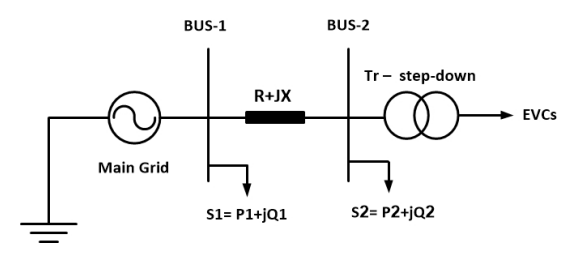
The model suggested in the Figure is created using MATLAB; the electrical loads are indicated below:
• The first load is a 560 kVA industrial load placed on the first bus
• The second load is a combined 112 kVA domestic load placed on the second bus
• Electric vehicle load is set at 34 kW, connected to the grid using an 11 kV/0.4 kV step-down transformer The electrical system is simulated as specified below:
• The system is evaluated without an electric vehicle charging load, and the power factor and harmonic distortion are specified.
• Electric vehicles are integrated to the proposed model, and the network is analysed.
Case study
This section discusses several simulations and network models to evaluate the adverse outcomes of connecting electric vehicles to the power system. This section is split into five cases, as specified below.
• Case A: The electrical system is assessed without electric vehicles to understand system characteristics in its initial state. The power network was simulated and modelled, as depicted in Fig. 4. System characteristics were set as indicated in section four.
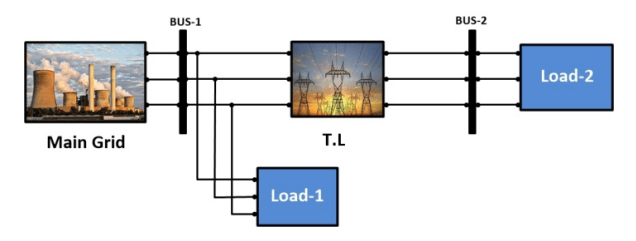
• Case B: The system was assessed by adding one electric vehicle load amounting to 34 kW to the second bus added to the load as in the first scenario. This system comprises an electric vehicle configured to draw 75 amps at 450 volts, allowing its 300-volt 50 amp-hour battery to charge in the fast mode. This scenario is devised and simulated with one vehicle attached to the second bus, as depicted in Fig.5.

• Case C: This scenario considers a charging station connected to the electrical system; the station is configured with four electric vehicles. The station is attached to the second bus. System model and simulation are performed using the electric vehicles and charging stations, as depicted in Fig.6. This scenario used four electric vehicles to understand the consequences of higher vehicle loads on the electrical system.
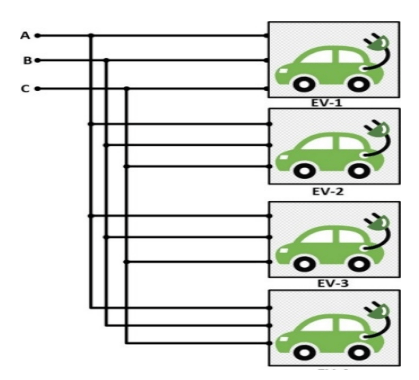
• Case D: This scenario considers a higher electric vehicle load by connecting another charging station comprising four vehicles; hence, the electrical system powers eight electric vehicles. Here, the tow charging stations are connected on the second bus, and the model is created and simulated. This scenario provides data about the electrical system, voltages, harmonic distortion, and power factor when the system is under a more significant load.
• Case E: The last scenario deals with twelve connected electric vehicles. The subsequent section presents the simulation outcomes for all specified cases. Simulation outcomes and discussion This section discusses the simulation outcomes for all scenarios described in the previous section.
A. First case
The first case was simulated using MATLAB, depicted using Fig. 4, and simulation outcomes are listed in Table 1.
Table 1. First case simulation outcomes

The standard conditions were assessed to record system voltages without electric vehicle load. As indicated in Table 1, the first and second bus voltage levels are within the recommended thresholds (0.95 < V < 1.05) [16]. The currents drawn from the system without electric vehicle loads are indicated in Table 1. It is noteworthy that this situation has zero total harmonic distortion owing to completely linear loading.
B. Second case
Fig. 5 depicts this scenario comprising one connected vehicle. Table 2. lists the simulation outcomes for this case. Table 2. indicates that this scenario has 2.435% total harmonic distortion compared to zero in the first case. Similarly, the second bus records 10.74% total harmonic distortion (THD). Power factor follows a similar trend, decreased to 0.8996 in this case, compared to 0.9039 for the first. The second bus follows similar trends due to nonlinear electrical loading by the vehicles, increasing system THD, and reducing the power factor, as specified in Table 2. When the electric vehicle is connected to the system, the second bus voltage reduces slightly, as specified in Table 2.
Table 2. Second case simulation results

A slight change is observed because a single electric vehicle is connected. In contrast, the vehicle load might introduce harmonics in the electrical system, as depicted in the first and second bus current waveforms in Fig.7.

Fig. 7 highlights that the second bus current waveform is distorted due to the electric vehicle load connected to it. In contrast, their effect was relatively minor concerning the current in the first bus, which was mildly affected due to a one-vehicle load.
Fig. 8 presents instantaneous values of phase A current to ascertain the presence of harmonics introduced by the vehicle connected to the second bus.

Fig. 8 indicates that the second bus has 10.74% total harmonic distortion due to one vehicle’s current drawn from the second bus. The first harmonic is most significant, compared to the relatively minor seventh and eleventh. The vehicle load introduces harmonics in the system, reducing the overall power factor, and deteriorating power quality. C. Third case This scenario considers one charging station and four vehicles connected to the second bus. The model was created and simulated, and its outcomes are specified in Table 3.
Table 3. Third case simulation results
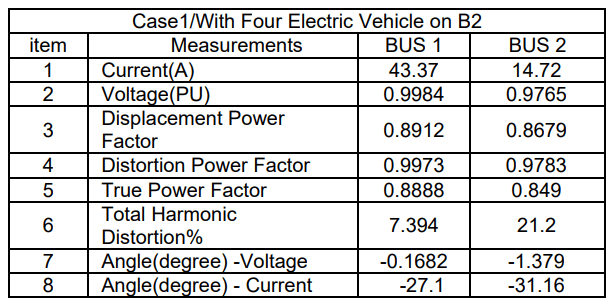
Table 3. indicates that this scenario has higher total harmonic distortion than the second scenario; the first bus records 7.394% THD compared to 2.435% in the previous case. The observations are similar for the second bus, where 21.2% THD is recorded.
Power factor also degrades, reducing from 0.8996 in the previous case to 0.8888 for the third case corresponding to the first bus. Similarly, the second bus also recorded a power factor reduction from 0.8743 to 0.849. Connecting a charging station reduces second bus voltage, corresponding to a final value of 0.9765 P.U. from 0.9867 P.U., as specified in Table (3,2).
D. Fourth case
Here, the second bus powered two charging stations; the system model and simulation outcomes are specified in Table 4.
Table 4. Fourth case simulation results
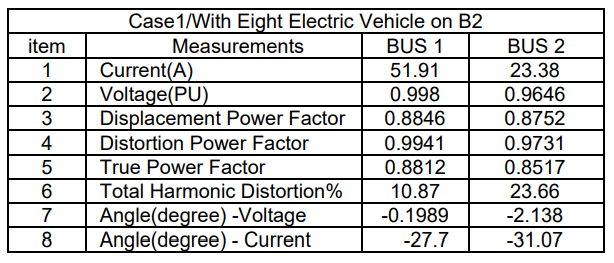
Table 4, indicates that total harmonic distortion degrades further, i.e., from 7.394% in case three to 10.87% for the first bus in the present case. The second bus has similar observations, where THD degrades to 23.66%, indicating higher total harmonic distortion as the connected electric vehicle load increases. The system power factor degrades to 0.8812 in the current scenario, from 0.8888 in the previous observation corresponding to the first bus. In the case of the second bus, we see that the distortion power factor deteriorated to 0.9731 in the fourth scenario from 0.9783 in the second. The higher power actual in the second case is attributed to the higher active power drawn by the system than the more reactive power drawn by the electric vehicle charger. In the second bus context, connecting the charging station reduced voltage to 0.9646 P.U. from 0.9765 P.U., as highlighted in Table (3,4).
E. Fifth case
This scenario considers twelve electric vehicle drawing power from the electrical network. This scenario was simulated, indicating the first bus total harmonic distortion to increase to 12.69%, compared to 10.87% in the previous scenario. Similarly, the power factor degraded to 0.8774 from 0.8812, indicating adverse effects on power factor and THD as more vehicles started charging on the network. Moreover, as more electric vehicles are connected to the system (penetration level), the acceptable voltage threshold is breached. The overall voltage delivered to the vehicle dropped to 0.95 P.U. These evaluated scenarios and observations indicate that electric vehicle connections introduce harmonics in the power network, adversely affecting the system and lowering the power factor. Moreover, higher use levels (penetration level) cause voltage deviations beyond acceptable thresholds, as indicated for load additions in Fig. 9.
Fig. 9, indicates that when no vehicles are being charged, the voltage levels on the electrical network are within acceptable limits. one-vehicle addition caused the voltage to reduce to 0.9867 P.U., while the voltage fell further to 0.9765 P.U. on the second bus as four electric vehicles were connected to the network. Moreover, voltage levels of 0.95 P.U. are observed when twelve vehicles charge using the power system; this is a critical measure that falls beyond the acceptable limit. Put differently, a higher number of connected vehicles cause a more significant voltage deviation, triggering unacceptable voltages.
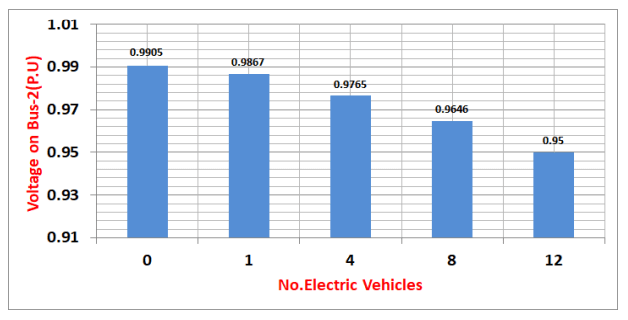
Fig. 10, depicts the relationship between total harmonic distortion of the network as a function of the number of vehicles charging on the network. An electrical system free from non-linear load does not create any harmonic distortion. One vehicle adds 2.44% THD, which increases to 7.39% for four vehicles, and further degrades to 12.69% for twelve vehicles. Hence, the harmonic distortion in the electrical network correlates directly with the number of connected vehicles.

Fig. 11, depicts the relationship between network power factor as a function of electric vehicle count. If the network is free of electric vehicles, a 0.9039 power factor is observed, which deteriorates to 0.8996 for a single connected vehicle. It reduced further to 0.8888 with more vehicles, while the overall power factor was 0.8774 when the maximum number of vehicles were connected. It suggests that a higher number of vehicles cause the power factor to drop.

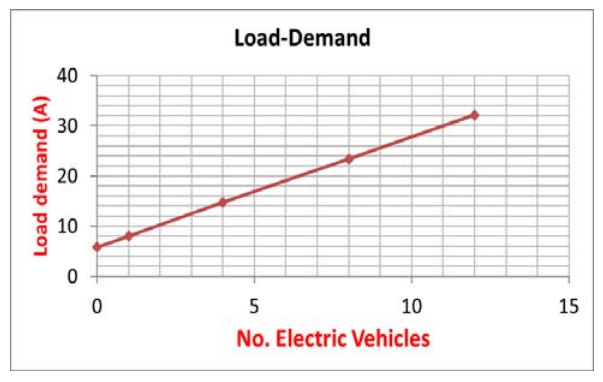
A higher number of connected vehicles raises power demand; hence, the current requirement increases linearly. Fig. 12, depicts the current drawn as a function of the increase of connected vehicles. The second bus supplied a 5.812 A current without any electric vehicle on the network; however, a one vehicle addition increased current to 8.01 A, while 32.14 A was drawn when twelve vehicles were connected.
Conclusion
This paper evaluated several scenarios to understand power network characteristics with increasing electric vehicles. A higher number of connected vehicles introduced more significant total harmonic distortion that breached the acceptable threshold; the system power factor was also reduced. THD values were 2.44% and 12.69% for one and twelve vehicles. Voltage dropped to 0.95 P.U. when twelve vehicles were drawing power. Hence, the adverse effects of electric vehicle charging must be regulated using charging control mechanisms, organised charging approaches, limiting electric vehicle purchase in a particular area, and electrical network augmentation, including filtering systems that eliminate harmonics from the electrical network.
REFERENCES
[1] N. M. Prasit PHOOSOMMA, Tanes TANITTEERAPAN, Tanapon Tamrongkunanan, “Application of a Single Supercapacitor for Driving an Electric Vehicle,” Prz Elektrotechniczny, no. 8, pp. 34–40, 2022.
[2] N. O. Kapustin and D. A. Grushevenko, “Long-term electric vehicles outlook and their potential impact on electric grid,” Energy Policy, vol. 137, no. April, p. 103-111, 2020.
[3] S. Habib, M. Kamran, and U. Rashid, “Impact analysis of vehicle-to-grid technology and charging strategies of electric vehicles on distribution networks – A review,” J Power Sources, vol. 277, pp. 205–214, 2015.
[4] G. A. Putrus, P. Suwanapingkarl, D. Johnston, E. C. Bentley, and M. Narayana, “Impact of electric vehicles on power distribution networks,” 5th IEEE Veh Power Propuls Conf VPPC ’09, pp. 827–831, 2009.
[5] H. Morais, T. Sousa, Z. Vale, and P. Faria, “Evaluation of the electric vehicle impact in the power demand curve in a smart grid environment,” Energy Convers Manag, vol. 82, pp. 268–282, 2014.
[6] L. Liu, Y. Zhang, C. Da, Z. Huang, and M. Wang, “Optimal allocation of distributed generation and electric vehicle charging stations based on intelligent algorithm and bi-level programming,” Int Trans Electr Energy Syst, vol. 30, no. 6, pp.1–21, 2020.
[7] H. Yu and A. L. Stuart, “Impacts of compact growth and electric vehicles on future air quality and urban exposures may be mixed,” Sci Total Environ, vol. 576, pp. 148–158, 2017.
[8] Y. Miao, P. Hynan, A. Von Jouanne, and A. Yokochi, “Current li-ion battery technologies in electric vehicles and opportunities for advancements,” Energies, vol. 12, no. 6, pp. 1–20, 2019.
[9] A. K. Verma, B. Singh, and D. T. Shahani, “Grid to vehicle and vehicle to grid energy transfer using single-phase half bridge boost AC-DC converter and bidirectional DC – DC converter, Int J Eng Sci Technol, vol. 4, no. 1, pp. 46–54, 2018.
[10] F. M. Shakeel and O. P. Malik, “Vehicle-To-Grid Technology in a Micro-grid Using DC Fast Charging Architecture,” 2019 IEEE Can Conf Electr Comput Eng CCECE 2019, no. October, 2019.
[11] W. Zhong, R. Yu, S. Xie, Y. Zhang, and D. K. Y. Yau, “On Stability and Robustness of Demand Response in V2G Mobile Energy Networks,” IEEE Trans Smart Grid, vol. 9, no. 4, pp. 3203–3212, 2018.
[12] M. A. Sayed, R. Atallah, C. Assi, and M. Debbabi, “Electric vehicle attack impact on power grid operation,” Int J Electr Power Energy Syst, vol. 137, pp. 1–28, 2022.
[13] J. Wang, C. Liu, D. Ton, Y. Zhou, J. Kim, and A. Vyas, “Impact of plug-in hybrid electric vehicles on power systems with demand response and wind power,” Energy Policy, vol. 39, no.7, pp. 4016–4021, 2011.
[14] J. P. Trovão, P. G. Pereirinha, L. Trovão, and H. M. Jorge, “Electric vehicles chargers characterization: Load demand and harmonic distortion,” Proceeding Int Conf Electr Power Qual Util EPQU, pp. 694–700, 2011.
[15] H. F. Farahani, A. Rabiee, and M. Khalili, “Plug-in electric vehicles as a harmonic compensator into microgrids,” J Clean Prod, vol. 159, pp. 388–396, 2017.
[16] A. Abaspahic, M. Saric, J. Hivziefendic, and T. Konjic, “Impact of Complementary Integration of Electric Vehicle Charging Stations and Photovoltaics on Voltage Quality and Voltage Stability,” 2021 20th Int Symp INFOTEH-JAHORINA, INFOTEH 2021 – Proc, no. March, pp. 17–19, 2021.
[17] S. Aggarwal and A. K. Singh, “Impact analysis of electric vehicle charging station integration with distributed generators on power systems,” Int J Circuit Theory Appl, vol. 49, no. 6, pp. 1811–1827, 2021.
[18] A. Hilshey, P. Hines, P. Rezai, and J. Dowds, “Estimating the impact of electric vehicle smart charging on distribution transformer aging,” IEEE Trans Smart Grid, vol. 4, no. June, pp. 905–913, 2013.
[19] M. R. A. Ashish Kumar Karmaker, Sujit Roy, “Analysis of the impacts of Electric Vehicle Charging Station in Bangladesh,” ECCE, IEEE Conf, pp. 7–9, 2019.
[20] B. Marah, Y. R. Bhavanam, G. A. Taylor, and A. O. Ekwue, “Impact of electric vehicle charging systems on low voltage distribution networks,” Proc – 2016 51st Int Univ Power Eng Conf UPEC 2016, vol. 2017-Janua, pp. 1–6, 2016.
[21] C. Gong et al., “Research on influence and resolution of the relay protections with electric vehicle charging station integrating into distribution network,” Int J Hydrogen Energy, vol. 42, no. 29, pp. 18747–18753, 2017.
[22] L. Rubino, C. Capasso, and O. Veneri, “Review on plug-in electric vehicle charging architectures integrated with distributed energy sources for sustainable mobility,” Appl Energy, vol. 207, pp. 438–464, 2017.
[23] S. M. Khudher, I. Bin Aris, N. F. Mailah, and R. K. Sahbudin, “Analysis of AC – To – DC uncontrolled converters harmonics for electric vehicles applications,” Pertanika J Sci Technol, vol.25, no. S, pp. 283–290, 2017.
[24] M. Yilmaz and P. T. Krein, “Review of battery charger topologies, charging power levels, and infrastructure for plugin electric and hybrid vehicles,” IEEE Trans Power Electron, vol. 28, no. 5, pp. 2151–2169, 2013.
[25] H. S. Das, M. M. Rahman, S. Li, and C. W. Tan, “Electric vehicles standards, charging infrastructure, and impact on grid integration: A technological review,” Renew Sustain Energy Rev, vol. 120, 2020.
[26] A. M. Eltamaly, A. Y. Abdelaziz, and A. G. Abo-Khalil, Control and Operation of Grid-Connected Wind Energy Systems. 2021.
[27] M. Bilal, M. Rizwan, I. Alsaidan, and F. M. Almasoudi, “AIBased Approach for Optimal Placement of EVCS and DG with Reliability Analysis,” IEEE Access, vol. 9, pp. 154204–154224, 2021.
[28] D. M. Michał SIERSZYŃSKI, Łukasz CHEŁCHOWSKI, Bogdan KACZMARCZYK, Paweł MUSZYŃSKI, “Analiza wybranych przepisów i norm istotnych z punktu widzenia projektowania autobusów elektrycznych część 1,” Prz Elektrotechniczny, no. 8, pp. 158–162, 2022.
Source & Publisher Item Identifier: PRZEGLĄD ELEKTROTECHNICZNY, ISSN 0033-2097, R. 99 NR 3/2023. doi:10.15199/48.2023.03.40


This article provides a thorough and insightful analysis of the impact of EV charging stations on power system performance. The detailed simulations using MATLAB/Simulink offer clear evidence of how increased EV integration affects total harmonic distortion, power factor, and voltage levels. The comprehensive case studies effectively illustrate the challenges and potential solutions for managing these impacts. It’s a highly informative read for anyone interested in the intersection of electric vehicles and power systems.
LikeLiked by 1 person