Published by Noureddine KHENFAR, Abdelhafid SEMMAH, Mohamed KADEM, Djillali Liabes University of Sidi Bel Abbes, Algeria.
Abstract. This paper deals with the use of an adaptive linear (ADALINE) neural network in a harmonic extraction algorithm based on the calculation of instantaneous active and reactive powers. This technique, called “ANN-PQ”, is developed in order to achieve an effective separation between the fundamental and harmonic components of the instantaneous powers, which used as reference variables in the control of the shunt active power filter (SAPF). In order to further increase the filtering performances of the SAPF, fuzzy logic theory is used in two parts of the SAPF control system. The first concerns the modulation technique where the hysteresis band of the current control strategy will be generated by a fuzzy inference system. In the second part, the fuzzy logic will be integrated into the external control loop of the SAPF to maintain the DC voltage at its reference value. The numerical simulation results, given at the end of this paper, clearly show the effectiveness of the proposed control techniques.
Streszczenie. W artykule omówiono zastosowanie adaptacyjnej liniowej sieci neuronowej (ADALINE) w algorytmie ekstrakcji harmonicznych opartym na obliczaniu chwilowych mocy czynnych i biernych. Technika ta, zwana „ANN-PQ”, została opracowana w celu uzyskania skutecznego oddzielenia składowych podstawowych i harmonicznych mocy chwilowych, które są wykorzystywane jako zmienne odniesienia w sterowaniu bocznikowym filtrem mocy czynnej (SAPF). W celu dalszego zwiększenia wydajności filtrowania SAPF, w dwóch częściach systemu sterowania SAPF zastosowano teorię logiki rozmytej. Pierwsza dotyczy techniki modulacji, w której pasmo histerezy jest generowane przez rozmyty system wnioskowania. W drugiej części logika rozmyta została zintegrowana z zewnętrzną pętlą sterowania SAPF, aby utrzymać napięcie stałe na jego wartości odniesienia. (Algorytm ekstrakcji harmonicznych ADALINE zastosowany do bocznikowego aktywnego filtru mocy w oparciu o sterowanie prądem adaptacyjnej rozmytej histerezy)
Keywords: Shunt active power filter, ADALINE estimation, fuzzy band hysteresis, DC fuzzy logic control.
Słowa kluczowe: równoległy aktywny filtr mocy, estymacja ADALINE, histereza pasma rozmytego, sterowanie logiką rozmytą DC.
Introduction
The proliferation of power electronics devices and the intensive use of nonlinear loads, as well as the widespread use of static converters in industrial systems and appliances, have a harmful effect on the energy quality of the power grid [1,2]. This degradation of the electrical energy quality is mainly due to the absorption of non-sinusoidal currents and the reactive power consumption by these non-linear loads.[2,3].
Active filtering of electric power using a shunt active power filter (SAPF) has now become a mature technology and a superior solution to passive filters for harmonic mitigation and reactive power compensation[3]. Since their basic compensation principles were introduced by Gyugyi and Strycula in 1976, many researches have been done on active filters and their practical applications[5,6]. Connected to the three-phase line system, the SAPF works as voltage source inverter. Its basic function is the injection of harmonic load currents in opposite-phase into the system so that to ensure a sinusoidal line current[6]–[8].
The control system of an SAPF is usually divided into two parts. The first, which is of a great importance, is the generation of reference harmonic signals. The second is the generation of control signals of the inverter switches. These two parts are crucial in the performance of the SAPF. The reduction of the THD of the line current and the improvement of the power factor, are related to the performance of the generation of the harmonic current references, but also depend on the control strategy adopted.
The present paper proposes improvements to the SAPF control system using the theory of artificial neural networks and that of fuzzy sets. Harmonic currents are identified by the famous instantaneous power method based on the use of an ADALINE for the extraction of harmonic components (ANN-RIIP). The proposed method can estimate total harmonic currents and harmonic components by independently performing selective compensation. This method consists in replacing the two low-pass filters of the RIIP method by two ADALINE networks [9]. Secondly the generation of switching times is done by the hysteresis current control technique where the hysteresis band will be generated by a fuzzy inference system. In this case, the fuzzy logic concept is introduced to reduce the deviations between the reference currents and the currents generated by the active filter[8]. Concerning the control strategy on the DC side, the fuzzy logic will still play an important role to maintain the measured value of the DC voltage at its reference value.
Shunt active power filter (SAPF)
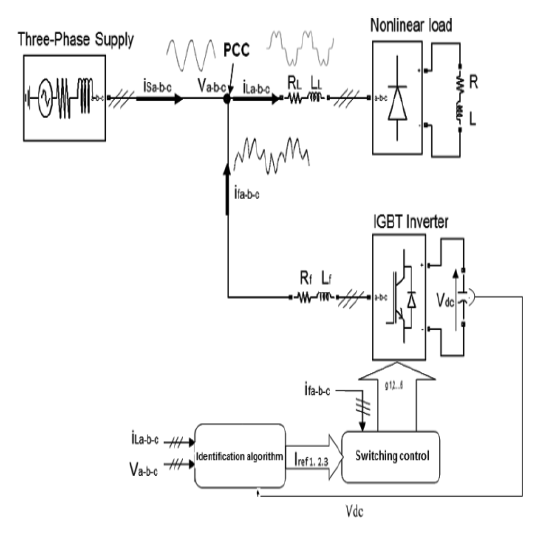
The principle diagram of the SAPF with its control circuit is shown in Figure 1. The power part has a bridge of six power transistors with anti-parallel diodes, which is used for the bidirectional power exchange.
In order to reduce the ripple due to the active filter’s switching operation, it is essential to connect the active filter to the network though a passive filter usually of the first order (Lf, Rf). On the DC side, a capacity C is connected in parallel to store energy. The capacity serves as a voltage source and allows the operation of the static converter as a rectifier or inverter.
The generation of reference signals is ensured by the p-q method. The switching times of the inverter are generated by the hysteresis control method where two techniques will be considered: a hysteresis current control with fixed band and another with fuzzy band. In order to ensure effective DC voltage control, a fuzzy logic controller is used in place of a PI regulator
PQ theory based on ADALINE algorithm extraction
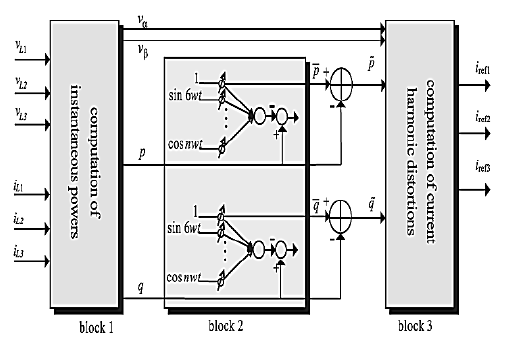
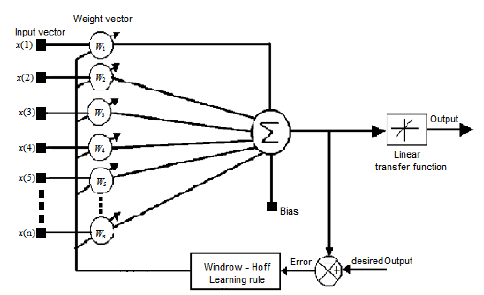
Generally, the extraction of harmonic powers is carried out in this technique by two low-pass filters. In order to be able to achieve good power separation and thus provide an exact set point for the SAPF modulation technique, the two low-pass filters will be replaced by two ADALINE-type neural networks (Fig.2.).
The first step of the harmonic extraction process using ADALINE is to generate the input vector xi of the ADALINE; this vector is constituted of a combination of Sine and Cosine waves at the frequency of the fundamental and the most dominant harmonics. Then, sensing the waveform of the signal to process and feeding it as a target result. Later, random widths vector wi is initiated, and the ADALINE is lunched. During every iteration the ADALINE force its output to converge toward the target signal by constantly updating the widths vector using the LMS algorithm (Fig.3.).[10].
In order to estimate the real and imaginary instantaneous powers, it is possible to decompose the currents Isabc and voltages Vsabc of an electric network into a Fourier series as follows[11]:
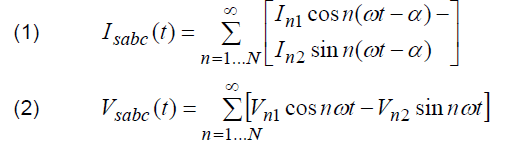
Where: ω – fundamental frequency of the electrical network, In1 and In2 – amplitudes of the sinus and cosine components of the network current, a – phase angle between current and voltage, Vn1 and Vn2 – amplitudes of the sine and cosine components of the main voltages.
Using a frequency analysis, the expressions (3) of the instantaneous powers is developed as follows:
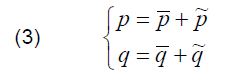
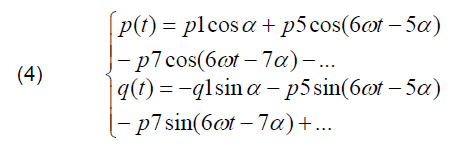
p1cosα and –q1sinα represent the continuous parts of p and q respectively. The rest of terms is the alternative parts. To extract estimate active and reactive powers, two ADALINE are developed, where the inputs are sinusoidal functions that correspond to each harmonic order in the mathematical developments shown in equations (4).The Fourier analysis can express the instantaneous real and imaginary powers in the general case as follows:
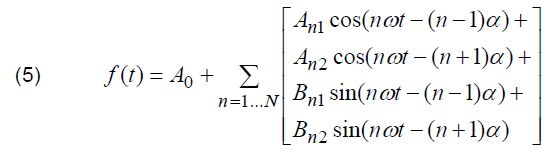
Where: A0 – continuous part, An1, An2 and Bn1, Bn2 – amplitudes of the sinus and cosines terms respectively. The vector representation of equation (5) is given by:

where: WT – weight vector of the network, X(t) – input vector of the network.
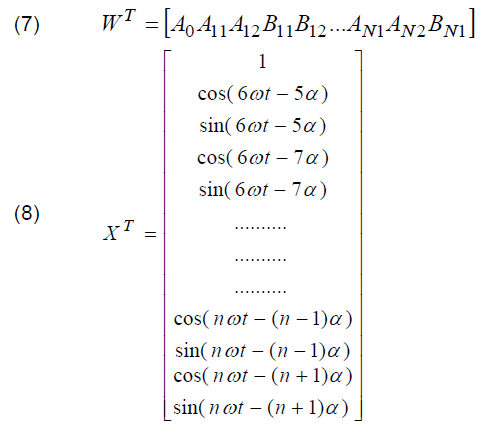
The equation (6) can then be implemented by the ADALINE configuration illustrated by Fig.3. where WT is the weight vector of the network and X(t) its input. Figure 4, shows this instantaneous power topology for p reel power (which is the same topology for q imaginary power) to be compensated by two ADALINE as illustrated in the figure below.
Hysteresis current control with fixed and fuzzy band
Switching times of the SAPF are generated using two modulation techniques: the hysteresis current control with fixed band (Fig.4) and fuzzy band (Fig.5).
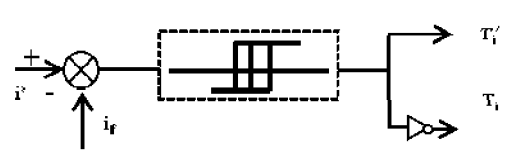
The hysteresis fixed band constitutes a major disadvantage for this control structure. The switching frequency depends essentially on the derivative of the set point current. The amplitude of the derivative is not mastered and the switching frequency is not fixed[8], [12].
This point can be particularly penalizing in the case of high power systems where the switching frequency is limited to values of the order of KHz because of the characteristics of the electronic power components. New techniques based on the same concept have been developed to improve performance of the hysteresis current control strategy: The most popular are the auto-adaptive band hysteresis, and the fuzzy auto-adaptive band hysteresis (figure 5)[12].
The current control with adaptive band hysteresis overcomes the problem of switching frequency variation, but this technique is sensitive to parametric variations in the SAPF. This is because this strategy control is based on the calculation of the hysteresis band so that the switching frequency remains constant[8]. Taking into account the parameters of the active filter (Lf, Vdc) as well as the reference current, the width of the band is regularly updated by the calculation algorithm making it possible to adapt it to the desired frequency.
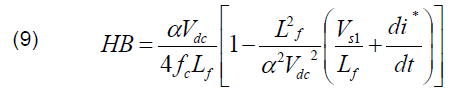
Fuzzy logic has been introduced to solve problems of conventional techniques of hysteresis current control. Current control with fuzzy hysteresis band is based on a dynamic tuning of the hysteresis band. This setting allows a constant switching frequency. The main advantage is the insensitivity of this control structure of the parametric variations of the SAPF.
The fuzzy hysteresis technique improves the performance of the network compared to the fixed hysteresis strategy and has a good filtering quality with more sinusoidal network currents[13].
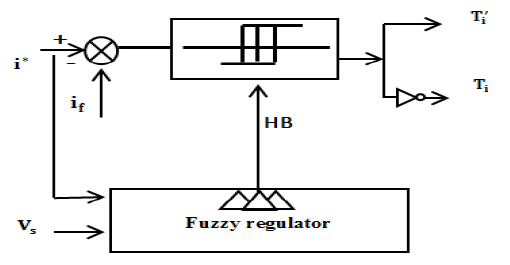
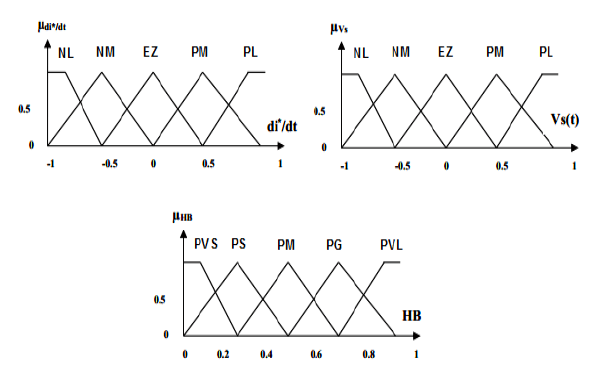
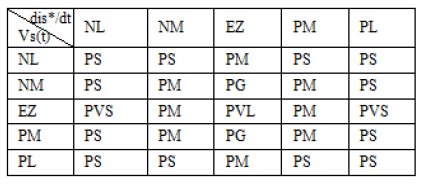
As input to the fuzzy controller, the main voltage and the current reference slop can be selected. The hysteresis band magnitude is used as output. To determinate the set of the linguistic values associated with each variable the following step is used. Each input variable is transformed into a linguistic size with five fuzzy subsets: PL is positive large, PM is positive medium, PS is positive small, EZ is zero, NL is negative large, NM is negative medium, and NS is negative small; for the output variable, HB, PVS is positive very small, PS is positive small, PM is medium positive, PL is positive large, and PVL is positive very large. The member ship functions of the input and output variables are shown in Fig. 8 and the resulting inference rules are listed in Table1[8].
Table 1. Matrix of inferences
Fuzzy DC voltage control
A fuzzy controller has been developed for controlling DC link voltage and improves filtering performance of the SAPF. To do this, we have introduced the concept of fuzzy logic as shown in Figure 9[14]. A fuzzy logic controller is based on a collection of control rules governed by the compositional rule of inference applied to maintain the constant voltage across the capacitor by minimizing the error between the capacitor voltage and it’s reference voltage[15].
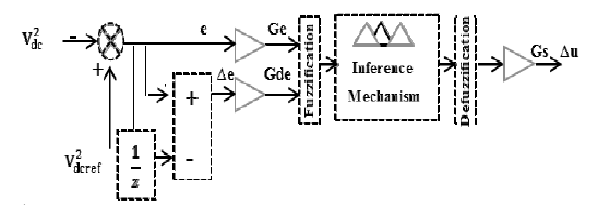
The control law of the system is a function of the error and its variation:

The most general form of this control law is defined as follows:

The error and its variation are defined as follows:
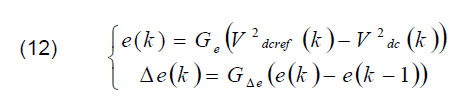
Where: X(t) – input, k – Iteration number, ∆u – command signal.
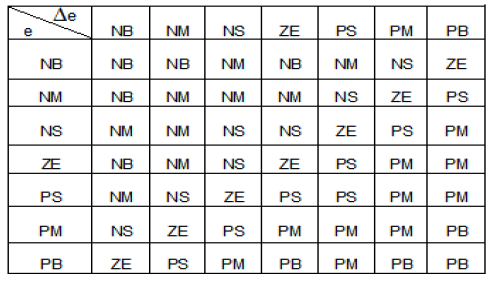
Table 2. Inference table of the fuzzy DC voltage controller
Results and discussion
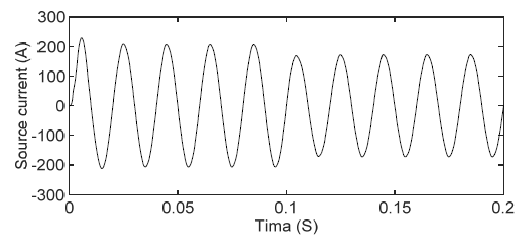
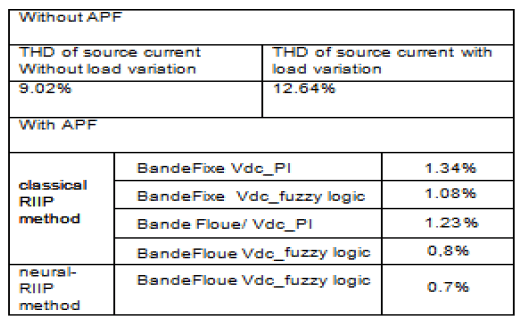
Simulation results were obtained under the Matlab \ Simulink environment and also using the Fuzzy toolbox. In order to show the advantages of Adaline Neural Network and fuzzy set theory to the SAPF control system, three comparative studies were carried out in this section: On the one hand, between the PI regulator of the SAPF DC voltage and a fuzzy logic controller, and on the other hand between the fixed band hysteresis and the fuzzy band modulation technique .the third study is the replacing of the two lowpass filters of RIIP method by two ADALINE networks for generation of reference currents of the SAPF, This is the Neural-RIIP (Real and Imaginary Instantaneous Powers) method. In order to further verify the effectiveness of the proposed control techniques, a load variation occurs from t=0.1 second (Fig.8). Figs.9, 10 shows the frequency spectrum of the load current before and after the load variation respectively. The THD of the line current is equal to 12.64%.We can see that the load variation has a negative effect on the value of the THD, since it goes from 9.02% to 12.64%. These spectral representations allow us to consider the 5th and the 7th harmonics as being the most dominant.
Table 3. Parameters of the studied system
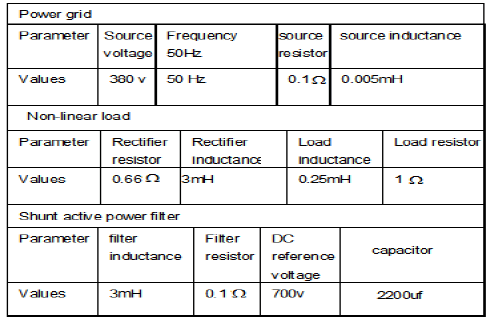
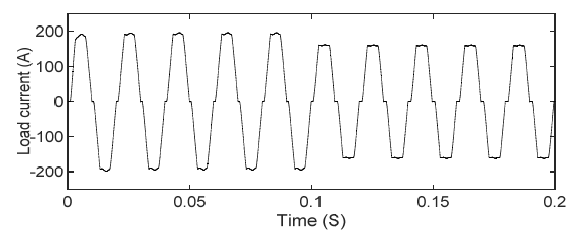
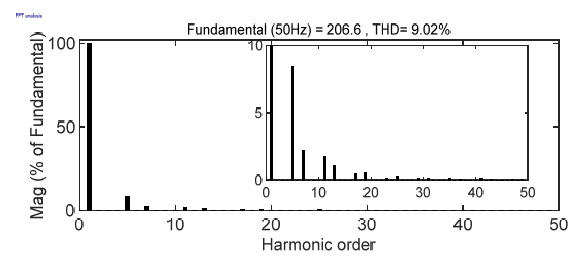
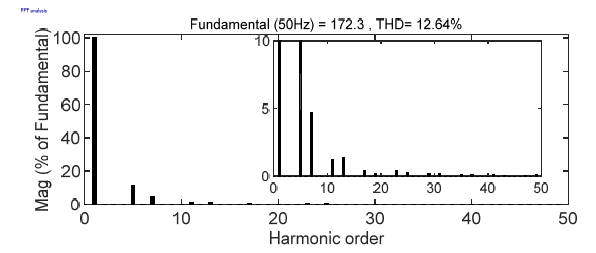
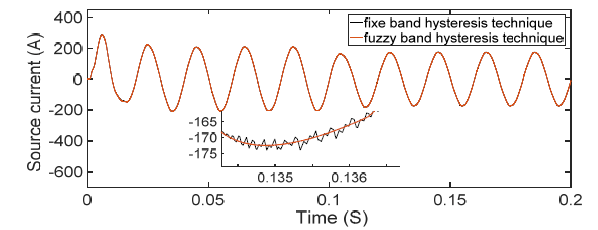
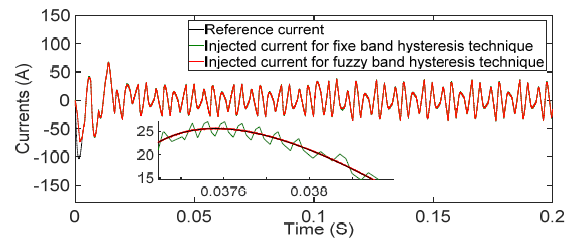
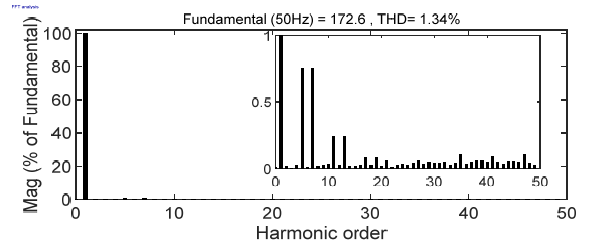
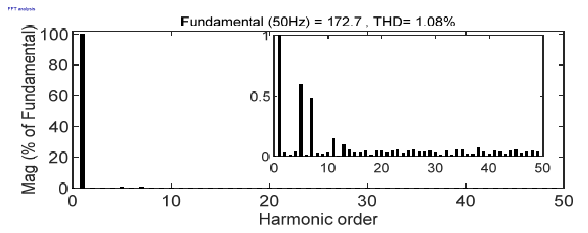
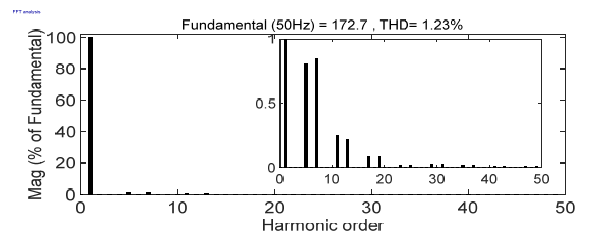
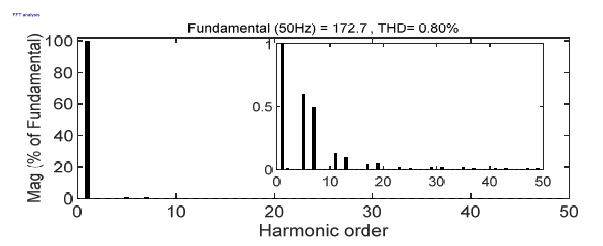
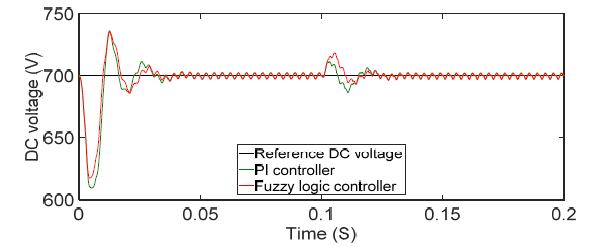
Figure 11 shows that the deformation of the line current has been corrected following the intervention of the SAPF. From the zoom performed on the spectral representations of the line current, the fixed band hysteresis current control technique generates additional harmonics of small amplitudes, unlike the fuzzy band hysteresis current control. which generates no additional harmonic.
The waveform of the current injected by the SAPF is illustrated in Fig. 12, where it is possible to observe the adaptation capacity of the SAPF during a disturbance in the load. The zooms performed on these figures show that the combination of fuzzy logic theory with the hysteresis current control strategy has eliminated the ripples of the line current. Effectively, the fuzzy band hysteresis improves the filtering performance of the SAPF by reducing the error between the reference current generated by the identification method and the current that the SAPF is injected on the grid.
Figures 13 and 15 shows that the application of the fuzzy band hysteresis current control technique has further improved the harmonic content of the line current by decreasing the THD from 1.34% to 1.23%
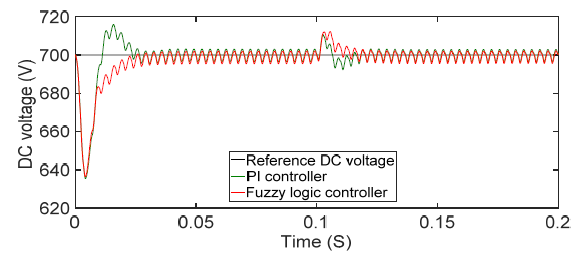
The results obtained correspond to a control of the DC voltage by a PI regulator. The use of a fuzzy logic controller allowed, according to Figs. 14, 16 and 17, to reduce the THD of the line current from 1.08% to 0.80%. The efficiency of the fuzzy logic controller can be clearly seen in Fig. 17 where the response of the DC voltage controlled by a fuzzy regulator is better compared to that of a PI regulator in terms of stability and rapidity.
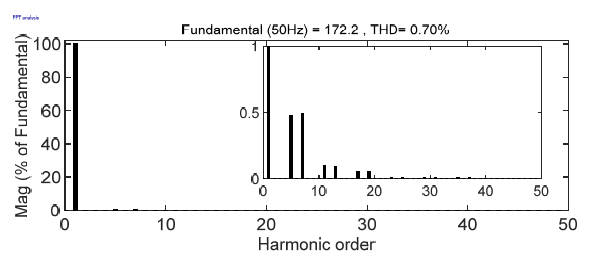
For Adaline Neural Network can be seen that with this method it is possible to estimate the harmonics individually and all harmonic currents considered in the inputs of the two ADALINE. The results obtained by the proposed ANN-RIIP extraction method have showed a great efficiency in harmonic identification. The waveforms show the measured load current before compensation, Fig. 10 with THD =12.64%. After the filtering used the ADALINE filter for harmonic extraction and the fuzzy hysteresis band technique for inverter modulation control and DC fuzzy controller to ensure DC voltage stability. We have given a very high development term of THD =0.7 fig.19 with a very efficient compensation of the reactive energy.
It is simple to calculate and allows a good dynamic response time, particularly when implementing the Neural- RIIP theory, which uses two ADALINE filters in place of a lowpass filter. The THD decreased from 12.64% to 0.7% meaning that in the case used ADALINE filters in place of low pass filters the THD decreased from 0.8%, to 0.7% figs.16, 19. The weak points of RIIP theory classic are the delay created by the low pass filter and the fact that it is limited to provide good filtering performance in the case of a balanced sinusoidal voltage system.
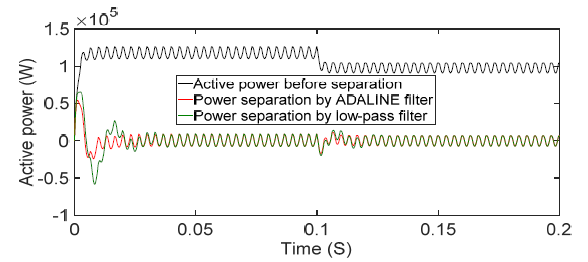
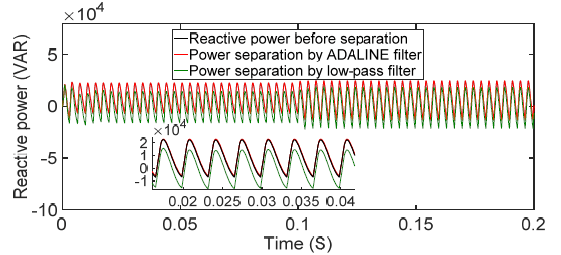
The separation of the active and reactive power which is made by the ADALINE technique shows a very clear improvement between the low-pass filter and the other ADALINE filter used, in the active power separated by the ADALINE filter gives a fast response time and less amplitude disturbances on the other hand the low-pass filter shows a large amplitude disturbance and slow response time compared to the ADALINE filter fig.20. For the reactive power, the ADALINE filter used gives a better compensation than the low-pass filter fig.21
Fuzzy control of the DC voltage has resulted in good disturbance rejection compared to a PI controller (Fig.22), especially when using the ADALINE filter for harmonic extraction.
Table 4. THD values of the source current for the different techniques used
Conclusion
In this paper, several control techniques have been discussed. These are the identification of harmonics by the classical RIIP and neural-RIIP theory, the fixed band and fuzzy band hysteresis control technique for current control and the use of a fuzzy logic controller for DC voltage control. In order to show the effectiveness of the proposed strategies, simulation tests were carried out under the conditions of a non-linear load variation. The results obtained show an improvement in the performance of the shunt active power filter in terms of current control. The fixed-band hysteresis current control provides a fast response but generates excessive current ripple due to the variable modulation frequency. This problem was solved using a fuzzy hysteresis band current control technique, which allowed the system to achieve good active filtering and minimize ripple and harmonic distortion of the line current. Fuzzy control of the DC voltage has resulted in good disturbance rejection compared to a PI controller, especially when using the ADALINE filter for harmonic extraction, and a satisfactory improvement in harmonic distortion of the current. ADALINE networks are linear estimators capable of learning signals on-line as a function of time. The learning is fast and robust while being compatible with a real-time constraint; moreover, the simplicity of its architecture gives it additional advantages: the interpretation of its weights and the lower harmonic reduction of 5% as required by the standards.
Acknowledgement This project was financially supported by the Directorate General for Scientific Research and Technological Development – Algerian Ministry of Higher Education and Scientific Research of Algeria.
REFERENCES
[1] A CHAOUI,J-P. GAUBERT,A BOUAFIA,” Experimental validation of new direct power control switching table for shunt active power filter power”, conference on Electronics and Applications (EPE),2013
[2] R. BELAIDI, M.HATTI,A HADDOUCHE, M. M. LARAFI,” Shunt active power filter connected to a photovoltaic array for compensating harmonics and reactive power simultaneously”, 4th international conference on power engineering, energy and electrical drives, may 2013
[3] B. SINGH, K. AL-HADDAD, A CHANDRA, “A review of active filters for power quality improvement”, IEEE transactions on industrial electronics, vol. 46,no. 5,October 1999
[4] G. W. CHANG, C. M. YEH, “Optimisation-based strategy for shunt active power filter control under non-ideal supply voltages “,lEE proceedings – electric power applications, vol.152,no. 2,pp. 182,2005
[5] H. AKAGI,E. HIROKAZU WATANABE,M AREDES,” Instantaneous power theory and application to
power conditioning”, USA: IEEE Press 200
[6] N.MESBAHI, AOUARI, D. OULD ABDESLAM, T.DJAMAH, AOMEIRI, “Direct power control of shunt active filter using high selectivity filter(HSF) under distorted or unbalanced conditions”, electric power systems research 108 (2014) 113-123
[7] GHADBANE Ismail BENCHOUIA Mohamed Toufik BARKAT Said “Real time implementation of feedback linearization control based three phase shunt active power filter”, European Journal of Electrical Engineering – n° 4/2018, 1-5
[8] B. MAZARI, F. MEKRI, “Fuzzy hysteresis control and parameter optimization of a shunt active power filter”, journal of information science and engineering 21,1139-1156 (2005)
[9] Larbi Hamiche1, Salah Saad*1, Leila Merabet1 & Fares Zaamouche2 “Adaline Neural Network and Real-Imaginary Instantaneous Powers Method for Harmonic Identification La méthode réseau de neurone Adaline et puissances instantanés réels imaginaires pour l’identification des harmoniques”, Rev. Sci. Technol., Synthèse 36: 129-140 (2018)
[10] Kadem, M., Semmah, A., Wira, P., & Slimane, A. (2020). Artificial Neural Network Active Power Filter with Immunity in Distributed Generation. Periodica Polytechnica Mechanical Engineering. doi:10.3311/ppme.12775
[11] Abdeslam, D. O., Wira, P., Merckle, J., Flieller, D., & Chapuis, Y.-A. (2007). A Unified Artificial Neural Network Architecture for Active Power Filters. IEEE Transactions on Industrial Electronics, 54(1), 61–76. doi:10.1109/tie.2006.888758
[12] F. Merki ‘Commande robuste des conditionneurs Actifs de puissances,’ thèse de doctorat, USTO,2007
[13] Loutfi, B. (2019). Comparative analysis hysteresis and fuzzy logic hysteresis controller of shunt active filter. Advances in Modelling and Analysis B, Vol. 62, No. 2-4, pp. 37-42. https://doi.org/10.18280/ama_b.622-401
[14] Georgios A. Tsengenes and al. « Performance Evaluation of PI and Fuzzy Controlled Power Electronic Inverters for Power Quality Improvement ». Chapter from the book Fuzzy Controllers – Recent Advances in Theory and Applications
[15] Rathika, P., Devaraj, D. (2010). Fuzzy logic based approach for adaptive hysteresis band and dc voltage control in shunt active filter. International Journal of Computer and Electrical Engineering, 2(3): 1793-8163
Authors: Khenfar noureddine, ICEPS Laboratory, phd student Sciences Faculty, Electrical Engineering Department, Djillali Liabes University of Sidi Bel Abbes 22000, Algeria..E-mail : khenfar.noredine@gmail.com.
Source & Publisher Item Identifier: PRZEGLĄD ELEKTROTECHNICZNY, ISSN 0033-2097, R. 97 NR 5/2021. doi:10.15199/48.2021.05.21
 Power Quality Blog