Published by Rana Muneeb Hassan, Andrzej Bie´n, Szymon Barczentewicz, Mohammad Abu Sarha, AGH University of Science and Technology
Abstract. Any country’s socio-economic growth is interlinked with number of factors, some of more significance with devastating impact whereas the others with very less impact. Amongst all such factors, energy is one of the major player in economic growth of a country, now a days as the energy sector drives the engine of progress, growth, and development in industrial, agricultural, and defense sectors, adding the impact to domestic consumers. The purpose of the study is to discuss the Pakistan’s current energy crisis which is getting worse and worse by everyday passing. Mainly the official data, along with the research work of scholars, international data and some raw data, all are collectively used to understand and convey a clear picture. This study would lay a basis for future studies which will uncover the solution to take the energy sector of Pakistan out of energy crisis.
Streszczenie. Na rozwój socjoekonomiczny kraju wpływa, w ró˙znym stopinu, wiele czynników. Po´sród nich jednym z najwa˙zniejszych jest energia. Dost˛epno´s´c energii wpływa na przemysł, rolnictwo, sektor obronny oraz ˙zycie codzienne mieszka´nców kraju. W niniejszym artykule opisano kryzys energetyczny w Pakistanie. Na podstawie danych oficjalnych i przegla˛du literaturowego oceniono stan energetyki w Pakistanie. W pracy zaproponowano tez˙ moz˙liwe droge˛ rozwoju sektora energetycznego Pakistanu.(Przegla˛d Systemu Energetycznego w Pakistanie)
Keywords: Pakistan, Energy, Development
Słowa kluczowe: Pakistan, Energetyka, Rozwój
1. Introduction
1.1. Overview
Recent technological developments and increasing concern over the sustainability and environmental influence of traditional fuel usage, the long term benefits of producing green and clean, sustainable energy in extensive amount from renewable energy sources arouses interest around the world.
In this study the energy sector operating in all parts of the country are discussed in detail. To make this study more versatile, convenient and understandable, not only the governmental but also private sector, the controlling authorities, the transmission and distribution companies along with production houses are also included. This paper will start from the government of Pakistan and then further going down to the consumer level.
While having discussed country’s domestic energy resources, this paper will lay a solid foundation of the available energy mix and also highlight the trend of supply and demand over a certain period of time. This study focuses on the diversity of energy resources projects—both national and international— that mostly remained short of realization. A statistical comparison of energy generation and energy consumption, and yearly basis comparison. Because of the limited nature of the subject, only a few published topics are accessible. Most of the data considered for this study comes from official government documents, official seminars, and scholarly journals and articles.
2. Energy sector in Pakistan
2.1. History
In the earlier decades, a significant increase in energy demand witnessed in Pakistan’s energy sector. On the contrary, energy production has followed a declined trajectory, which caused increase in the demand and supply gap exponentially. The contemporary energy resources and local potential will be discussed further in this paper.
Pakistan’s energy mix is not spread over many sources, also the major dependence is on imported fuel which leaves no other option in addressing the energy deficit. The current energy mix consists of the below sources [1]:
• Thermal 62.1
• Hydro energy 25.8
• Nuclear 8.2
• Renewable 3.9
2.2. Infrastructure
To get a better understanding of the current energy situation in Pakistan, this paper will present the inherited, & implemented infrastructure, needs of stake holders, and expectations of shareholders and layout of energy sector. The three main sectors of energy sector generation, transmission and distribution system of Pakistan’s energy sector is a bit more complex. The generation companies, transmission sector[9] and distribution companies[10] are working all together with the Government of Pakistan.
2.2.1. Inherited Infrastructure
From 1947 the independence time, energy shortage was also one of the challenges amongst the others Pakistan has been facing which till today is still unresolved. In early 1960s, Pakistan military took the responsibility and played their role in delivering huge infrastructure and accumulate thousands of watts in national energy sector, with the help of local and foreign funding[2]. At that time, energy mix mainly comprised of hydro-power and thermal power stations. In the 1970s, the first nuclear power station was established and commissioned in Karachi. In the 1980s, the utilization of nuclear sources further improved and the authorities continued with the development of nuclear power infrastructure.
In early 1990s, the government launched energy conservation program by introducing Independent Power Producers (IPPs) to produce 13000 megawatts of energy [3]. In 1990s, the total installed capacity was 11000 megawatts, out of which more than 50% of energy was producing from the hydro power sources whereas nuclear and thermal sources were contributing around 40% of the total generation [3].
2.2.2. Contemporary Infrastructure
In 2007, the shortage was 6000 MW responsible for prolonged and consistent blackouts [6]around the country. After 2010, energy crisis, frequent power shortages and failure hit the ceiling and became worst [7].
According to the 2017-18 national economic survey, by February 2018 the country’s installed capacity to generate electricity increased over 29000 MW whereas previously in June 2013 was around 23000 MW, which shows significant growth of around 30% during 5 years but still is not satisfactory to meet the needs [5].
2.3. Governing Bodies

A number of governmental, semi-governmental, autonomous, and private departments, authorities, companies and organizations are involved in the whole process of generating energy through different means, then transmission of energy nationwide and finally pass on the energy to the consumer level. The energy generation is based on more than one source i.e, hydro, thermal, nuclear, renewable, and others and more than 42 Independent Power Producers (IPPs) are involved in the generation. All generated energy are then entered into the national grid managed by another independent body responsible for transmission lines and infrastructure. Then 11 distribution companies came into play for distribution within their specified areas. (Fig. 1), presents the hierarchical structure of energy sector in Pakistan:
2.3.1. MINISTRY OF WATER AND POWER
The Ministry of Water and Power was a federal ministry in Pakistan. The ministry was dissolved in August 2017. The water and power divisions shifted to Ministry of Water Resources and Ministry of Energy respectively.
2.3.2. WAPDA
Pakistan Water and Power Development Authority (WAPDA) was came into being in 1958. Federal government took the administrative control of this autonomous authority. Structural changes were made in past to make sure that WAPDA could solely focus on the development of water reservoirs and hydro-power resources in more effective and efficient manner.
WAPDA is focused on the construction of five, multidimensional short and long-term water reservoirs in coming years to serve purposes like water storage, energy generation and flood control. The goal is to ensure the continuous supply of economical, green and clean energy to the consumers. The construction of water reservoirs like dams will be vital for hydro-power projects and to meet the water requirements.
2.3.3. AEDB
In May 2003, the Federal Government established the Alternative Energy Development Board (AEDB) and set milestone for year 2030, of generating over 5% of total power capacity through renewable energy technologies. The government of Pakistan authorize AEDB to perform following tasks:
• Evolve private sector to implement policies, programs and projects within the scope of ARE
• Ensuring the sustainable economic growth through development & generation of ARE
• Proactively transferring of technology & developing local manufacturing units for ARE
• Promotion and commercialization of ARE resources based energy generation
2.3.4. PEPCO
Another company working as a division of Ministry of Water and Power is Pakistan Electric Power Company (PEPCO). Following companies are operating under PEPCO:
• National Transmission & Despatch Company (NTDC)
• Generation companies (GENCOs)
• Distribution companies (DISCOs)
2.3.4.1. GENCOs
Generation Company (GENCO) is a company responsible for power generation in Pakistan. The Water and Power Development Authority is the owner of all these companies but still they are operating separately [8]. There are currently four GENCOs which are working with WAPDA.
2.3.4.2. DISCOs
Distribution companies (DISCOs) are operating under Pakistan Electric Power Company (PEPCO) and are responsible for the distribution of electricity in the respective specified allocated areas by purchasing electricity from generation companies and sell it to consumer. The Government of Pakistan owned all the distribution companies except the KElectric which was privatized.
2.3.4.3. NTDC
National Transmission & Despatch Company (NTDC) is a governmental company solely engaged in power transmission across the country.[11][12] The NTDC owned network of 5970 kilometers of 500 KV transmission lines and 11322 kilometers of 220 KV also sixteen 500 KV and forty-five 220 KV grid stations all across the country.[12]National Transmission and Despatch Company (NTDC) administers the interconnected transmission networks by linking power generation units with load centers which are spread all over the country.
2.3.5. PAEC
The Pakistan Atomic Energy Commission (PAEC) is an autonomous governmental authority & a scientific research institute, focused on promotion of nuclear science, and nuclear technology [13–14].
PAEC was established in 1956, and the active nuclear power plants are shown in (Fig. 2). PAEC has successfully delivered 5 commercial nuclear power plants. As of 2012, approximately 3.6% of overall power produced in the country is generated by commercial nuclear power plants, as compared to 62% from traditional energy resources, 33% from hydro power and approximately 0.3% from coal power plants. Pakistan plans on constructing 32 nuclear power plants by 2050.

In 1972, PAEC somehow managed to develop one nuclear reactor of only 85 MW with foreign help and it remained the only reactor for 3 decades. From 2000 on-wards, PAEC successfully launched 4 more nuclear power reactors and added 1320 MW collectively till 2017. The overall generation capacity of all nuclear power plants are presented in Table 1.
Table 1. Nuclear Power Plants Capacity

2.3.6. PRIVATE SECTOR
2.3.6.1. KESC
The electric supply company operating only in Karachi is K-electric. K-Electric (KE) is absolutely a joined investor owned company responsible for all three stages – generation, transmission and distribution. In short responsible of producing and delivering energy to consumers.
2.3.7. IPPs
An independent power producer (IPP) is an entity, not a public company but owns facilities to generate electricity power for sale to utilities and end users. In 1994, Pakistan Government announced an investor oriented strategy to develop IPPs based on oil, coal and gas, which was vital in formation of 16 IPPS. Later on, in 1995, a hydro power policy was also pronounced which rose in development of country’s first Hydro IPP.
In 2002, new government came up with new policy, through which more 12 IPPs added into the main stream. In 2015, again policy changed which further caused the addition of another 13 IPPs, mostly by Chinese companies. As of 2018, currently more than 40 IPPs are working in Pakistan.
3. Energy Mix
3.1. Electricity Generation
The hydropower generation share in overall total electricity generation has increased in FY2020 as compared to its share in FY2019. Recently, thermal has the largest share in the electricity generation. Gas and Re-gasified Liquefied Natural Gas (RLNG) are other cheaper sources. Decent growth of RLNG usage in energy mix has already taken part in improving supply to various power plants like Bhikki, Haveli Bahadur Shah, Balloki, Halmore, Orient, Rousch, KAPCO, Saif and Sapphir. Furthermore RLNG is also being supplied to massive fertilizer plants, industrial and transport sectors. The comparison of share of different sources of electricity generation is given below:
Table 2. Share in Electricity Generation

In recent years the country is shifting the energy mix towards more sustainable resources and in just an year it can be seen, that the share in electricity generation through hydro-power, and nuclear increased by 5 % each whereas dependency on thermal has been decreased till here, the numbers are depicting a good picture, except that the decrease in renewable sources increased by remained almost the same between the same period of time in 2019 and 2020.
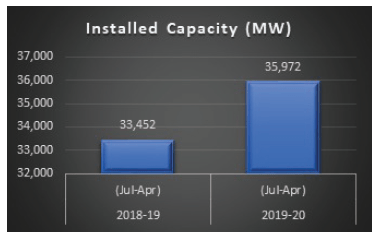
Till April, FY2020, installed capacity of electricity was reached to 35,972 MW which in April 2019, was 33,452 MW, grew by 7.5 percent.
3.2. Electricity Consumption
As far as consumption is concerned, no major change witnessed in the pattern of electricity consumption. Whereas, during July-April FY2020, because of the better and prolonged rainy season, the consumption of electricity in agriculture sector declined.
Table 3. Sector wise Electricity consumption share

As far as consumption is concerned, no major change witnessed in the pattern of electricity consumption. Whereas, during July-April FY2020, because of the better and prolonged rainy season, the consumption of electricity in agriculture sector declined. As the increase in population and more tendency of digitization has caused the increased household electricity consumption. The comparison between consumption patterns of electricity during March 2019-20 is shown above.
Also the change in percentage consumption during the Mar-2019 and 2020 is depicted in Fig.4.

4. Transmission Lines
The country is divided into two sectors, based on the geographical grounds, Northern part of the country where the major hydro-power plants are in installed and southern part of the country where thermal generation plants are responsible of generating electricity. One major challenge in this sector is the generation installations are remote and far from the load centers. The flow of power through transmission lines are as:
• Power transmission from north to center of the country in summer
• Power transmission from south to center of the country and north in winter
Table 4. Transmission Sector

In summer, due to increased flow of water, the hydropower plants in north supply the electricity to center and coup with the increased demand of electricity whereas in winters the hydro-power plants could not generate at the fullest capacity because of harsh cold weather and the demand in the center also decreased so the electricity is transmitted from south to north.
5. Renewable Energy
The renewable energy sources are not given enough space and importance in energy policy as well as current energy mix whereas the focus was only on traditional nonrenewable sources, which had a lasting impact on country’s energy sector. Pakistan’s first wind power project introduced and came live in 2012 which was the time when the whole world already have producing thousands of megawatts through such renewable projects.[4]
5.1. Wind Energy
Pakistan possess about 346 GW potential for wind energy generation. In 2006’s Energy Security Action plan, the government of Pakistan tasked the Alternative Energy Development Board to increase the wind energy share by 5 % in power generation capacity by year 2030. AEDB has developed commercial opportunities and numerous high paced projects to promote wind power generation. AEDB is running 40 wind power projects generating total of approximately 2010.2 MW.
• Twenty-Four (24) wind power projects generating total of 1235.20 MW
• Twelve (12) under construction wind power projects of potential 610 MW
• Four (04) wind power projects of potential 165 MW capacity are at different stages of completion
5.2. Solar Energy
Geographically, Pakistan is situated in a region offering over 2,900 GW of solar energy potential with over 300 sunshine days, having annual average temperature of 26-28 degree Celsius and 1900-2200 kWh/m3 annual global irradiance as shown in Fig.5. Pakistan started the solar journey with 440KW installed capacity of 18 photo-voltaic systems in 1980. Nonetheless, the life of the system was relatively short because of poor maintenance, carelessness and lack of knowledge. Later on, the authorities introduced a concept of solar villages’ for the remote areas where power transmission was neither possible nor feasible.

Installation of up to 500W/unit photo-voltaic systems of for electricity generation and water heating increased the import of solar water heaters which was 260 in 2007 and increased to 16175 in 2013. So far, Pakistan has been increasing share of solar energy but remarkable and giant steps are still required for this sector to decrease the load shedding duration.
AEDB is pursuing 22 solar PV power projects of cumulative capacity of approximately 890.80 MW.
• The operational projects are six (06) solar power projects contributing total of 430 MW
• IPPs have four (04) projects sharing total of 41.80 MW
• Furthermore twelve (12) projects accumulating capacity of 419 MW are under construction.
5.3. Small Hydro
The massive hydro power potential of Pakistan is non match-able. The geographic layout of the country, the natural water flow systems and irrigation system in the country manifest hydro power potential that can be harnessed to meet the increasing energy needs of the country. Other than the large hydro, there are certain prospects of development of small mini- micro hydro power which are considered as the worthwhile options for power generation. Currently, the generation is 128 MW whereas 877 MW is under construction and 1500 MW is under development.
Table 5. Transmission Sector

6. Conclusion
This research discovered and shed light over the energy situation and also provides a brief overview and understanding of energy sector operating in Pakistan also pertain the policies and planning implemented during different regimes from the independence. The whole study concluded that during the early years the governments proactively focused on water resources management which somehow also contributed in energy generation. Furthermore in 1960s, the priority shifted towards energy generation, which resulted in the development of infrastructure like hydro-power plants and implementation of energy policies. This review provides a detailed analysis of energy sector of Pakistan, the energy policies and departments involved from generation to consumer level. The dependence of the energy generation majorly is upon imported conventional resources and even during the worst energy shortage period during last decade, Pakistan could not generate clean, green and sustainable energy also because of the involvement of international oil, the tariff is always fluctuating which is troublesome at consumer end. The involvement of large number of public and private departments have put the whole energy sector in a more vulnerable situation and also make it more difficult to come up with effective and efficient solution.
This research paper is a part of an ongoing doctorate studies. In coming days, a more detailed research based solution will be presented. The solution will involve demand side management through designing, modeling and analysis of energy mix. More strategic energy planning framework will be developed to coup the continuous increase of energy demand.
REFERENCES
[1] Yearly Survey Book “Pakistan Economic Survey 2018-19” Retrieved from: [web page] http://www.finance.gov.pk/survey_1819.html/. Energy, Ministry of Finance, Government of Pakistan,,pp. 234–241, 2019.
[2] Inter-Services Public Relations (ISPR) Retrieved from: [web page] https://www.pakistanarmy.gov.pk/journeyscratch-nuclear-power.php.
[3] Aziz, Sartaj. “Who is responsible?” Retrieved from: [web page] https://archive.pakistantoday.com.pk/2013/04/23/who-is-responsible-4/.
[4] “50 MW wind power project connected to national
grid” Retrieved from: [web page] https://nation.com.pk/09-Nov-2012/50mw-wind-project-connected-to-national-grid.
[5] “Country’s installed electricity capacity increases by 30pc to 29,573MW” Retrieved from: [web page] https://www.thenews.com.pk/print/309535-country-s-installed-electricity-capacity-increases-by-30pc-to-29-573mw.
[6] “Pakistan’s Ongoing Electricity Shortage” Retrieved from: [web page] http://www.energytribune.com/articles.cfm?aid=864/articles.cfm?aid=864/.
[7] “More Crises in Pakistan: Electricity, Flour, Sugar, Water, Sui Gas Crises – What is the way out? : ALL THINGS PAKISTAN” Retrieved from: [web page] http://pakistaniat.com/2008/01/03/more-crises-in-pakistan-electricity-floursugar-water-sui-gas-crises-what-is-the-way-out/.
[8] NEPRA Retrieved from: [web page] http://www.nepra.org.pk/lic_gencos.html/.
[9] National Transmission & Despatch Company Limited Retrieved from: [web page] https://ntdc.com.pk/vision-mission/.
[10] National Electric Power Regulatory Authority (NEPRA) Retrieved from: [web page] https://nepra.org.pk/.
[11] “NTDC to pay Rs5m fine for violating performance standards The Express Tribune” Retrieved from [web page] https://tribune.com.pk/story/1570268/2-ntdc-pay-rs5m-fine-violating-performance-standards/.
[12] National Transmission & Despatch Company Limited Retrieved from: [web page] https://ntdc.com.pk/.
[13] “IAEA presentation on nuclear power by PAEC” Retrieved from: [web page] http://www.iaea.org/NuclearPower/Downloadable/Meetings/2013/2013-10-01-10-04-TM-NPE/2.3.pakistan.pdf/.
[14] “Nuclear Power in Pakistan” Retrieved from: [web page] http://www.world-nuclear.org/info/Country-Profiles/Countries-O-S/Pakistan/.
[15] “Biomedical engineering at PAEC” Retrieved from: [web page] http://www.paec.gov.pk/Medical/.
[16] “Agriculture and Biotechnology” Retrieved from: [web page] http://www.paec.gov.pk/Agriculture/.
[17] ”PAEC & Summer College on Physics”. International Nathiagali Summer College. Pakistan Atomic Energy Commission Retrieved from: [web page] http://www.paec.gov.pk/INSC/.
[18] “CERN and Pakistan: a personal perspective” Retrieved from: [web page] http://cerncourier.com/cws/article/cern/28934/.
[19] “Pakistan and CERN”. Express Tribune Retrieved from: [web page] http://tribune.com.pk/story/769312/pakistan-and-cern-2/.
[20] “National Command Authority”. Director-General of the Inter-Services Public Relations Retrieved from: [web page] https://www.ispr.gov.pk/front/main.asp?o=t-nca_press_release_archive/.
[21] “Prime Minister inaugurates 340 MW Chashma Nuclear Power Plant Unit-2: Government to provide full support to PAEC for Nuclear Power Projects Urges International Community to make nuclear technology accessible to Pakistan for power generation” Retrieved from: [web page] http://www.paec.gov.pk/p-mj11-news1b.htm/.
[22] Zia H. Siddiqui, I. H. Qureshi Nuclear Power in Pakistan The Nucleus,A Quarterly International Scientific Journal, pp. 31—33.
[23] “Nuclear Power Generation Programme” Retrieved from: [web page] https://en.wikipedia.org/wiki/Pakistan_Atomic_Energy_Commission/.
Authors: Ph.D. Rana Muneeb Hassan, dr hab. in˙z. Andrzej Bie´ n, dr in˙z. Szymon Barczentewicz, Ph.D. Mohammad Abu Sarhan, Department of Power Electronics and Energy Control System, Faculty of Electrical Engineering, Automatics, Computer Science and Biomedical Engineering, AGH University of Science and Technology, aleja Adama Mickiewicza 30, 30-059 Kraków, Poland, email: hassan@agh.edu.pl
Source & Publisher Item Identifier: PRZEGLA˛D ELEKTROTECHNICZNY, ISSN 0033-2097, R. 97 NR 10/2021. doi:10.15199/48.2021.10.07
 Power Quality Blog
This study highlights the critical role energy plays in shaping a nation’s growth. Pakistan’s energy crisis is indeed a complex issue that needs urgent attention. I hope future studies can provide effective solutions to address this ongoing challenge. For those managing household gas bills amidst this crisis, an easy-to-use gas bill calculator can be found at Sui Gas Bill, which helps you understand your charges better.
LikeLiked by 1 person