Published by Sherkhon SULTONOV1 , Murodbek SAFARALIEV2 , Sergey KOKIN2 , Stepan DMITRIEV2 , Inga ZICMANE3 , Shokhin DZHURAEV1,4 Tajik Technical University, Tajikistan
(1), Ural Federal University (2), Riga Technical University, Latvia (3), Branch of the National Research University ‘Moscow Power Engineering Institute’ in Dushanbe City (4)
ORCID: 1. 0000-0003-2322-5272; 2. 0000-0003-3433-9742; 3. 0000-0001-7493-172X; 4. 0000-0001-8781-2383; 5. 0000-0002-3378- 0731; 6. 0000-0003-4092-2758.
Abstract. The paper describes the distinctive features of the isolated power system of Tajikistan, significant part of which is constituted by the hydropower plants; identifies the main problems of the electric power system of the Republic of Tajikistan in terms of power generation; describes specific features of HPP cascade management; proposes a method of determining the alternative fully drawn down level of the Norak HPP reservoir, taking into account the water level requirements in various water volume conditions from the point of view of power generation increase; estimates the economic efficiency of reducing the deficit of electricity in the power system with view to long-term optimization.
Streszczenie. W artykule opisano charakterystyczne cechy izolowanego systemu elektroenergetycznego Tadżykistanu, którego znaczną część stanowią elektrownie wodne; identyfikuje główne problemy systemu elektroenergetycznego Republiki Tadżykistanu w zakresie wytwarzania energii; opisuje specyficzne cechy zarządzania kaskadowego HPP; proponuje metodę określenia alternatywnego całkowicie obniżonego poziomu zbiornika Norak HPP z uwzględnieniem wymagań poziomu wody w różnych warunkach objętości wody z punktu widzenia przyrostu mocy; szacuje ekonomiczną efektywność redukcji deficytu energii elektrycznej w systemie elektroenergetycznym z myślą o długoterminowej optymalizacji. (Specyfika zarządzania elektrownią wodną w izolowanym systemie)
Keywords: hydropower resources, optimization, Vakhsh cascade, Norak HPP, power system of Tajikistan, power generation.
Słowa kluczowe: zasoby hydroenergetyczne, optymalizacja, kaskada Vakhsh, Norak HPP, system energetyczny Tadżykistanu, energetyka.
Introduction
Optimal management of hydropower plants (HPPs) regimes is a complex task that should be solved individually for each power system, depending on its structure and nature. Each power system has its own specific characteristics and requires individual approach for solution of particular tasks. Most often, the target of HPP optimal management is the rational use of hydropower resources. The HPP operation regime depends on the river flow, which is probabilistic and varies widely depending on weather conditions and other factors. HPP regime management is even more complicated under severe water economic management restrictions. Currently, the adjustment range of the HPPs is limited by the water economic management requirements. In this regard, there is a need to analyze and change the methods and tasks of optimal use of HPP resources [1-3].
Long-term regime optimization includes finding effective HPP operation regimes for the entire control cycle. It is necessary to define the regime of use of water and energy resources of the water reservoirs, with establishment of refill and drawdown schedules for the water reservoirs. Planning of optimal long-term HPP regimes is necessary for the implementation of rational use of reservoir resources. Efficient use of water in HPP reservoirs can increase electricity generation by 5 % or more [4-6].
For many years, many classical algorithms, such as linear programming [7], heuristic programming [8], dynamic programming [9], network flow algorithms [10], etc., have been widely developed and applied to the aforementioned optimization task. Solving problems related to large-scale hydropower systems, usually used methods that can reduce or facilitate computational dimensions. Therefore, it is extremely important to develop other optimization algorithms in order to reduce dimensionality, increase computational efficiency, and improve the efficiency and practicality of optimization results.
Tajikistan’s electric power system (EPS), which consists mainly of HPPs, has some characteristic features that should be taken into account when applying optimization methods.
Description of the Research Object
Tajikistan is a country whose territory is 93 % covered with mountains. It has unique potential of renewable and environmentally friendly energy sources – the hydropower resources. Hydropower is the main energy source for the electric EPS of the Republic of Tajikistan. Tajikistan ranks the 8th in the world in terms of hydropower resource potential after China, Russia, the United States, Brazil, Zaire, India, and Canada. Its hydropower reserves are estimated at 527.06 billion kWh per annum. Technically available and economically feasible potential is 317 billion kWh per annum, just 5% of which have been used so far [11-13]. Hydropower potential is 58.55 thousand kWh per annum per person, making it second largest in the world. Tajikistan exceeds many countries in terms of Hydropower potential per square kilometer of the territory (3682.7 kWh per annum /km2 ). The main rivers of Tajikistan are Vakhsh, Panj, Kofarnihon, Zarafshon and Syr Darya Rivers, whose basins cover more than 75% of its territory. Combined, the rivers of Tajikistan account for 55.4% of the average annual surface runoff of the Aral Sea basin [14-16].
Tajikistan has virtually no oil and gas resources, their amount accounting for less then 1% of the total power resources. In Tajikistan, the electricity sector is managed by an Open Joint-Stock Holding Company (OJSHC) “Barqi Tojik”. This state-owned company controls power plants and networks, power generation, power transmission and distribution of electricity across the Republic, with the exception of Gorno-Badakhshan Autonomous Oblast (GBAO) [17-20].
The electricity system of Tajikistan consists mainly of HPPs, and the following significant features should be taken into account for optimal power plant regime management of the power system [15,17,21 ]:
• almost 90% of the installed capacity of the system is accounted for by HPPs, which produce about 99.5% of the country’s electricity;
• Thermal power plants operate during the winter period (November-February) and supply hot water and electricity to Dushanbe city residents only;
• almost all HPP capacity (97 %) is concentrated on the Vakhsh river, which requires to take into account the downstream relations of the HPPs located thereof when determining optimal HPP operating regimes; the capacity of the Norak HPP, which has an annual (seasonal) regulation reservoir, is 80% of the total capacity of the Vakhsh cascade HPPs. Such predominance results in the fact that the water flow of the other HPPs in the cascade, which as a rule have daily regulated reservoirs, is mainly determined by the transit runoff of the Norak HPP. Naturally, the adjustment capacities of such hydropower plants in the EPS are extremely small.
The major part of electricity in Tajikistan is generated by HPPs concentrated on the Vakhsh, Syrdarya, and Varzob rivers. The main source of water resources are the mountains, mainly due to snowmelt. The water flows down in a natural way, reaching its peak level in June. The natural regime of levels and flow rates of the Vakhsh River in the period from October to March is characterized by a stable low-water period with small, almost uniform water flow rates, the lowest of them in December, with slight fluctuations in level. Vakhsh is characterized by low levels and expenditures in the autumn-winter period, when the river is fed mainly by groundwater and periodical precipitation. The rise in water consumption begins in April, the highest water consumption is observed in July, sometimes in late or early August, and the decline begins in mid-August, lasting until October. In mid-October, the lowwater state of the river begins, with flow rates of about 150- 250 m3 / sec. The hydrograph of the Vakhsh River is shown in Fig.1.

Thus, at present, Tajikistan is experiencing serious difficulties associated with a constant shortage of electricity; the power shortage amounts to 2-4 billion kWh in winter. The main causes of energy shortage in the Republic of Tajikistan are as follows [21]:
Tajikistan are as follows [21]:
• of all the HPPs, only the Norak HPP has a reservoir of annual (seasonal) regulation with a capacity of 10.5 km3 of water; all other HPPs have either daily regulation or no regulation at all. Stored energy cannot cover the country’s needs during the winter period.
• isolated operation of the power system. Since 2009, Tajikistan’s energy system has been operating in isolation, which makes it impossible to import electricity from neighboring countries in winter. In summer, the country has a surplus of electricity, which cannot be exported to neighboring countries. Therefore, a huge amount of water is discharged in vain. Energy loss in the summer period ranges from 3 to 7.5 billion kWh, depending on the water amount of a specific year.
• increase in electricity consumption by the population during the winter heating period. Thus, the relevance of this paper lies in the research and finding the solutions to the task of reduction of the current electricity shortage in Tajikistan based on the calculations of the optimal operating regimes for the HPPs in the country’s power system.

Method of additional drawdown of Norak HPP reservoir
Eight HPPs are located in a cascade on the Vakhsh river. Six of them are located on the Vakhsh River itself; they are Bilding Rogun, Norak, Boygozi, Sangtuda – 1, Sangtuda – 2 and Sarband HPPs. The other two, Markazi and Sharshara HPPs, are located on the Vakhsh River main canal. Since the latter two HPPs have small installed capacities and are located on relatively small diversion dams intended for the accumulation of irrigation channels, they are not studied in this paper. We should point out that out of five reservoir- equipped HPPs under consideration, Norak HPP reservoir is the only one with the ability to regulate annual (seasonal) flow, while the remaining HPPs located downstream have daily regulation only. Vakhsh cascade scheme is shown in Fig.2.
With the cascade arrangement of HPPs, the task of optimization of their long-term regimes becomes more complicated. Cascade stations are linked in terms of flow rate, water pressure, power capacity, and power generation. HPPs of the cascade differ in varying degrees of flow regulation [22]. The upstream plants affect the downstream ones in the cascade, namely, the regulation of the flow and, as a result, the generation of electricity and power. The larger the reservoirs of the plants upstream, the greater is the effect. In the cascade, the joint flow regulation is implemented, based on the requirements of the power consumers and the power capacity of each HPP in the cascade. Usually, water and energy regulation of runoff is carried out according to the principle of maximum efficiency of the entire cascade, but each station can set its own limits for regulating the runoff [23].
The Government of Tajikistan is actively working to complete the construction of the Rogun HPP. The Rogun HPP with an installed capacity of 3,600 MW will become the largest station in Tajikistan, with an average annual power energy generation of 13.1 billion kW∙h [24]. The Rogun hydropower unit is the largest on the Vakhsh River, providing the most efficient operation of the entire cascade. With the commissioning of this station, it is possible to practically fully mastering the water and energy potential of the entire Vakhsh River, as well as regulate the flow of the Amu Darya River. The reservoir of the Rogun HPP will have an annual flow regulation, which will allow storing a huge amount of water in summer and dumping it in winter, thereby reducing the shortage of electricity in the country. Also, the construction of the Rogun HPP on the Vakhsh River will improve the operation mode of the Nurek HPP, since the joint work of Rogun and Nurek allows the efficient use of hydropower resources. [25].
The issues of long-term optimization of HPP regimes in isolated power systems by means of optimal flow redistribution between the years of different water level are covered in [22]. This paper addresses the task of determining the optimal fully drawn down level for the Norak HPP reservoir.
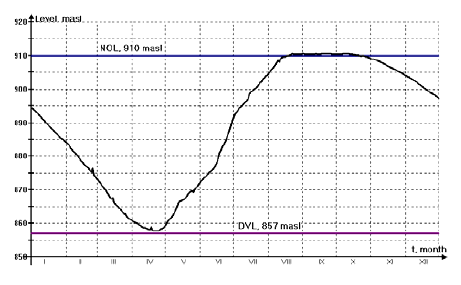
The refill regime of the Norak reservoir depends on the river flow. The reservoir needs to be filled to the normal operating level (NOL) during the high-water period, and emptied till the dead volume level (DVL) during the lowwater period. The management of the regime of the reservoir is a challenging task, as the river flow is stochastic in nature. Improper flow management can lead to serious consequences. Errors in the drawdown of water from the reservoir can lead to non-delivery of the guaranteed power in case of premature reduction till the DVL, while failure to draw down the water till DVL will lead to idle discharges, i.e. energy losses. Errors during water refill can result in failure to fill the reservoir to the NOL, with the possible underproduction of the guaranteed power; premature filling up to the NOL will lead to an increase of idle discharges [3]. To date, the refill/drawdown regimes of the Norak HPP reservoir are defined by the Dispatching control service of the OJSHC “Barqi Tojik”. The schedule of refill/drawdown of the Norak HPP reservoir is shown in Fig. 3.
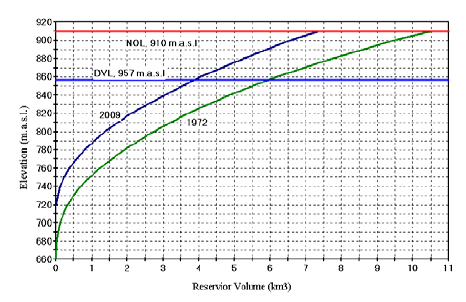
Definition of the optimal fully drawn down level of reservoir allows to designate the DVL mark. The main provisions and method given below are part of the water and energy calculations of HPPs with annual regulation [26]. The main task of the annual regulation reservoir is to increase the amount of energy and capacity of Hydropower plant during the low-water period of the year by using the excess water retained in the reservoir during the high-water period. Thus, there is a need to divide the entire volume of the annual regulation reservoir into two parts – useful and dead volumes. For the total volume of a reservoir, it is necessary to divide it into the above two volumes, i.e. to solve the problem of determining the fully drawn down level of the reservoir hop, and to set the DVL mark. When solving this task, we assume that the NOL of the reservoir is already known, and that the reservoir can be filled anytime during a high-water period. The part of the total reservoir volume that lies between the fully drawn down level and the NOL mark represents the useful volume of the reservoir Vus (Fig. 4). The volume curves (Fig. 4) show that the volume of the Norak HPP reservoir has changed over the time of its operation. On the basis of bathymetric surveys of 1989, 1994, 2001 and 2009, the volume losses of the Norak HPP reservoir were calculated. As of 2009, the total volume of the Norak HPP reservoir has decreased by 10.5 billion m3 as compared to the planned volume, and amounted to 7.37 billion m3 [21, 23].
Below is the calculation of the optimal fully drawn down level of the Norak HPP reservoir based on the method suggested in [27]. The task is to find the fully drawn down level of the reservoir that will provide for the maximum energy effect of the hydropower plant. When the reservoir is drawn down below the DVL, the electricity generation increases by ΔW.
The criterion for completing the calculation, i.e. determining the optimal hop, m, is as follows: if WHPPhopi > WHPPhop(i+1) , then hopi is the optimal fully drawn down level and the calculation ends. However, according to calculations, we can find that with an increase in the fully drawn down level hop, Wres increases more than the decrease of Wriver. It can be found that the curve of the total HPP output EHPP does not bend even when the water is drawn down 23m below the planned DVL mark, i.e. the condition WHPPhopi > WHPPhop(i+1) is not met (Fig. 5).
Thus, it can be found that the generally accepted method for determining the optimal fully drawn down level of the reservoir [27] is not relevant for the Norak HPP reservoir. This method is applicable for the calculation of the optimal fully drawn down level of low- and medium-pressure HPP reservoirs, for which, as we have already indicated above, the pressure reduction is decisive. For high-pressure Hydropower plants, such as Norak, Sayano-Shushenskaya and other, the rule of changes in output depending on the fully drawn down level of the reservoir, shown in Fig. 5, does not apply. In [26], a different method was proposed for determining the optimal fully drawn down level of the Norak HPP reservoir by searching for a compromise solution, taking into account additional restrictions on the hydrology and technical characteristics of the dam. Taking into account the two above limitations, it is possible to determine the fully drawn down level of the reservoir at which the greatest energy effect can be obtained at the Hydropower plant. The power generation increases by ΔW for each (-1) meter of water draw down below the DVL. Additional Norak HPP electricity generation at draw down below the DVL is shown in Fig. 6.


The specific features of the hydraulic facilities of the Norak HPP are also taken into account. Pressure water conduits of the Norak HPP have the following specific features: the water is supplied to the HPP turbines of the Hydropower station from three water intakes; each of the three units is powered by a single supply pressure tunnel with a diameter of 10 m. The upper elevation of the pressure tunnel is 842 m above sea level, i.e. 15 m below the DVL (857 m) [26]. It can be said that the design of the hydraulic facilities provides for the drawdown of the reservoir below the planned DVL mark; and the difference between the maximum fully drawn down level and the planned DVL should not exceed 15m.
It is absolutely required to check the solution for the possibility of refill of the reservoir up to the NOL. It is necessary to calculate the drawdown energy and the refill energy of the reservoir. In case the refill energy exceeds the drawdown energy, the reservoir can be filled up to the NOL.

The calculations prove that even when the reservoir is emptied up to the level of 7 m below the planned DVL mark, the refill energy is greater than the drawdown energy. The drawdown of the Norak HPP reservoir is 7 m below the planned DVL mark, and the reservoir does get refilled up to the NOL during the high-water period. For the entire period of operation of the reservoir

The calculations show that when the Norak HPP reservoir is emptied to the level of 7 m below the planned DVL mark, the reservoir is filled to the NOL during the highwater period.
If we limit the drawdown of the reservoir to the level of 7 m below the planned DVL mark, and on condition the abovementioned restrictions are met, we can get an additional electricity generation of 178 million kWh, which will make for a 7% reduction of the winter energy deficit, and reduce the amount of idle discharges during the highwater period.
Conclusions
The major part (94%) of electricity in Tajikistan is generated by Hydropower plants of the Vakhsh cascade. Out of five HPPs in the cascade, only the Norak HPP has seasonally regulated reservoir, generating about 60% of the country’s electricity. All other HPPs are located downstream the Norak HPP and have daily regulated reservoirs.
It is possible to obtain additional electricity generation by drawing down the Norak HPP reservoir to a level below the planned DVL mark, with observance of all relevant restrictions. According to the compromise solution search results, lowering the water level in Norak HPP water reservoir by 7 m below the DVL will provide for an up to 7% cut in the power deficit.
Currently, the Norak HPP is operated in a mode where about 4.2 cubic kilometers of water accumulates in the reservoir in summer, and then this water is used to generate electricity in winter. Thus, the water level in the reservoir of the Norak HPP rises and falls by 50 meters during the year. In the presence of the Rogun HPP, the water level in the reservoir of the Norak HPP can be maintained at a constant level, while the reservoir of the Rogun HPP will be used to regulate the flow, the difference in the water level in it will vary up to 30 meters. This will make it possible to establish a permanent seasonal flow regime for the Norak HPP. The directions of further research will be connected with this.
REFERENCES
[1] Feng, Zhong-kai, Wen-jing Niu, and Chun-tian Cheng, Optimization of hydropower reservoirs operation balancing generation benefit and ecological requirement with parallel multi-objective genetic algorithm, Energy, 153 (2018), pp. 706-718.
[2] Thaeer Hammid Ali, et al., A review of optimization algorithms in solving hydro generation scheduling problems, Energies, 13.11 (2020), 2787.
[3] Ibanez Eduardo, et al., Enhancing hydropower modeling in variable generation integration studies, Energy, 74 (2014), pp. 518-528.
[4] Nikitin Viacheslav, Nikolay Abasov, and Evgeny Osipchuk, Modeling of Long-term Operating Regimes of Hydro Power Plants as Part of Energy and Water Systems in the Context of Uncertainty, E3S Web of Conferences, 209 (2020).
[5] Liao Sheng-li, et al, Long-term generation scheduling of hydropower system using multi-core parallelization of particle swarm optimization, Water Resources Management, 31.9 (2017), pp. 2791-2807.
[6] Ahmad Asmadi, et al, Reservoir optimization in water resources: a review, Water resources management 28.11 (2014), pp. 3391-3405.
[7] Azamathulla H.Md, et al., Comparison between genetic algorithm and linear programming approach for real time operation, Journal of Hydro-environment Research 2.3 (2008), pp. 172-181.
[8] Ngoc Trieu Anh, Kazuaki Hiramatsu, and Masayoshi Harada. “Optimizing the rule curves of multi-use reservoir operation using a genetic algorithm with a penalty strategy.” Paddy and Water environment 12.1 (2014): pp. 125-137.
[9] Kumar D. Nagesh, and Falguni Baliarsingh, Folded dynamic programming for optimal operation of multireservoir system, Water Resources Management, 17.5 (2003), pp. 337-353.
[10] Braga Benedito, and Paulo SF Barbosa, Multiobjective real-time reservoir operation with a network flow algorithm 1, JAWRA Journal of the American Water Resources Association 37.4 (2001), pp. 837-852.
[11] Xenarios Stefanos, Murodbek Laldjebaev, and Ronan Shenhav, Agricultural water and energy management in Tajikistan: a new opportunity, International Journal of Water Resources Development, 37.1 (2021), pp. 118-136.
[12] Safaraliev M. Kh, et al, Energy Potential Estimation of the Region’s Solar Radiation Using a Solar Tracker, Applied Solar Energy, 56.4 (2020), pp. 270-275.
[13] Laldjebaev M., R. Isaev, and A. Saukhimov, Renewable energy in Central Asia: An overview of potentials, deployment, outlook, and barriers, Energy Reports 7 (2021), pp. 3125-3136.
[14] Ghulomzoda A. et al., Recloser-Based Decentralized Control of the Grid with Distributed Generation in the Lahsh District of the Rasht Grid in Tajikistan, Central Asia, Energies, 13 (2020), p. 3673.
[15] Asanov M.S. et al., Algorithm for calculation and selection of micro hydropower plant taking into account hydrological parameters of small watercourses mountain rivers of Central Asia, Int. J. Hydrogen Energy, 46 (2021), № 75. pp. 37109-37119
[16] Ghulomzoda A. et al., A Novel Approach of Synchronization of Microgrid with a Power System of Limited Capacity. Sustainability, 13(2021), p. 13975.
[17] Matrenin P. et al., Adaptive ensemble models for medium-term forecasting of water inflow when planning electricity generation under climate change, Energy Reports, 7 (2021).
[18] Kirgizov A.K. et al., Expert system application for reactive power compensation in isolated electric power systems, Int. J. Electr. Comput. Eng., 11 (2021), No 5, pp. 3682-3691.
[19] Masih A. et al., Application of Dual Axis Solar Tracking System in Qurghonteppa, Tajikistan, in Proceedings of 2019 the 7th International Conference on Smart Energy Grid Engineering, SEGE 2019, 2019, no. 2, pp. 250–254.
[20] Matrenin P. et al., Medium-term load forecasting in isolated power systems based on ensemble machine learning models, Energy Reports, 7 (2021).
[21] Kirgizov A., et al, Characteristics of Relative Growth for HPP Power Systems of Tajikistan, IOP Conference Series: Materials Science and Engineering, 883 (2020), No. 1.
[22] Filippova T.A., Sidorkin Yu. M., and Rusina A.G., Optimization of electric power plants and power systems regimes, Novosibirsk: NSTU publishing House, 2007, 356 p.
[23] Yuri Sekretarev, Sherkhon Sultonov and Victor Shalnev, Optimal Control Regime of the Vakhsh Hydropower Reservoirs to Reduce Electricity Shortages in Tajikistan, Applied Mechanics and Materials, 792 (2015), pp. 446-450.
[24] Safaraliev Murodbek, et al., The transient analysis of the hydrogenerator of Nurek HPP subject to automatic excitation control action.” Przegląd Elektrotechniczny 96 (2020), No. 8, pp.35-38
[25] Kokin S.E., et al., Transient stability analysis in rotor winding of hydrogenerator at various short circuit values in power grid in consideration with AEC, in 2019 16th Conference on Electrical Machines, Drives and Power Systems, ELMA 2019 – Proceedings, 2019, pp. 1–4.
[26] Sekretarev Yu. A., Sultonov Sh.M.,and Nazarov M. Kh, The possibility of additional drawdown of the Norak reservoir to increase production, Hydropower Stations in the XXI century: collection of materials of the Third All-Russian Scientific and Practical Conference. Sayanogorsk, 2016, pp. 384-388.
[27] Sekretarev Yu. A., Zhdanovich A.A., and Mitrofanov S.V., Hydropower engineering: contra. of the task and method, Novosibirsk: NSTU Publishing house, 2013, 64 p.
Authors: PhD Sultonov Sherkhon Murtazoqulovich, Department of Electric stations, Tajik Technical University named after academic M. S. Osimi, Dushanbe 734042, Tajikistan, e-mail: sultonzoda.sh@mail.ru; post–graduate student Murodbek Kholnazarovich Safaraliev , Department of Automated Electrical Systems, Ural Federal University, 19, Mira Street, Yekaterinburg, 620002, Russian Federation, e-mail: murodbek_03@mail.ru; D.Sc Sergey Evgenevich Kokin, Department of Automated Electrical Systems, Ural Federal University, 19, Mira Street, Yekaterinburg, 620002, Russian Federation, e-mail, e-mail: s.e.kokin@urfu.ru; Stepan Alexsandrovich Dmitriev, Department of Automated Electrical Systems, Ural Federal University, 19, Mira Street, Yekaterinburg, 620002, Russian Federation, e-mail: dmstepan@gmail.com; PhD Inga Zicmane, Faculty of Electrical and Environmental Engineering, Riga Technical University, LV1048 Riga, Latvia, e-mail: Inga.Zicmane@rtu.lv; PhD Shokhin Dzhuraevich Dzhuraev, Department of Electric Power Engineering, Branch of the National Research University ‘Moscow Power Engineering Institute’ in Dushanbe City, Dushanbe 734002, Tajikistan, e-mail: dzhuraevsh@mail.ru
Source & Publisher Item Identifier: PRZEGLĄD ELEKTROTECHNICZNY, ISSN 0033-2097, R. 98 NR 4/2022. doi:10.15199/48.2022.04.12
 Power Quality Blog