Published by Mustafa Hussein Ibrahim1, Muhammed A Ibrahim2, University of Mosul (1), Ninevah University(2) Iraq. ORCID: 1. 0000-0002-9950-6524, 2. 0000-0003-4818-1245
Abstract. The government of Iraq recently joined the Paris Climate Agreement, it has now begun to encourage the participation of small and large consumers to generate electricity from renewable energy resources. This article analyses a hybrid solar-wind electrical system for Duhok city northern part of Iraq to know the feasibility of this system compared to the local electrical network. Firstly, an access to solar and wind resources have been ensured for Duhok. For evaluation and optimization study, both stand-alone (off-grid) and grid connecting (on-grid) systems taken into consideration to be optimized. HOMER is a software application employed to perform the power and cost analysis based on wind speed, solar irradiance and load profile. According to the numerous configurations. Simulation outcomes have been shown that the on-grid hybrid solar-wind energy system at Duhok site is most cost-effective than off-grid design for the same load, also it is better cost efficient than Duhok residential power grid, as our system cost unit COE is (0.0109 $\kWh) while Duhok residential electricity COE is 0.1$\kWh.
Streszczenie. Niedawno rząd Iraku dołączył do paryskiego porozumienia klimatycznego, teraz zaczął zachęcać małych i dużych odbiorców do udziału w wytwarzaniu energii elektrycznej z odnawialnych źródeł energii. Ten artykuł analizuje hybrydowy system energii słonecznej i wiatrowej dla północnej części Iraku w mieście Duhok, aby poznać wykonalność tego systemu w porównaniu z lokalną siecią elektryczną. Po pierwsze zapewniono Duhok dostęp do zasobów energii słonecznej i wiatrowej. Do oceny i badania optymalizacyjnego brane są pod uwagę zarówno systemy autonomiczne (poza siecią), jak i systemy przyłączania do sieci (w sieci). HOMER to aplikacja służąca do przeprowadzania analizy mocy i kosztów w oparciu o prędkość wiatru, nasłonecznienie i profil obciążenia. Według licznych konfiguracji. Wyniki symulacji wykazały, że hybrydowy system energii słonecznej i wiatrowej w sieci w Duhok jest najbardziej opłacalny niż projekt poza siecią dla tego samego obciążenia, a także jest bardziej opłacalny niż mieszkaniowa sieć energetyczna w Duhok, ponieważ koszt naszego systemu jednostka COE wynosi (0,0109 $\kWh), podczas gdy wskaźnik COE energii elektrycznej w budynkach mieszkalnych Duhok wynosi 0,1 $\kWh. (Analiza hybrydowego systemu zasilania energią słoneczno-wiatrową przy użyciu Homera dla Duhok, Irak)
Keywords: Renewable, Hybrid, Solar, Wind.
Słowa kluczowe: energia odnawialna, ogniwa fotowoltaiczne, elektrownie wiatrow
Introduction
The Turning to the renewable energy resources and improving the efficiency of that environmentally, friendly power in the developed countries has been significantly noticed. This is because of rapid increase in normal or fossil fuel charge that leads to air pollution and global warming. [1]. This kind of energy expected to be invested to cover around fifty percent of the total world’s energy consumption by 2040. [2]. The dependency on nuclear power and fossil fuel can be reduced via growing the renewable energy applications. Renewable resources are unpolluted, sustainable and used as decentralized generation units. Moreover, it has an extra constructive position of being free energy [3].
The government of Iraq recently joined the Paris Climate Agreement, which aims to reduce global warming. The government has now begun to encourage the participation of small and large consumers to generate electricity from renewable energy resources. In the present work, we use HOMER Pro software to evaluate a suggested hybrid solar-wind electrical system at Duhok city to know the feasibility of this system compared to the local electrical network, also for more optimization details, both stand-alone and grid connecting systems taken into consideration to be optimized.
The suggested model at this article is unique because a similar study has not been done before in this site (Dohuk city) therefore cannot to be precisely compared among other available models at other sites. for the reason that the input parameters such as wind/solar/temperature can certainly vary from site to site making the optimization results varied and cannot be compared correctly.
System Description
The proposed hybrid solar-wind electrical system with battery bank and local grid, illustrated in simple diagram as shown in Fig. 1 below:

The solar system provides energy when the sun is shine( clear sky days ) whereas on frosty days which are frequently to be cloudy, the wind systems will substitute solar panels in providing more power for both off-grid and on-grid appliances. Here is a design of both on-grid in addition to the off-grid systems for hybrid solar-wind power system in Duhok city. The main reason of selecting Duhok site (Fig. 2) is location where the power grid availability is about 24 hours and the ease access for solar and wind resource.
The available sun radiation on earth computed in to two main approaches. The first method is calculated according to the Global Horizontal Irradiance GHI which is usually calculated by a pyranometer while the second technique is according to immediate normal irradiance DNI which is measured by a pyrheliometer [4][5].
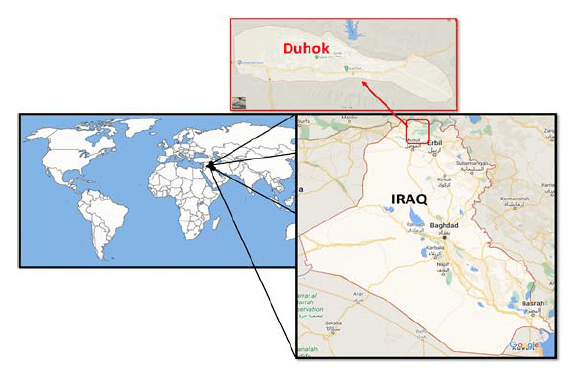
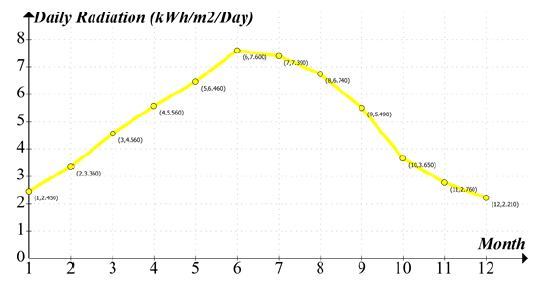
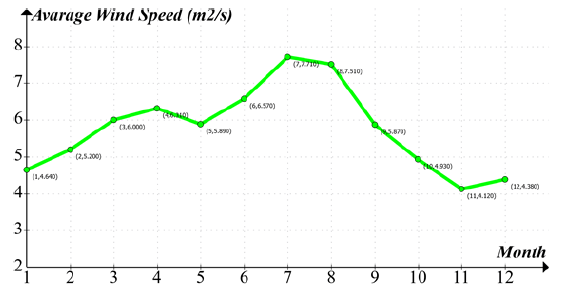
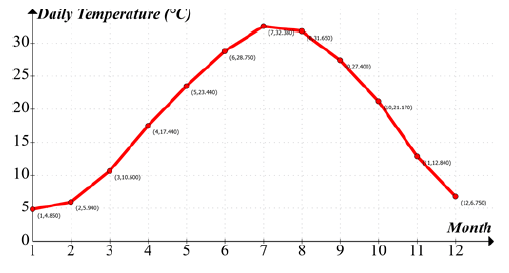
Both wind speed and solar Irradiance data have been obtained for Duhok, Iraq is determined by surface meteorology and solar energy project (SSE) of National Aeronautics and Space Administration (NASA) [6], which collects meteorology and insolation data for entire earth in order to help in the evolution of renewable and clean energy systems [7]. As showed in HOMER program software, the longitude and latitude of Duhok is 42°56’38.0″ E, 36°51’36.4″ N respectively. The mean daily irradiance per each month showed in Fig. 3 for an annual average 4.85 (kWh/m2/day), whereas Fig. 4 reports the mean daily wind speed per each month for annual average 5.67 (m/s). also the mean daily irradiance per each month showed in Fig. 5 .
Methods
Wind turbine system
Wind turbine acquires the mean power production characteristic which varies according to determinations of the producer. Wind turbine starts generating electricity at their cut-in speed then power starts to increase until turbine reaches the rated speed. It should be noted that power curve of wind turbines is one of very significant characteristics, which describes the relation of the power produced by the turbine with a rotational speed [8][9]. The total annual power (WE) in (kWh) generated by wind turbine can be represented via equation (1) below:
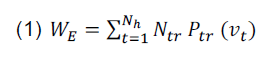
where (Nh) is the number of data hour in the year, (t) is the hour of the year, (Ptr) is the power output in (kW) as function of the average wind speed over a given hour, and (Ntr) is the numbers of turbines at the site [7].
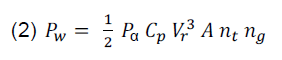
The wind power output (Pw) in (kW) is specified by the following relation in equation (2), where (pα) is the air density ≈ (1.22 kg/m3), (A) is the swept area of wind turbine rotor in (m2), (Vr) is the velocity of wind in (m/s), (Cp) is the wind turbine power coefficient, (ng) is the efficiency of wind generator and (nt) is the efficiency of wind turbine.
Photovoltaic system
The following relation in equation (3) can calculate the total annual power (SE) results from Photovoltaic system in (kWh). Where (Nh) is the number of data hour in the year, (t) is the hour of the year, (Asolar) is the fixed area of the solar field in (m2), (Gt) is the hourly insulation in (Wm-2), (nsolar,t) is the solar system efficiency for a specified hour of day through a given month [10].

The output power of the photovoltaic system (ppv) in (kW) expressed in the following relation in equation (4). Where (fPV) is the derating factor percentage for the photovoltaic array, (YPV) is the photovoltaic array rated capacity in (kW), which is the power production under STC. (GT,STC) is the incident solar insolation at STC (1 kW/m2), (GT) is the solar insolation incident on the PV array at the current time step in (kW/m2), (Tc,STC) is the temperature of the photovoltaic cell under STC which is 25°C, (Tc) is the temperature of the photovoltaic cell at the current time step in (°C), and (αP) is the power temperature coefficient in (%/°C). [11][12][13].

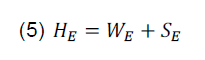
The following relation in equation (5) determines the total annual power output in (kWh) obtained from the renewable hybrid system (HE) that denotes to the sum of PV power (SE) and WT power (WE) [14]:
HOMER program simulation model
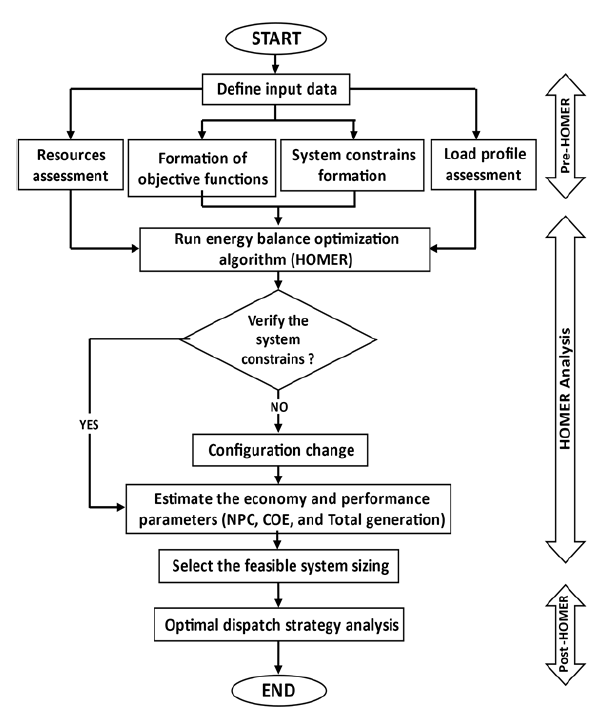
Hybrid optimization model for electric renewables (HOMER) is a computer model established by the National Renewable Energy Laboratory in the United States (NREL) to help designers to design renewable energy systems in both ON-grid and OFF-grid projects and ease the assessment of power generation technologies through an extensive variety of combinations. [15],[16]. A flowchart of HOMER simulation process can be found in Fig. 6 below which describing all the simulation stages in detail [17]:
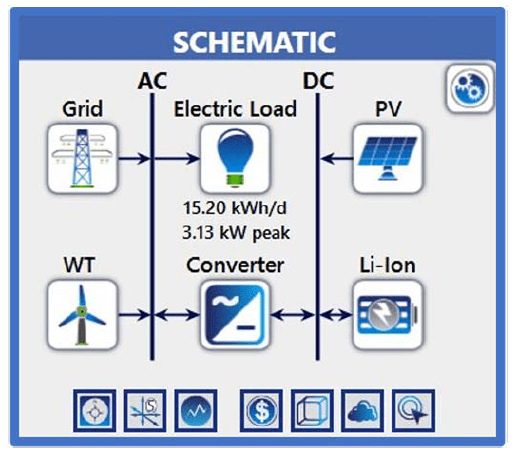
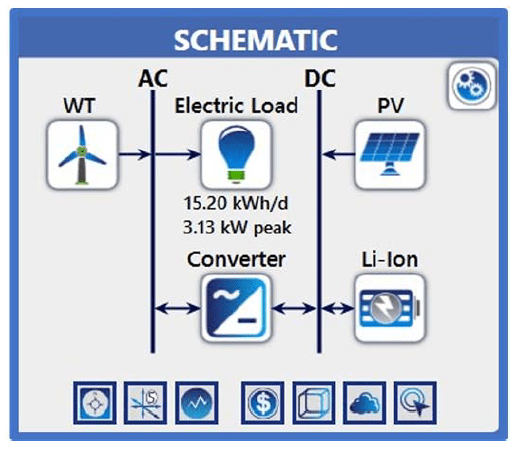
The hybrid power model designed in the HOMER program is shown in Fig. 7 & Fig. 8 respectively. This model consists of Generic 3 kW wind turbine, Generic PV flat plate, electronic converter, Generic Li-ion 1 kWh battery and residential load.
Optimization analysis
HOMER simulates all the achievable solutions for the system, then shows a list of all feasible system patterns planned gradually from lowest to highest in NPC (Net Present Cost) and excludes all the infeasible configurations. HOMER use a proprietary derivative-free algorithm to exploration for the optimum solution among all these feasible systems. The least NPC is the optimum design for the system [18],[19],[20].
Many researchers have utilized HOMER for analyzing [21],[22],[23],[24]. Analysis with HOMER needs a wide range of data on renewable resources, energy storage systems, control algorithms and economic restrictions. The evaluation criteria of the HOMER assessment are the Net Present Cost (NPC) and the Cost of Energy (COE). The COE is defined in HOMER as the mean cost/kWh of valuable power generated by the system. To compute the value of COE, Homer program will divide the yearly cost of electricity production by the beneficial generated electricity. the COE can be calculated by the relation in the following equation (6):

Where (Egrid,sales) is the overall sold energy from the grid in(kWh/year), (Eprim,DC) is the DC primary load served in (kWh/year), (Eprim,AC) is the AC primary load served in (kWh/year) and (Cann,tot) is the overall yearly cost in ($/year).
The total NPC is calculated in HOMER using the relation in the following equation (7), where (Cann,tot) is the overall yearly cost in ($/year), (CRF) is the capital recovery factor, (Rproj) the project lifetime in year, (i) the interest rate %, While the (CRF) is calculated by the equation (8) [11].

In order to calculate the optimal cost, the model has been configured to simulate the same electrical load with the off-grid and on-grid design.
Table 1. The Data Input for Proposed Model.
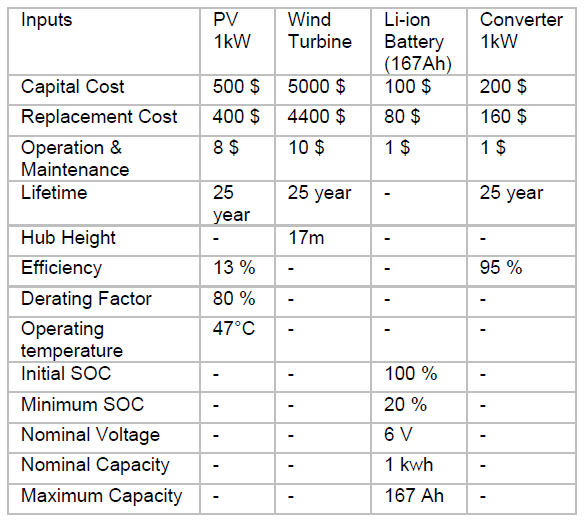
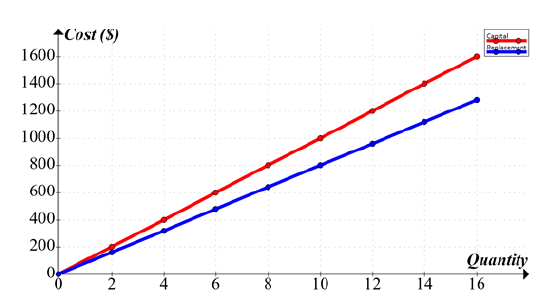
A Generic PV flat panel is utilized, these photovoltaic panels are flat plate builds by Generic, the wind unit is an A.C Generic 3 KW, also a generic lithium-ion battery has been utilized with a nominal capacity of 1 kWh, and a generic converter this is important to supports the hybrid system design in off-grid configuration. From observing the cost curve in Fig. 9, it is clear that varying the amount of batteries will affect the cost, which will ultimately affect the total NPC.
The grid model unit is a local grid with 10 kW capacity, power rate definition is 0.1$\kWh and sellback rate of 0.05$\kWh, when there is power shortage, the grid provides electricity to achieve a load request. Further, it receives electrical power when excessive energy is available.
Results and discussion
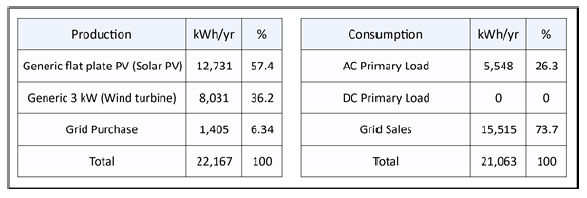
In this paper, a domestic load used in the proposed hybrid system. Supposing that the project life is 25 year. Fig. 10 and Fig. 11 presents the optimization outcomes for proposed model in both designs on-grid and off-grid respectively. Optimization progression has been executed during each achievable choice of variables of this hybrid system regardless the effect of sensitive variables. Fig. 12 shows the total annually production of proposed model 22,165 kWh/yr with 21,063 kWh/yr consumption in residential load.
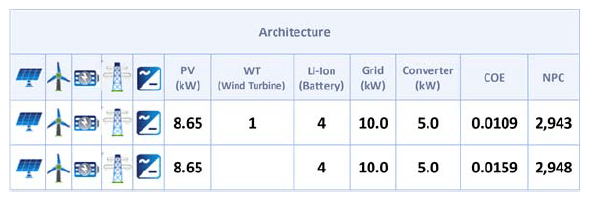
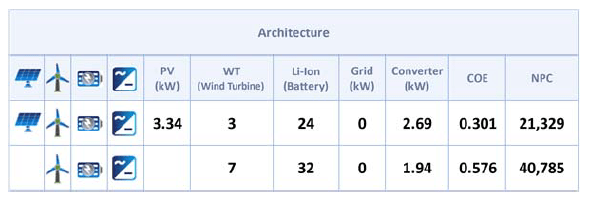
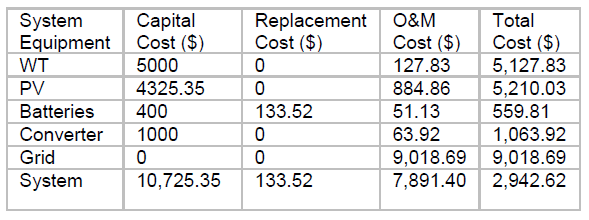
Table 2. Cost Optimization Analysis for the System
The lowest COE (Cost of Energy) obtained from HOMER results is 0.0109$, while Duhok residential electricity is 0.1$\kWh [25]. the renewable energy contribution was 93%. HOMER’s derivative-free algorithm will determine the optimal contribution ratio between renewable energy sources to supply the residential load efficiently with the desired power. As shown in Fig. 11 the energy cost of an off-grid system (COE 0.301$) is much higher than the on-grid system (COE 0.0109$). The total NPC for off-grid and on-grid system are 21,329$ and 2,943 $ respectively.
Conclusion
This academic piece of paper presents a comparative study of a two hybrid renewable energy systems, one connected to the local grid (on-grid) and the other is standalone (off-grid), without taking the influence of sensitive variables into consideration. This study occurred in Duhok , north of Iraq due to ease of solar and wind data access. The simulation results of the proposed system proved that hybrid solar-wind energy system connected to the local grid is most cost-effective than off-grid design for the similar load. Our hybrid system is better cost efficient than Duhok residential power grid, as our system cost unit is (0.0618 $\kWh) while Duhok residential electricity is 0.1$\kWh.
Acknowledgements Authors are very grateful to the (Mosul university / college of science and Nineveh University / College of Electronics Engineering) for their provided facilities, which helped to enhance the quality of this work.
REFERENCES
[1] Razak N, Othman M. Bin, Musirin I. Optimal sizing and operational strategy of hybrid renewable energy system using HOMER. 4th International Power Engineering and Optimization Conference (PEOCO). Selangor, Malaysia. 2010; 1: 495-501.
[2] Kharrich M, Mohammed O, Kamel S, Selim A, Sultan H, Akherraz M, Jurado F. Development and implementation of a novel optimization algorithm for reliable and economic grid independent hybrid power system. Applied Sciences (Switzerland). 2020; 10(18).
[3] Al-hafidh M, Ibrahem M. Zero Energy House in Iraq. International Journal of Inventive Engineering and Sciences. 2014; 2(7).
[4] Reno M, Hansen C. Global horizontal irradiance clear sky models implementation and analysis. Sandia National Laboratories. Report number: 2389. 2012.
[5] Vendoti S, Muralidhar M, Kiranmayi, R. Modelling and optimization of an off-grid hybrid renewable energy system for electrification in a rural area. Energy Reports. 2020; 6(2352).
[6] The Atmospheric Science Data Center (ASDC). (2021, May 7). NASA Earth Science Data. https://earthdata.nasa.gov/eosdis/daacs/asdc.
[7] Alsharif M. Optimization design and economic analysis of energy management strategy based on photovoltaic/energy storage for heterogeneous cellular networks using the HOMER model. Solar Energy. 2017; 147(38).
[8] Sarkar J, Khule S. A study of MPPT schemes in PMSG based wind turbine system. International Conference on Electrical, Electronics, and Optimization Techniques (ICEEOT). Chennai, India. 2016; 1: 100–105.
[9] Tigabu M, Guta D, Admasu B. Economics of Hydro-Kinetic Turbine for off-grid Application: A Case Study of Gumara River, Upper Blue Nile, Amhara, Ethiopia. International Journal of Renewable Energy Research-IJRER. 2019; 9(3).
[10] Reichling J, Kulacki F. Utility scale hybrid wind-solar thermal electrical generation: A case study for Minnesota. Energy. 2008; 33(4).
[11] Fantidis J, Bandekas D, Vordos N. Study of a Wind/PV/Battery hybrid system – Case study at Plaka in
Greece. Journal of Engineering Science and Technology Review. 2015; 8(3).
[12] Sanni S, Ibrahim M, Mahmud I. Potential of Off-grid Solar PV/Biogas Power Generation System: Case Study of Ado Ekiti Slaughterhouse. International Journal of Renewable Energy Research-IJRER. 2016; 9(3).
[13] Ladide S, EL Fathi A, Bendaoud M. Flexible design and assessment of a stand-alone hybrid renewable energy system: a case study Marrakech, Morocco. International Journal of Renewable Energy Research-IJRER. 2019; 9(4).
[14] Sofimieari I, Bin Mustafa M, Obite F. Modelling and analysis of a PV/wind/diesel hybrid standalone microgrid for rural electrification in Nigeria. Bulletin of Electrical Engineering and Informatics. 2019; 8(2302)
[15] Givler T, Lilienthal P. Using HOMER® Software NREL’s Micropower Optimization Model to Explore the Role of Gensets in Small Solar Power Systems. A national laboratory of the U.S. Department of Energy Office of Energy Efficiency & Renewable Energy. Report number: TP-710-36774. 2005.
[16] Lilienthal P, Lambert T. HOMER The Micropower Optimization Model. A national laboratory of the U.S. Department of Energy Office of Energy Efficiency & Renewable Energy. Report number: FS-710-35406. 2004.
[17] Murugaperumal K, Ajay P. Feasibility design and technoeconomic analysis of hybrid renewable energy system for rural electrification. Solar Energy. 2019; 188(38).
[18] Giraud F, Salameh Z. Steady-state performance of a grid-connected rooftop hybrid wind-photovoltaic power system with battery storage. IEEE Transactions on Energy Conversion. 2001; 16(1).
[19] Al-Hafidh M, Ibrahem M. Hybrid power system for residential load. International Conference on Electrical, Communication, Computer, Power, and Control Engineering (ICECCPCE). Mosul, Iraq. 2013; 12: 70-75.
[20] Ibrahim MH, Ibrahim MA. The Optimum PV Panels Slope Angle for Standalone System: Case Study in Duhok, Iraq. IOP Conf. Ser.: Mater. Sci. Eng. Diyala, Iraq. 2021; 1076: 12004.
[21] Babalola AD, Yakubu AJ. Development of an Alternative Hybrid Power System using Hybrid Micro Power Optimization Model (HOMER). International Journal of Advance Industrial Engineering. 2019; 7(1).
[22] Goyal S, Mishra S, Bhatia A. A comparative approach between different optimize result in hybrid energy system using HOMER. International Journal of Electrical and Computer Engineering (IJECE). 2019; 9(1).
[23] Deshmukh M, Singh A. Modeling of energy performance of stand-alone SPV system using HOMER pro. Energy Procedia. 2018; 156(1876): 90–94.
[24] Kamran M, Asghar R, Mudassar M. Designing and Optimization of Stand-alone Hybrid Renewable Energy System for Rural Areas of Punjab, Pakistan. International Journal of Renewable Energy Research-IJRER. 2018; 8(4).
[25] General Directorate of Duhok. (2021, May 29). General Directorate of Duhok Government Electricity. http://www.duhokprovince.com
Authors: Mustafa Hussein Ibrahim, Department of New and Renewable Energy, College of Science, Mosul University, Iraq, Email: MustafaHussein@uomosul.edu.iq ; Muhammed A Ibrahim, Department of Systems and Control, College of Electronics Engineering, Ninevah University, Iraq, E-mail: muhammed.ibrahim@uoninevah.edu.iq .
Source & Publisher Item Identifier: PRZEGLĄD ELEKTROTECHNICZNY, ISSN 0033-2097, R. 97 NR 9/2021. doi:10.15199/48.2021.09.28
 Power Quality Blog