Published by Andi Abdul Halik LATEKO1, Yusri Syam AKIL2, Universitas Muhammadiyah Makassar (1), Hasanuddin University (2) ORCID: 1. https://orcid.org/0000-0002-9002-131X
Abstract. This paper employs a Vector Error Correction Model (VECM) analysis to investigate the influence of economic growth (GDP) and investment (FDI) on electricity consumption (EPC) in Indonesia. By examining annual data from 1971-2019, the study explores the short-term dynamics and long-run equilibrium relationships among the variables. A negative relationship is observed between EPC and GDP in the long run, while a negative relationship exists between EPC, GDP, and FDI in the short term. The short-run analysis reveals that GDP significantly influences EPC at the three-year horizon, and FDI has a significant negative effect on EPC at the one- and two-year horizons. Another result concerning the causality test indicate a unidirectional relationship between EPC and GDP, while EPC and FDI exhibit bi-directional causality. The findings underscore the influential role of GDP and FDI in driving changes in EPC. Understanding these relationships is crucial for policymakers and energy planners in effectively managing electricity demand, infrastructure investments, and sustainable economic growth. This research contributes to the existing literature by providing insights specific to Indonesia, guiding decision-making processes regarding energy infrastructure development, energy efficiency measures, and sustainable economic development.
Streszczenie. W artykule wykorzystano analizę Vector Error Correction Model (VECM) w celu zbadania wpływu wzrostu gospodarczego (PKB) i inwestycji (BIZ) na zużycie energii elektrycznej (EPC) w Indonezji. Analizując dane roczne z lat 1971-2019, badanie bada krótkoterminową dynamikę i długookresowe relacje równowagi między zmiennymi. W długim okresie obserwuje się ujemną zależność między EPC a PKB, podczas gdy w krótkim okresie istnieje ujemna zależność między EPC, PKB i BIZ. Analiza krótkookresowa ujawnia, że PKB istotnie wpływa na EPC w horyzoncie trzyletnim, a BIZ mają znaczący negatywny wpływ na EPC w horyzoncie rocznym i dwuletnim. Kolejny wynik dotyczący testu przyczynowości wskazuje na jednokierunkową zależność między EPC a PKB, podczas gdy EPC i BIZ wykazują dwukierunkową przyczynowość. Odkrycia podkreślają wpływową rolę PKB i BIZ w napędzaniu zmian w EPC. Zrozumienie tych zależności ma kluczowe znaczenie dla decydentów i planistów energetycznych w skutecznym zarządzaniu zapotrzebowaniem na energię elektryczną, inwestycjami w infrastrukturę i zrównoważonym wzrostem gospodarczym. Badania te wnoszą wkład do istniejącej literatury, dostarczając spostrzeżeń specyficznych dla Indonezji, kierując procesami decyzyjnymi dotyczącymi rozwoju infrastruktury energetycznej, środków efektywności energetycznej i zrównoważonego rozwoju gospodarczego. (Analiza VECM dotycząca wpływu wzrostu gospodarczego i inwestycji na zużycie energii elektrycznej w Indonezji)
Keywords: Vector Error Correction Model, economic growth, investment, electricity consumption, Indonesia.
Słowa kluczowe: Vector Error Correction Model, wzrost gospodarczy, inwestycje, zużycie energii elektrycznej, Indonezja.
Introduction
The relationship between economic growth, investment (particularly foreign direct investment – FDI), and electricity consumption has received significant attention in the literature. Understanding this relationship is crucial for policymakers and energy planners in formulating effective strategies for sustainable energy development. In the context of Indonesia, a rapidly growing economy in Southeast Asia, it becomes imperative to examine the impact of economic growth and FDI on electricity consumption.
A number of studies have investigated the relationship between economic growth and electricity consumption. For instance, in [1] conducted a study for the middle east and south Africa and found evidence of a positive relationship between economic growth and energy consumption. Similarly, in [2] examined OECD countries and observed a bidirectional relationship between GDP and non-renewable electricity consumption. Next a study for Tunisia found longrun bi-directional causality between GDP and energy consumption [3]. For the impact of FDI on energy consumption, it has also been explored as can be found in the literatures [4-6]. In [4] investigated Pakistan countries and identified a positive relationship between FDI and energy consumption. In [5] focused on Bangladesh and found a bi-directional causality between FDI and energy consumption. Meanwhile in [6] analysed European countries and established a positive and strong relationship between FDI and energy consumption.
Regarding methods for analysis, the VECM approach has been widely used in many studies. For example, in [7] employed a VECM framework to examine the relationship between CO2 emissions, energy consumption, and economic growth in Pakistan and found evidence of a positive and significant relationship between them. In [8] investigated the causal effects between CO2 emissions, use of energy, GDP, and population in India using ARDL and VECM methods and revealed a positive relationship between GDP and energy use.
Moreover, country-specific studies have been conducted to explore the relationship between economic growth, FDI, and electricity consumption. For example, in [9] investigated the impact of renewable energy consumption, GDP, and FDI in Kazakhstan and Uzbekistan. Their study highlighted a two-way relationship between FDI and renewable energy consumption in these two countries. In [10] analysed China and found a positive relationship between renewable energy, FDI, and economic growth. Besides that, several studies have examined the relationship between the two variables and energy consumption using advanced econometric techniques [11-14]. The authors in [11] conducted a causality analysis between energy consumption, FDI, and GDP for several countries (Mexico, Indonesia, Nigeria, and Turkey), and established a long-run equilibrium relationship between these variables. In [12] examined Benin countries and found a significant long-run relationship of electricity consumption, FDI, and GDP. In [13] focused on 13 MENA countries and observed a positive relationship between energy consumption, ICT, FDI, and economic growth. Another study in [14] employed a decomposition scale approach to investigate the impact of financial development and FDI on renewable energy consumption for 39 countries.
The existing literatures provide valuable insights into the relationship between economic growth, FDI, and electricity consumption for some different countries. However, limited research has been conducted specifically for Indonesian context. This study proposes a VECM approach to analyse the impact of economic growth and FDI on electricity consumption in Indonesia. The analysis focus on the short-term dynamics and long-run equilibrium relationships between the observed variables. Besides can fill the research gap, resulted information can provide more insights for decision-making processes regarding energy infrastructure development, energy efficiency measures, and sustainable economic development in Indonesia. Some related studies for the context of Indonesia can be found in [11, 15-16].
The remainder of the paper organized as follows. The second section describes data and methodology. In Section 3, the obtained results and analyses for each stage are highlighted. In the final section, the conclusion and future works of the study are presented.
Methodology
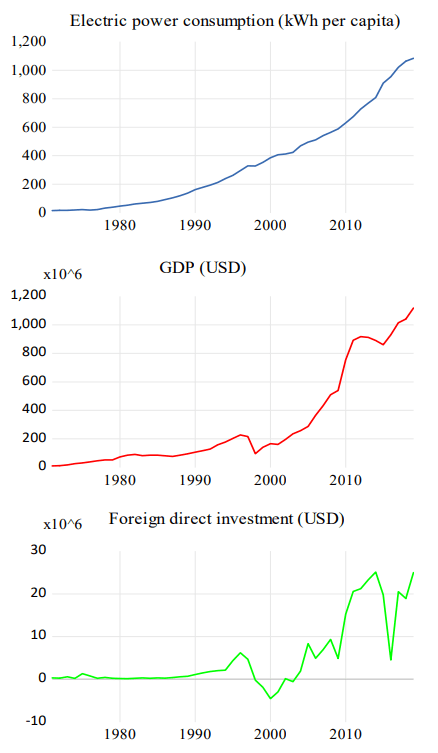
The analysis in this study focuses on examining the relationship between Electric Power Consumption (EPC), Gross Domestic Product (GDP), and Foreign Direct Investment (FDI) in Indonesia over a period of 48 years, from 1971 to 2019. The data for each variable is obtained from the World Bank [17]. Figure 1 provides a visual representation for the trend of each variable over the years. It is evident from the figure that EPC, GDP, and investment have shown a consistent increase. For instance, the per capita primary energy consumption has risen from 14.2969 kWh in 1971 to approximately 1084 kWh in 2019. Similarly, the GDP has grown from 9.333 billion USD in 1971 to 1119.099 billion USD in 2019, while investment has increased from 0.299 billion USD in 1971 to 24.993 billion USD in 2019. The increasing trends in these variables make it intriguing to investigate their interrelationships further. To do so, this study employs co-integration and causality analyses, including unit root tests to assess data stationarity, lag selection processes for determining optimal lag length, Johansen co-integration tests to identify long-run relationships, and Vector Error Correction Model (VECM) analysis to examine both short-term dynamics and long-run equilibrium relationships among the variables [18].
Results and Analysis
A. Unit Root Test
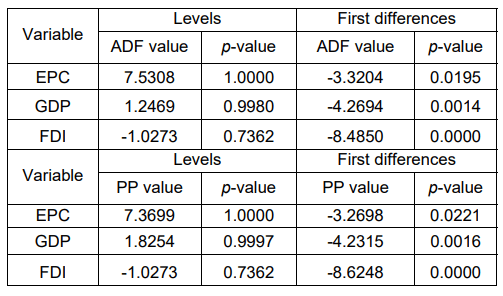
The stationary properties of the observed variables are examined using Augmented Dickey-Fuller (ADF) and Phillips-Perron (PP) tests, and the results are summarized in Table 1. The tests reveal that the variables are not stationary in their levels, as indicated by the p-values exceeding 0.05. However, when tested in first differences, all variables (EPC, GDP, and FDI) exhibit p-values below 0.05, indicating stationarity after differencing (non-stationary data are rejected at a 5% significance level). Therefore, the variables are considered stationary at first differences.
Table 1. Results for unit root test
B. Optimal Lag Length for VECM Model
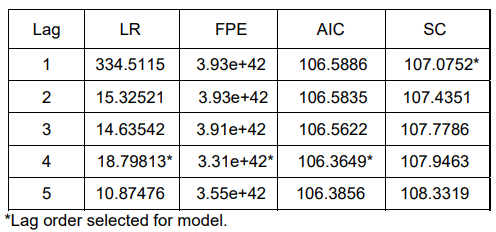
The next step involves determining the optimal lag length for the VECM model. Lag order selection is crucial for obtaining a better model fit. In this study, several common lag selection criteria are utilized, including the Sequential Modified LR Test Statistic (LR), Final Prediction Error (FPE), Akaike Information Criterion (AIC), and Schwarz Criterion (SC). The values obtained for each lag selection criterion are presented in Table 2. Based on the results, the optimal lag length for the VECM model is identified as the fourth lag, and because the data was differencing, the lag used in the next step is 3. This determination is supported by the values of the applied selection criteria, where the lowest values are consistently obtained at the fourth lag, as observed in the LR, FPE, and AIC criteria. Subsequently, the stability of VECM model is assessed. Figure 2 displays the inverted values of the characteristic roots, revealing that the majority of these
Table 2. Results for lag length selection
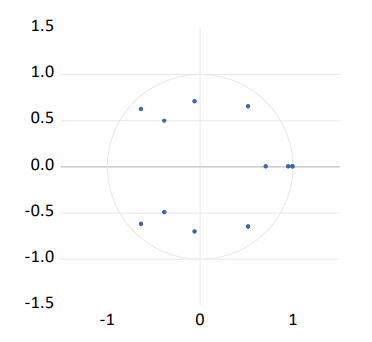
Inverse roots of AR characteristic polynomial values fall within the unit circle. This observation suggests that the constructed VECM model is stable and suitable for the subsequent step of the co-integration test analysis.
C. Co-integration Analysis
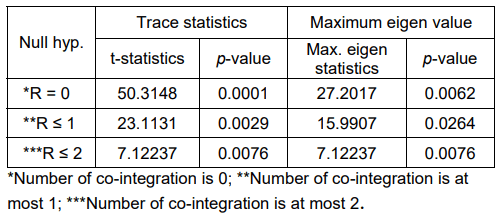
In this step, the focus is on observing the long-term relationship among the EPC, GDP, and FDI variables. To examine the relationship, a co-integration test using the optimal lag length from the previous step is conducted, employing the Johansen co-integration test. The results of the co-integration test are presented in Table 3. The values of the Trace statistics and Maximum Eigen statistics indicate whether the null hypothesis can be rejected at a 5% significance level or if a co-integration relationship (R = 0) does not exist. Additionally, the null hypotheses concerning the existence of at most 1 and 2 co-integration relations (R ≤ 1 and R ≤ 2) are also rejected at the same significance level. These findings suggest the presence of more than 3 co-integration equations, indicating that the analysed variables exhibit a shared tendency over a long period. Co-integration signifies a systematic co-movement among the variables considered in the model [19]. Consequently, it can be concluded that EPC, GDP, and FDI in Indonesia have a long-run relationship.
Table 3. Results for co-integration test
D. VECM Granger Causality Analysis
In the final stage of this study, the VECM Granger causality test is applied to the model using the differenced data obtained in the previous step. This test is utilized to examine the short-run and long-run causal relationships between the variables included in the model. Table 4 presented VECM results. The presence of significant coefficients with a negative sign suggests a long-term relationship between the variables, while coefficients with a non-significant negative sign indicate a short-term dynamic relationship [20]. The error correction mechanism reveals a short-term relationship among all the variables. In the long term, there exists a negative relationship between EPC and GDP. However, in the short term, there are indications of a negative relationship between EPC, GDP, and FDI.
Table 4. Long-term and short-term relationships of the Vector Error Correction
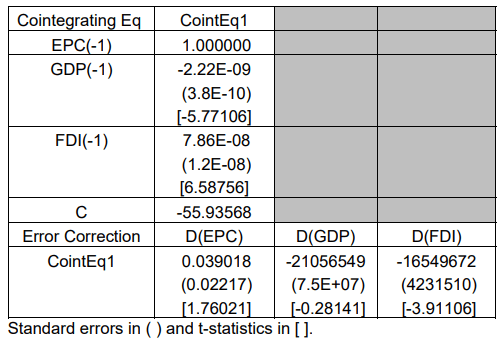
Equation (1) shows the co-integration formula of the model:
(1) D(EPC) = 0.0390178082912(EPC(-1) – 2.21969292975E-09GDP(-1) + 7.86306945367E08FDI(-1) – 55.9356827521 ) – 0.0149640076872D(EPC(-1)) + 0.155962988885D(EPC(-2)) + 0.392610534548D(EPC(-3)) + 1.7352267132e10D(GDP(-1)) + 2.55642190373e-11D(GDP(-2)) – 1.02109012853e-10D(GDP(-3)) – 2.19749170889e09D(FDI(-1)) – 2.55628964545e-10D(FDI(-2)) + 1.12283147008e-09D(FDI(-3)) + 10.7835707096
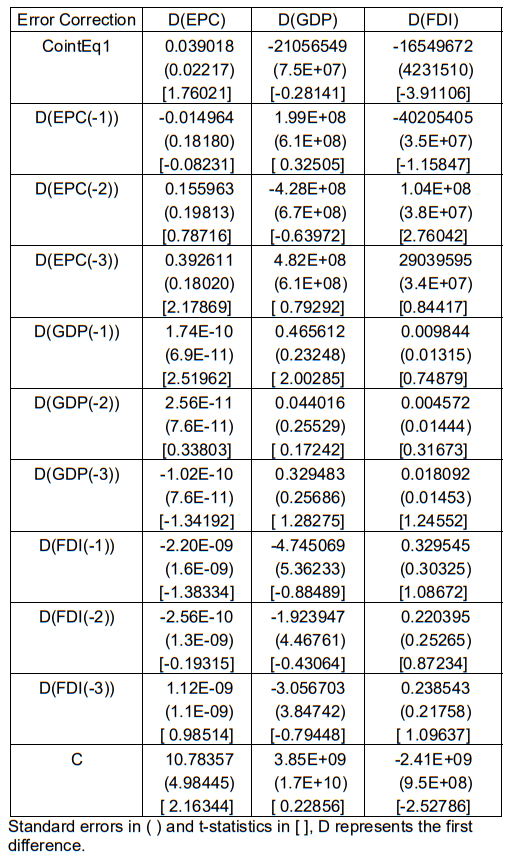
Table 5. Summary of VECM results
In the long-term, there exists a negative relationship between EPC and GDP, while a positive relationship is observed between EPC and FDI. This implies that an increase in EPC in Indonesia encourages the FDI to rise, while concurrently leading to a decrease in GDP.
The analysis of the causality relationship among the variables using the VECM model reveals important findings. Specifically, the results indicate that GDP has a negative and significant impact on EPC at the three-year horizon, while FDI demonstrates a negative and significant effect on EPC at the one- and two-year horizons. These results, which show the causality relationship among the variables, are presented in Table 5.
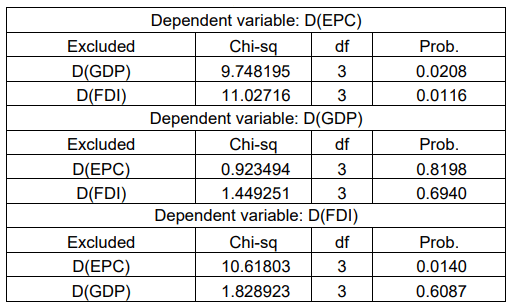
In order to assess the causal relationship between the variables, the Granger causality test is employed. The results of this test, which shows the causal relationship between the variables, are presented in Table 6. At a significance level of 5%, it is observed that there exists a unidirectional causal relationship between the variables EPC and GDP. Specifically, the GDP variable significantly influences EPC as indicated by a F-statistic probability below 0.05, namely 0.0208 (leading to the rejection of the null hypothesis). Additionally, a bidirectional causality is found between EPC and FDI. However, there is no causal relationship observed between GDP and FDI. These findings confirm that GDP and FDI play crucial roles in driving the increase in EPC. Therefore, it is essential for stakeholders to facilitate greater access and reduce constraints in utilizing electric power consumption to achieve high levels of economic growth and investment.
Table 6. VEC Granger Causality
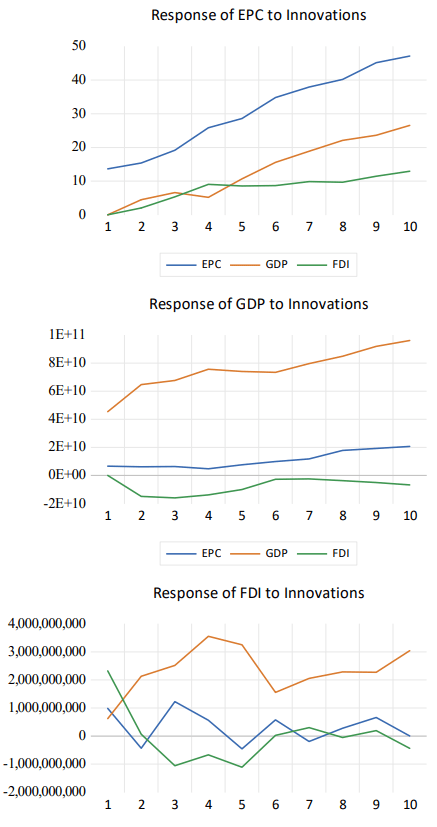
In order to assess the impact of disturbances on the variables under consideration, the impulse response function is employed. This function provides insights into the timing and magnitude of the variables’ responses to disturbances originating from other variables [21]. Figure 3 illustrates the general impulse responses of EPC, GDP, and FDI to innovations (other variables), respectively. The results demonstrate a significant and gradual increase in the response of GDP and FDI to EPC over a 10-year period.
Conclusions
This paper focuses on conducting co-integration and VECM causality analysis within the Indonesian context, considering three key variables: electric power consumption (EPC), GDP, and FDI. The analysis reveals that all the variables exhibit a long-run relationship, which is confirmed through co-integration analysis utilizing the Johansen cointegration test. In the long run, a negative relationship is observed between EPC and GDP. However, in the short term, there are indications of a negative relationship between EPC, GDP, and FDI. Specifically, the results reveal that in the short-run causality analysis, GDP has a significant negative impact on EPC at the three-year horizon. Additionally, FDI shows a significant negative effect on EPC at the one- and two-year horizons. The causality test results indicate a unidirectional causal relationship between EPC and GDP, with GDP significantly influencing EPC. Furthermore, a bi-directional causality is observed between EPC and FDI, while no causal relationship is found between GDP and FDI. It is evident that the volume of GDP and FDI serves as driving factors for the increase in EPC. Consequently, stakeholders, including the government, play a crucial role in reducing constraints and facilitating access to electric power consumption in relevant sectors, potentially through policy interventions. These efforts are essential for stimulating rapid economic growth and attracting foreign investment. It should be recognized that the level of economic growth directly impacts foreign direct investment, thereby increasing the likelihood of foreign investors to invest in various sectors in Indonesia. The findings of this study hold significant value for public policymakers involved in designing energy policies, particularly for the electricity sector, to effectively support economic growth and foreign investment in Indonesia. For future research, we will consider more variables for application, such as the long-term prediction of electricity consumption.
REFERENCES
[1] Muhammad, Bashir. “Energy Consumption, CO2 Emissions and Economic Growth in Developed, Emerging and Middle East and North Africa Countries.” Energy, 179 (2019), 232–245.
[2] Aydin, Mucahit. “Renewable and Non-Renewable Electricity Consumption–Economic Growth Nexus: Evidence from OECD Countries.” Renewable Energy, 136 (2019), 599–606.
[3] Belloumi, Mounir. “Energy Consumption and GDP in Tunisia: Cointegration and Causality Analysis.” Energy Policy, 37 (2009), No. 7, 2745–2753.
[4] Latief, Rashid, and Lin Lefen. “Foreign Direct Investment in the Power and Energy Sector, Energy Consumption, and Economic Growth: Empirical Evidence from Pakistan.” Sustainability, 11(2019), No.192, 1-21.
[5] Hasan, Md Arif, Kh Md Nahiduzzaman, Adel S. Aldosary, Kasun Hewage, and Rehan Sadiq. “Nexus of Economic Growth, Energy Consumption, FDI and Emissions: A Tale of Bangladesh.” Environment, Development and Sustainability, 24 (2021), No. 5, 6327–6348.
[6] Zeng, Shaolong, Yiqun Liu, Junjie Ding, and Danlu Xu. “An Empirical Analysis of Energy Consumption, FDI and High Quality Development Based on Time Series Data of Zhejiang Province.” International Journal of Environmental Research and Public Health, 17 (2020), No. 3321, 1-17.
[7] Aftab, Samina, Aftab Ahmed, Abbas Ali Chandio, Bright Asiamah Korankye, Aamir Ali, and Wang Fang. “Modeling the Nexus between Carbon Emissions, Energy Consumption, and Economic Progress in Pakistan: Evidence from Cointegration and Causality Analysis.” Energy Reports, 7 (2021), 4642–4658.
[8] Pachiyappan, Duraisamy, Yasmeen Ansari, Md Shabbir Alam, Prabha Thoudam, Kuppusamy Alagirisamy, and Palanisamy Manigandan. “Short and Long-Run Causal Effects of CO2 Emissions, Energy Use, GDP and Population Growth: Evidence from India Using the ARDL and VECM Approaches.” Energies, 14 (2021), No. 8333, 1-17.
[9] Grabara, Janusz, Arsen Tleppayev, Malika Dabylova, Leonardus W. Mihardjo, and Zdzisława Dacko-Pikiewicz. “Empirical Research on the Relationship amongst Renewable Energy Consumption, Economic Growth and Foreign Direct Investment in Kazakhstan and Uzbekistan.” Energies, 14 (2021), No. 332, 1-18.
[10] Fan, Weiyang, and Yu Hao. “An Empirical Research on the Relationship amongst Renewable Energy Consumption, Economic Growth and Foreign Direct Investment in China.” Renewable Energy, 146 (2020), 598–609.
[11] Lin, Boqiang, and I. Nelson Benjamin. “Causal Relationships between Energy Consumption, Foreign Direct Investment and Economic Growth for Mint: Evidence from Panel Dynamic Ordinary Least Square Models.” Journal of Cleaner Production, 197 (2018), 708–720.
[12] Atchike, Desire Wade, Zhen-Yu Zhao, and Geriletu Bao. “The Relationship between Electricity Consumption, Foreign Direct Investment and Economic Growth: Case of Benin.” International Journal of Energy Economics and Policy, 10 (2020), No. 4, 507–515.
[13] Saidi, Kais, Mounir Ben Mbarek, and Mounira Amamri. “Causal Dynamics between Energy Consumption, ICT, FDI, and Economic Growth: Case Study of 13 MENA Countries.” Journal of the Knowledge Economy, 9 (2015), No. 1, 228–238.
[14] Shahbaz, Muhammad, Avik Sinha, Chandrashekar Raghutla, and Xuan Vinh Vo. “Decomposing Scale and Technique Effects of Financial Development and Foreign Direct= Investment on Renewable Energy Consumption.” Energy, 238 (2022), No. 121758, 1-13.
[15] Sijabat, Rosdiana. “The Association of Economic Growth, Foreign Aid, Foreign Direct Investment and Gross Capital Formation in Indonesia: Evidence from the Toda–Yamamoto Approach.” Economies, 10 (2022), No. 93, 1-22.
[16] Shahbaz, Muhammad, Qazi Muhammad Hye, Aviral Kumar Tiwari, and Nuno Carlos Leitão. “Economic Growth, Energy Consumption, Financial Development, International Trade and CO2 Emissions in Indonesia.” Renewable and Sustainable Energy Reviews, 25 (2013), 109–121.
[17] Indonesia | Data – World Bank Data. Accessed May 12, 2023. https://data.worldbank.org/country/indonesia?view=chart.
[18] Tan, Lan, Yifan Xu, and Alemayehu Gashaw. “Influence of Exchange Rate on Foreign Direct Investment Inflows: An Empirical Analysis Based on Co-Integration and Granger Causality Test.” Mathematical Problems in Engineering 2021, (2021), 1–12.
[19] Ivascu, Larisa, Muddassar Sarfraz, Muhammad Mohsin, Sobia Naseem, and Ilknur Ozturk. “The Causes of Occupational Accidents and Injuries in Romanian Firms: An Application of the Johansen Cointegration and Granger Causality Test.” International Journal of Environmental Research and Public Health, 18 (2021), No. 7634, 1-17.
[20] Apostu, Simona Andreea, Mirela Panait, Daniel BalsalobreLorente, Diogo Ferraz, and Irina Gabriela Rădulescu. “Energy Transition in Non-Euro Countries from Central and Eastern Europe: Evidence from Panel Vector Error Correction Model.” Energies, 15 (2022), No. 9118, 1-21.
[21] Si, Ruishi, Noshaba Aziz, and Ali Raza. “Short and Long-Run Causal Effects of Agriculture, Forestry, and Other Land Use on Greenhouse Gas Emissions: Evidence from China Using VECM Approach.” Environmental Science and Pollution Research, 28 (2021), No. 45, 64419–64430.
Authors: Andi Abdul Halik Lateko, Ph.D., Department of Electrical Engineering, Universitas Muhammadiyah Makassar, Indonesia, E-mail: halik@unismuh.ac.id (corresponding author); Yusri Syam Akil, Ph.D., Department of Electrical Engineering, Hasanuddin University, Indonesia, E-mail: yusakil@unhas.ac.id.
Source & Publisher Item Identifier: PRZEGLĄD ELEKTROTECHNICZNY, ISSN 0033-2097, R. 100 NR 2/2024. doi:10.15199/48.2024.02.28
 Power Quality Blog