Published by Ikhlas KITTA1, Salama MANJANG1, Ida RACHMANIAR1, Wahyu SANTOSO1, Makmur SAINI2, Hasanuddin University (1), State Polytechnic of Ujung Pandang (2), Indonesia
Abstract. Renewable energy power plants such as Mini Hydro Power Plants are currently being developed in Indonesia to fulfill electrical energy. Generally, the location of the Mini Hydro Power Plant (MHPP) far from the load center, and it requires a long electricity network so it is necessary to know the optimal position when connecting to a 20 kV distribution system. The technical and economic approach is carried out on the interconnection of the MHPP to the 20 kV distribution system. One thing that needs to be added to the selection of connection point locations is the environmental criteria that are intended to reduce GHG emissions by reducing the use of oil-fired plants such as Diesel Power Plants. Because sometimes the decision to choose the location of the generator connection point is technically and economically more optimal than other locations, but from an environmental perspective it is less than optimal compared to other locations. As explained in the decision making of the Rongkong MHPP which is directly connected to Masamba which can reduce the power capacity of the Cakaruddu Diesel Power Plant (Diesel-PP) maximally, even though the connection investment costs are more expensive than the closest location to the Diesel-PP.
Streszczenie. W Indonezji trwają prace nad budową elektrowni wykorzystujących energię odnawialną, takich jak mini elektrownie wodne, które mają dostarczać energię elektryczną. Generalnie lokalizacja Mini-Elektrowni Wodnej (MHPP) z dala od centrum obciążenia wymaga długiej sieci elektroenergetycznej, dlatego konieczna jest znajomość optymalnego położenia przy podłączaniu do systemu dystrybucyjnego 20 kV. Do wyboru lokalizacji przyłącza należy dodać kryteria środowiskowe, które mają na celu redukcję emisji gazów cieplarnianych poprzez ograniczenie wykorzystania elektrowni opalanych olejem, takich jak elektrownie Diesla. Czasami decyzja o wyborze lokalizacji punktu przyłączenia generatora jest technicznie i ekonomicznie bardziej optymalna niż inne lokalizacje, ale z punktu widzenia ochrony środowiska jest mniej niż optymalna w porównaniu z innymi lokalizacjami. Jak wyjaśniono w procesie decyzyjnym Rongkong MHPP, który jest bezpośrednio połączony z Masamba, co może maksymalnie zmniejszyć moc elektrowni Diesla Cakaruddu (Diesel-PP), mimo że koszty inwestycji w przyłączenie są wyższe niż lokalizacja najbliższa Diesel-PP. (Mini elektrownia wodna dołączona do sieci 20 kV jako alternatywa dla generatora Diesla)
Keywords: Renewable energy, Mini Hydro Power Plant, 20 kV distribution system
Słowa kluczowe: Energia odnawialna, Mini Elektrownia Wodna, dystrybucja 20 kV
1. Introduction
Energy plays an important role in humans, especially in modern life like today, humans cannot live without energy [1]. Human activity is highly dependent on the availability of energy for various purposes, namely transportation, electricity, household needs, and the needs of Mini and macro industries. Energy is very broad when viewed from its source, the most common of which is fossil energy in the form of oil, natural gas, and coal but recently there are new and renewable energies.
In 2015, Indonesia’s need for 166 MTOE fulfilled its needs by using petroleum (oil) as the main source. Fig. 1 concerning Indonesia’s National Energy Mix in 2015 shows that new and renewable energy (NRE) has been used as much as 5% of the total national energy mix [2]. The installed capacity of the Renewable Energy power plant in 2015 was recorded at 8215 MW of the total potential of 443208 MW, in other words, only 1.9% of the total potential of Renewable Energy in Indonesia has been successfully utilized.

With reference of National Energy Policy (NEP) as stipulated in the Government Regulation of the Republic of Indonesia No.79 of 2014, the realization of the use of Renewable Energy in the national energy mix is targeted to reach 23% in 2025 and 31.2% in 2050.
Hydropower is a very large potential source of renewable energy, but the utilization is still far below its potential. The potential for hydropower in the South Sulawesi area (one of the provinces in Indonesia located on the island of Sulawesi) is estimated at around 3709 MW [3].
Renewable energy power plants in the form of Mini Hydro Power Plant (MHPP) are generally located in suburban areas far from the load center [4]. To make use of it, the Mini hydro power plant is interconnected in the electricity system, especially in the 20 kV electric power distribution system. Long distances will result in reduced power that reaches the load due to power losses.
When connecting the MHPP to the 20 kV power distribution system, it will have a positive and negative impact on technical and economic parameters [5]. There are several kinds of sources of electrical energy supply in the distribution network, namely: (a) a network whose source is directly supplied from Substation, (b) there is a system supplied by a substation and a conventional energy power plant in the form of a Diesel Power Plant (Diesel-PP), (c) there are those from substations and renewable energy power plants such as Mini Hydro Power Plants, (d) and those supplied from substations and a mixture of Renewable Energy (MHPP) and conventional power plants (Diesel-PP).
One of the objectives of developing a renewable energy power plant in the form of a MHPP is to reduce energy consumption from petroleum, where this petroleum energy will produce carbon dioxide (CO2) which has an impact on the increase in emissions of the Greenhouse Gasses (GHG) [6]. Therefore, in this paper, it is explained how the interconnection process of a MHPP in a 20 kV distribution system which is supplied from the Grid, MHPP and Diesel- PP. This interconnection study is approached technically, economically, and environmentally. An environmental approach is carried out by reducing as much as possible the power capacity of the Diesel Power Plant when the MHPP is connected to the system.
2. Methodology Object analysis
The object of analysis in this paper is the Rongkong MHPP in the North Luwu area. North Luwu Regency has a population of 290365 people consisting of 146312 men and 144053 women. With an annual population growth rate of 0.98%. The population growth continues to increase every year should be the government’s attention in development planning in the area. The total population is divided into 68904 households, where the average number of household members is 4 people.
In the area of North Luwu Regency, there are 8 (eight) large rivers that cross the area, and the longest river is the Rongkong River with a length of about 108 km. Based on the hydrological flow system in North Luwu Regency, it shows that the movement of water (surface water and groundwater) both moves towards the sea. The condition of clear surface water is an opportunity for the development of a Hydro Power Plant.
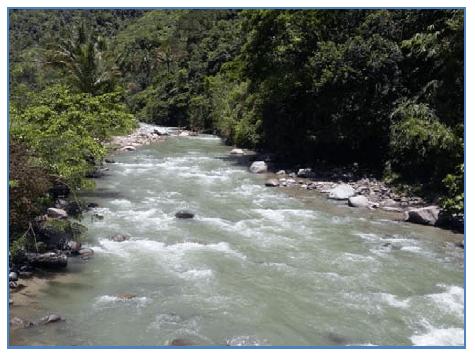
In the area of North Luwu Regency, there are 8 (eight) large rivers that cross the area, and the longest river is the Rongkong River (Fig. 2) with a length of about 108 km. Based on the hydrological flow system in North Luwu Regency, it shows that the movement of water (surface water and groundwater) both moves towards the sea. The condition of clear / clear surface water is an opportunity for the development of a Hydro Power Plant.
The supply of electrical energy to North Luwu Regency is an important infrastructure that should have adequate reliability, quality, security and economic characteristics in line with the function and role of the electricity sector in the Regency. Capacity development and expansion of the 20 kV medium voltage distribution network that will consistently meet the electricity needs of industry and other customers in North Luwu Regency, require correct handling in terms of selecting supply so that load centers in the area are served, so that a service system is obtained that is optimal. The electricity load in North Luwu Regency is 12786 kW, mostly in the Sabbang and Masamba areas.
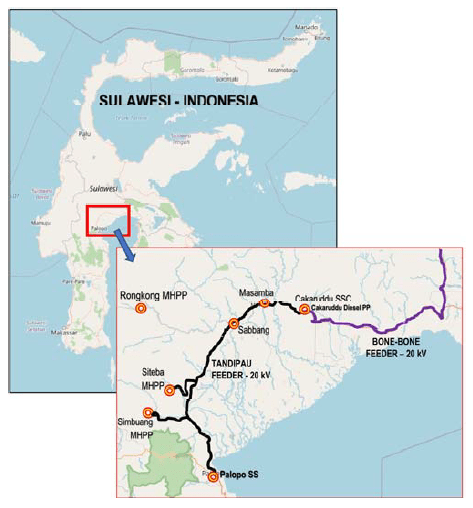
Before the evaluation is carried out, it is necessary to provide data that will be used in the analysis process. Primary data is obtained from field measurements of the length of the network, the type and dimensions of the cable/conductor, as well as the distance between nodes/points (between distribution substations and between branches) in the distribution network of the Palopo Substation (SS), Cakaruddu Connecting Substation (SSC) to the location of the Rongkong MHPP powerhouse plan as shown in Fig. 3.
Connection Scenarios
Near the location of the Rongkong MHPP, there is a 20 kV medium voltage network, namely the Tandipau feeder (outgoing Palopo SS), if you draw a distance of 40 km from the planned location of the Rongkong MHPP 7600 kW as shown in Fig. 3 and Fig. 4. Cakaruddu SSC with a 70 km long Rongkong MHPP. The distance of the Palopo SS to the Rongkong MHPP is 99 km.

The plan for the distribution of electrical energy from the Rongkong MHPP to the load center which are Sabbang Distribution Substation and Masamba Distribution Substation which will use the 20 kV Medium Voltage Network connected to the Tandipau feeder. Besides being able to pass through the Tandipau feeder, the electrical energy from Rongkong MHPP can also be directly connected to Cakaruddu SSC using an express feeder. And also go directly to the Palopo SS. So that this distribution plan will be analyzed in 4 models/scenarios (Fig. 5), which are:
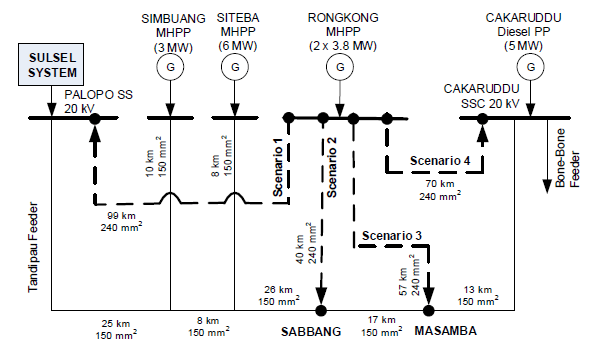
1. Scenario 1: Rongkong MHPP is connected to the South Sulawesi system via an express feeder using an A3CS 240 mm2 conductor with a line length of 99 km by connecting to the Palopo SS in Palopo City.
2. Scenario 2: Rongkong MHPP is connected to the Palopo distribution system via a 40 km sub feeder using an A3CS conductor with type 240 mm2 by connecting to a 20 kV Medium Voltage Network power pole in Sabbang to the Tandipau feeder at the LHAJ distribution substation pole.
4. Scenario 3: Rongkong MHPP is connected to a Tandipau Feeder with a 20 kV voltage at one of the distribution substations in Masamba City. Electrical energy will be channeled using an A3CS 240 mm2 conductor along 57 km.
5. Scenario 4: In this scenario, the Rongkong MHPP is connected to the Cakaruddu SSC via a sub feeder using an A3CS 240 mm2 conductor along 70 km.
Calculation
To determine the value of the operational parameters of the 20 kV distribution system, a power flow analysis is performed. This power flow study will determine the voltage, voltage phase angle, current, active power, and reactive power found at various points in an electrical network under normal operating conditions, both currently running and those expected to occur in the future. The Newton-Raphson method is used in this study report.
This method has good results for large systems. The small number of iterations required to solve a problem based on the size of the system. The Newton-Raphson method [7][8] is formulated in the following equation:
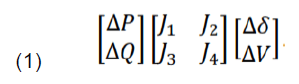
Notes : ΔP and ΔQ is the real power and the reactive power. Δδ and ΔV is the phase angle and the bus voltage value. For J1, J2, J3, and J4 is a Jacobian matrix.
The operational limitation of the power system consists of the limitation of the power generated by the power plant, the power produced by the generator must be the same as the load power itself plus the data transmitted to other buses with losses in the line. Where is the active power equation on the bus i is PGij – PDij – PLij = 0. The defined stress inequality Vimin ≤ Vi ≤ Vimax. And the inequality of generating capacity is PGimin ≤ PGi ≤ PGimax.
The things that will be considered in the analysis for these four scenarios are as follows:
• Effect of Rongkong MHPP on network losses.
• Change in voltage at the distribution substation by looking at the voltage drop.
• Additional network investment costs.
• Reduction of the power capacity of the Diesel-PP to maximize the function of the MHPP as renewable energy in the electricity system.
3. Result and Discussion
Results of Power Supply and Losses for Diesel-PP 5000 kW
Table 1 and Table 2 below are the results of simulation calculations when the Rongkong MHPP 7600 kW is connected to the Tandipau feeder, where the Simbuang MHPP 3000 kW, the Siteba MHPP 6000 kW, and the Cakaruddu Diesel-PP 5000 kW (maximum operates).
Table 1 shows the calculation results of the generation of each source in the existing conditions, scenario 1, scenario 2, scenario 3, and scenario 4. Table 1 is showing the impact of connecting the Rongkong MHPP to the 20 kV distribution system.
Table 1. Palopo System Profile when supplying 5000 kW from Cakaruddu Diesel-PP

The power supply from the Palopo SS is urgently needed before the Rongkong MHPP is connected to the Palopo system so that the table shows a positive value or direction towards the Tandipau Feeder. Likewise, if the Rongkong MHPP is connected to the electrical system, the direction of the power flow is negative because there is excess power in the Tandipau feeder.
Table 1 also shows the conditions for losses before and after the Rongkong MHPP is connected to the electrical system. And the 3rd row of table 1 also shows the investment costs for the 20 kV Rongkong MHPP network. For the next, the results of the calculation of the stress value for each scenario are shown in Table 2.
Table 2. Voltages in all scenarios

The results of power supply and losses for reduced Diesel-PP
Based on the voltage limitation in the power system, the power capacity of the Cakaruddu Diesel-PP can be reduced due to the operating effectiveness of the Rongkong MHPP which is renewable energy, where the purpose of being operated by the Rongkong MHPP is to reduce the operation of the Cakaruddu Diesel-PP.
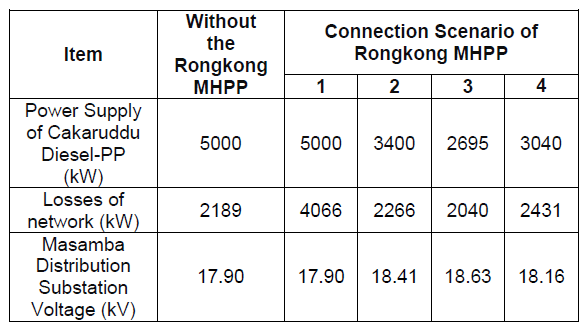
By maintaining the voltage at Cakaruddu SSC of 19.02 kV according to the existing voltage, it can be seen in Table 3 that the power of the Cakaruddu Diesel-PP can be reduced to 3400 kW in scenario 2, 2685 kW in scenario 3, and 3040 kW in scenario 4.
Table 3. Palopo System Profile when Cakaruddu Diesel-PP supply is reduced
Discussion
The electric power system in the Tandipau Feeder is based at the Palopo SS, there is the Simbuang MHPP with a capacity of 3000 kW, the Siteba MHPP with a capacity of 6000 kW, the Cakaruddu Diesel-PP 5000 kW which serves a load of 12786 kW.
The results of the simulation on the Palopo / Masamba system and the South Sulawesi system, it was found that when the existing conditions, the voltage of Cakaruddu SSC in the existing conditions was 19.02 kV and at the bus the closest point to the LHAJ distribution substation (Sabbang) which is the connection point for Rongkong MHPP on the Tandipau feeder equal to 17.12 kV.
Scenario 1 shows that there is no voltage change in the Palopo / Masamba system due to the interconnection of the Rongkong MHPP at the Palopo SS power transformer. Meanwhile, power losses increased due to power losses along the express feeder of the 99 km-long Rongkong MHPP. Based on International Energy Agency (IEA) statistical data, the average energy loss during distribution and transmission in a centralized electricity generation system is the range between 8 and 15% [9]. This is evidenced by the change in losses from 2189 kW to 4066 kW. The Rongkong MHPP can only sell its electric power of 5723 kW. The investment cost that must be provided due to the addition of the 20 kV network along the 99 km is 94.38 billion rupiah.
Scenario 2 is a scenario for the connection of the Rongkong MHPP with a capacity of 7600 kW to the Palopo / Masamba system via the Tandipau feeder. The impact of connecting the Rongkong MHPP to the Tandipau feeder is that the voltage at Cakaruddu SSC changes to 20 kV, this is due to the reduced voltage drop on the Tandipau feeder due to the reduced electric current flowing from the Simbuang MHPP and Siteba MHPP towards Sabbang and Masamba. This is also supported by changes in power losses in the system from 2189 kW to 2013 kW. This power loss includes power losses in an additional 40 km line. The investment cost in scenario 2 is IDR 38.92 billion.
Table 1 and Table 2 show the conditions when the Rongkong MHPP is connected to the Masamba system to be precise at the LMCT distribution substation (Masamba City) as far as 57 km through a medium voltage network of 20 kV with a 240 mm2 cross-section. When Rongkong MHPP is connected, the voltage at the LMCT distribution substation changes from 17.90 kV to 19.46 kV. This is also supported by changes in power losses in the Masamba system from 2189 kW to 2201 kW. And it can be concluded that if scenario 3 is realized, then Rongkong MHPP with a capacity of 7600 kW will improve the voltage of the Masamba system but increase the losses. The investment cost required to build a network of 57 km is 54.90 billion Rupiahs.
Scenario 4 shows an improvement in voltage due to the integration of the Rongkong MHPP in the Palopo / Masamba system through the Cakaruddu SSC, where the working voltage of the Cakaruddu SSC is 20 kV, which was previously 19.02 kV. For the number of power losses, there is an increase in power losses when the Rongkong MHPP is connected to the Cakaruddu SSC, from 2189 kW to 2665 kW. The investment cost in this scenario is IDR 67.12 billion.
Of the 4 (four) scenarios, technically and economically (voltage drop, power losses, and investment) the scenario chosen for the connection of the Rongkong MHPP is scenario 2. Of the 4 scenarios, interconnection has been described by maximizing the use of Cakaruddu Diesel Power Plant by 5000 kW.
This section explains the selection of the connection location based on the use of the smallest capacity of the Diesel Power Plant by limiting the busbar working voltage of the Cakaruddu SSC by 19.02 kV (based on the existing voltage conditions of the Cakaruddu SSC). The results of the voltage limitation are shown in Table 3. Scenario 3 gets the smallest Cakaruddu Diesel-PP, which is 2695 kW which means a decrease of 2305 kW.
Scenario 1 cannot reduce the power at the Cakaruddu Diesel Power Plant because it is the same as the existing condition. Furthermore, in scenario 2 the capacity of the Cakaruddu Diesel-PP becomes 3400 kW, and the voltage on the Masamba Distribution Substation becomes 18.41 kV. Likewise, the loss value is 2266 kW.
The selection of scenarios for the connection of the Rongkong MHPP is focused on scenario 2 and scenario 3, the interconnection of the Rongkong MHPP is carried out so it can be seen in terms of investment and reduction of thermal generators. Then back to the renewable energy development plan, the choice of integration falls into scenario 3.
4. Conclusion
With an explanation of the results and discussion, the conclusions are:
1. Rongkong MHPP is a power plant using renewable energy in the form water emergy converted into electrical energy which is currently the goal of Indonesia’s national energy development.
2. In addition to assessing the limits of losses, voltages, and investment costs of the electric power system in the process of selecting a location for connecting a Mini Hydro Power Plant (MHPP) or renewable energy generator, a reduction in the power capacity of a Diesel Power Plant or conventional (thermal) energy generator must also be used for this assessment.
3. Technically and economically, scenario 2 is preferable to be used as a scenario for connecting the Rongkong MHPP, but in reducing the power of Diesel Power Plant (Diesel-PP) which is conventional energy using diesel fuel, scenario 3 is superior than scenario 2.
Acknowledgment – The authors gratefully acknowledge Indonesia Government of ministry of national education for financial support of this research.
REFERENCES
[1] Dolf G, Francisco B, Deger S, Morgan D.B, Nicholas W, and Ricardo G, The role of renewable energy in the global energy transformation, Energy Strategy Reviews, Vol. 24, April 2019, pp. 38-50
[2] Indonesia Energy Outlook, 2016
[3] ESDM Ministry (Indonesia), 2019 PLN electric power supply business plan for 2019 – 2028, Jakarta
[4] Jahidul IR, Riasat SI, Rezaul H, Samiul H, and Fokhrul I, A Comprehensive Study of Micro-Hydropower Plant and Its Potential in Bangladesh, International Scholarly Research Notices, Volume 2012, No. 635396
[5] Ikhlas K, Salama M, and Wahyu S, The technical and economic approach to the connection of the MHPP in the distribution network, Przegląd Elektrotechniczny, No. 2 (2020), pp. 209-213
[6] Lamiaa A. and Tarek ES, Reducing Carbon Dioxide Emissions from Electricity Sector Using Smart Electric Grid Applications, Journal of Engineering, Volume 2013, No. 845051
[7] Tanmay S and Rajesh S, Impact of Slack Bus Inclusion in Newton Raphson Load Flow Studies: A Review, International Journal of Innovative Science And Research Technology, Vol.2, Issue 7, July – 2017, pp. 124-126
[8] M.A. Haq, Syafii, H.D. Laksono, and G. Hidayat, Voltage profile evaluation based on power flow analysis using Newton Raphson method: Central and South Sumatera Subsystem, IOP Conference Series: Materials Science and Engineering, Vol. 602 (2019), pp. 012012
[9] Salama M, and Yuli AM, Distributed photovoltaic integration as complementary energy: consideration of solutions for power loss and load demand growth problems, Przegląd Elektrotechniczny, No. 9 (2020), pp. 56-61.
Source & Publisher Item Identifier: PRZEGLĄD ELEKTROTECHNICZNY, ISSN 0033-2097, R. 97 NR 6/2021. doi:10.15199/48.2021.06.21
 Power Quality Blog