Published by A. M. Shiddiq YUNUS1, Ahmed Abu-SIADA2, Mohammad A.S. MASOUM3, State Polytechnic of Ujung Pandang, Indonesia (1), Curtin University, Australia (2), Utah Valley University , USA (3)
Abstract. Wind turbine generator (WTG) installation has been rapidly growing globally in the last few years. In the year of 2017, the WTG installation has reached a global cumulative installation of about 539 GW. Among several types of WTG, the doubly fed induction generator (DFIG) has been taking a large portion of the overall WTG installation since 2004. This popularity is due to the DFIG several advantages that include more extracted energy when compared with the fixed speed type and low cost due to the one-third size of the used converters when compared to the full converter type. However, the DFIG is vulnerable to grid faults. In this paper, a new application of Vector Based Hysteresis Current Regulator (VBHCR) of STATCOM is introduced to enhance the dynamic performance of DFIG-based wind turbine farm. The system under study is investigated using Matlab. Robustness of the proposed VBHCR is investigated through exploring the system performance under various levels of voltage sags. Simulation results show that for certain level of voltage sags at the point of common coupling (PCC), VBHCR-STATCOM can effectively improve the performance of the DFIG. As a result, voltage profile at the PCC can comply with the fault ride through codes of Spain to avoid the disconnection of the DFIGs from the grid.
Streszczenie. Zaprezentowano nowy sterownik do turbiny wiatrowej DFIG – Vector Based Hysteresis Current Regulator VBHCR systemu STATCOM umożliwiający poprawę dynamiki. Zbadano pracę układu przy różnych poziomach zapadu napięcia. Stwierdzono poprawę dynamiki i zabezpieczenie przed odłączeniem generatora od sieci. Nowe zastosowanie regulatora VBHCR systemu STATCOM do poprawy dynamiki generatora DFIG,.
Keywords: DFIG, Wind Energy, Vector Based Hysteresis Current Regulator, STATCOM.
Słowa kluczowe: turbina wiatrowa, generator DFIG, STATCOM, regulator VBHCR.
Introduction
Installation of renewable energy-based power plants has been tremendously increased over the past decade to fulfil the target of generating 25% worldwide electric power from renewable energy by in 2025 [1].
As reported by the Global Wind Energy Council [2], about 539,123 MW of wind based power plants were installed worldwide by the year 2017. In UE, offshore wind farms are expected to growth by about 65GW by 2030 [3]. There are several types of WTG available in the market, for example Permanent Magnet Synchronous Generator (PMSG) [4], fixed speed [5] and Doubly Fed Induction Generator (DFIG). Among them, DFIG has become the most popular type that dominated the worldwide installation by 64% in the year 2016 [6]. This is attributed to the several advantages that a DFIG exhibits which include low converters ratings and more energy harvesting.
Although DFIG is designed to maintain acceptable performance during wind speed fluctuation through its pitch control mechanism, it is vulnerable to grid faults [7]. Therefore, some countries employ a strict grid code to avoid any damage to the wind turbine generator during certain levels and duration of grid faults. An example of the fault ride through (FRT) grid code for Spain wind power installation is shown in Figure 1 [8].

Figure 1 specifies three main areas of wind power operation [8]. Area “A” indicates the maximum voltage rise of the FRT of Spain, where it allows 130% voltage rise lasting for 0.5s duration and 120% for the next 0.5s. Area “B” in the other hand indicates the normal condition of FRT of Spain. Any voltage variation within ±10% (90-110%) is allowed within this area. The minimum voltage threshold limit and duration are specified in Area “C”. Within this area, a minimum threshold voltage of 50% lasting for 0.15s is permitted which is then gradually an increase to a voltage level of 90% after 15 seconds. Any voltage drop below Area “C” will lead to the disconnection of WTG from the grid.
Several papers to improve the control system for DFIG to comply with the grid codes can be found in the literatures [9-13]. However, all presented techniques are only suitable for the new installations. Owing to the fact that there is several of first generation of DFIG already installed worldwide since 2000s, therefore, an external compensator has become a better solution to improve the FRT capability of such WTGs.
References [14, 15] introduce the application of superconducting magnetic energy storage (SMES) unit on WTGs-grid connected to compensate the voltage at the point of common coupling (PCC) during grid faults. However, SMES unit is still an expensive technology due to the cryogenic system required to maintain the coil within superconducting state. The application of static synchronous compensator (STATCOM) in DFIG has been presented in [16-19]. In [17], application of the STATCOM was only limited for full converter-based wind energy conversion systems (FC-WECS). The main focus of [18] is the investigation of power electronic switching faults on the overall performance of the DFIG which might not cost effective as switching fault is a rare fault event. In [19], the study was limited to the voltage at the PCC without considering other important parameters such as the dc-link voltage, generated power and rotor speed.
The new idea presented in this paper is to employ a vector based hysteresis current regulator (VBHCR) to control the operation of a STATCOM connected to a DFIG-based WECS. Simulations are carried out using Simulink/MATLAB and the results are investigated and analysed considering the Spain FRT grid code [8]. The performance and robustness of the proposed VBHCR and the PCC voltage profile are examined under various levels of voltage sags.
System under Study
The system under study as shown in Fig. 2 consists of 6 x 1.5 MW DFIG that is connected to the grid via two transformers and a 30 km distribution line. The STATCOM is connected at the PCC via a step-up transformer. All system parameters are listed in Tables 1 and 2.

Table 1. Parameters of DFIG
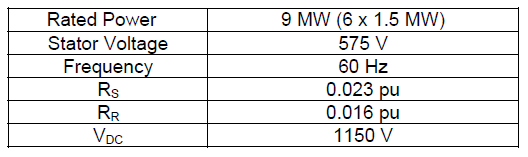
Table 2. Parameters of Transmission Line

The DFIG system (Fig. 3) consists of two converters linked by a DC link capacitor to connect the rotor windings of the induction generator to the PCC transformer that is also connected to the induction generator stator windings.

Vector based hysteresis current regulator based STATCOM
The concept of Equidistant-Band Vector Based Hysteresis Current Regulator (VBHCR) is introduced in [20] where the VBHCR is employed for both DFIG converters; Rotor Side Converter (RSC) and Grid Side Converter (GSC). Equidistant-Band VBHCR features a better steady state performance including fast transient response, adaptable to machine parameter variations and simple control algorithm. As mentioned above, designing new controller for the existing DFIG installation may not be cost effective. Therefore, the utilisation of VBHCR-STATCOM as an external compensator could be a practical and economical solution for the existing DFIG systems.
Proposed VBHCR of STATCOM for DFIG Applications
The proposed VBHCR for STATCOM is shown in Fig. 4. In this controller, a dq-abc transformation is applied, where d-q axes reference currents Id* and Iq* are generated from the error signals of the voltage across the DC link (ΔVdc), the voltage at the PCC (ΔVs) and two conventional proportional-integral (PI) controllers. The output current of the dq-abc transformation is compared with the line currents to generate an error current signal (ΔIabc) that is fed to the VBHCR to generate appropriate switching signals to the STATCOM switches. To eliminate the interference between phases (referred as inter-phases dependency) and maintain the advantages of the hysteresis controller, a phase-locked loop (PLL) technique is employed.

The key point of VBHCR principle is based on the use of switching table for the VSC (shown in Table 2) of the proposed VBHCR as detailed discussed in [20]. Before fed into the switching table, the digital outputs of comparators (Dx and Dy) are created from four-level hysteresis comparator for x-axis and three-level hysteresis for y-axis. The practical proposed VBHCR is shown in Fig. 5.

Results and Discussion
In order to investigate the robustness of the proposed STATCOM controller for DFIG applications, various case studies and scenarios are investigated.
Case Study 1: A Moderate Voltage Sag of 0.7 per-unit at the Grid Side
In this case study, grid voltage sag of 0.7 pu is applied at 1.5s and cleared out at 1.55s. Simulation results for this case study are shown in Figure 6.
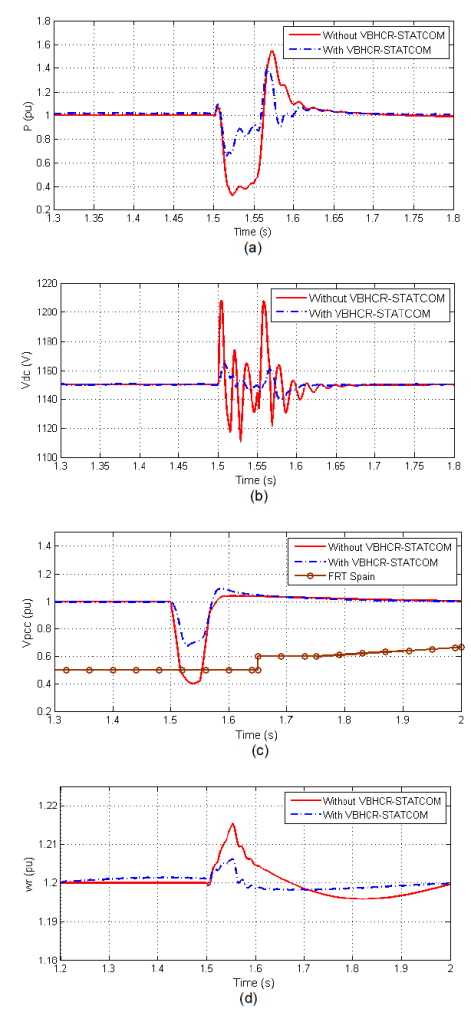
As shown in Fig. 6(a), without the proposed VBHCR-STATCOM, the output power tends to drop to a level less than 0.4 pu. This drop is compensated when the VBHCRSTATCOM is connected to the PCC to reach a level of 0.8 pu. Fig 6(b) reveals that without VBHCR-STATCOM, the voltage across the DC link will exhibit rapid oscillations due to a voltage dip at the grid side. With the proposed VBHCR-STATCOM connected to the system, this oscillation can be significantly damped. It is worth noting that significant oscillations in the DC link voltage may cause the protection system to block the converter operation [7]. As can be seen in Fig. 6(c), the voltage at the PCC exhibits 0.6 pu voltage sag and drops to a level of 0.4 pu during the fault duration. Compared with the FRT code of Spain, this level violates the minimum threshold voltage limit allowed by this code. When the VBHCR-STATCOM is connected to the PCC, the reactive power compensation by the STATCOM elevates this voltage to a level of 0.5 pu which is a safety accepted limit by Spain FRT code. Due to the drop in the generator active power, the shaft speed (ωr) accelerates as shown in Fig. 6(d) and reaches a crest value of 1.215 pu and takes a long time to settle down to the nominal value after fault clearance. With the connection of the VBHCR-STATCOM, both maximum overshooting and settling time are substantially reduced.

Case Study 2: A Large Voltage Sag of 0.9 per-unit at the Grid Side
To investigate the capability of the proposed STATCOM to perform under large voltage sag levels, the level of sag at the grid side is increased to 0.9 pu. As can be seen in Fig. 7 (a), the power output of the DFIG is significantly dropping to almost zero level within the duration of fault. When the VBHCR-STATCOM connected to the system, the output power drop can be compensated by about 50%, which implies that the DFIG can contribute about 50% active power during the fault event. This is a momentous advantage of the proposed VBHCR-STATCOM.
Fig. 7 (b) shows the significant oscillations that the DC link voltage profile will exhibit if the proposed controller is not adopted. With the VBHCR-STATCOM connected to the system, the maximum overshooting and oscillations of the DC link voltage will be significantly damped. For a gird voltage sag of 0.9 pu, the voltage at the PCC will be reduced by about 0.7 pu and violates the low voltage limit of the Spain grid code as shown in Fig. 7(c).
Whereas with the connection of the proposed compensator, this level will be raised to a safe value (0.6 pu) which complies with the Spain codes requirement. Without the VBHCR-STATCOM, the rotor shaft speed exhibits a significant maximum overshooting during the fault and a long settling time after fault clearance. Both parameters are greatly enhanced when the proposed VBHCR-STATCOM is connected as shown in Fig. 7(d). This is a further contribution of the proposed VBHCR-STATCOM.
Conclusion
This paper presents a new application of the Vector Based Hysteresis Current Regulator (VBHCR) on STATCOM to improve the low voltage ride through capability of DFIG-based WECS. For the moderate and high voltage sag levels investigated in this paper, the following main conclusions can be drawn:
• Without employing any compensator, the performance of a DFIG-based WECS will be significantly degraded due to voltage sag events at the grid side. As a result of such faults, the generated power of the DFIG drops, voltage across the DC link exhibits significant oscillations, voltage at the PCC may violate the minimum threshold limit of the grid code, and rotor shaft speed accelerates affecting overall system stability.
• The proposed VBHCR-STATCOM acts to compensate the power at the point of common coupling during fault events. This results in maintaining system parameters such as the generated power and voltage at the PCC at accepted limits that allows the DFIG to support the grid during fault events rather than disconnecting it.
Acknowledgment: First author would like to thank Research, Technology and Higher Education Ministry of Indonesia for supporting the Research.
REFERENCES
[1] Ghislaine Kieffer, Toby D. Couture, Renewable Energy Target Setting, International Renewable Energy Agency (IRENA), June (2015).
[2] Anenomous, Global Wind Statistic (2017).
[3] M. Seghidi, M. Moradzadeh, O. Kukrer, M. Fahrioglu, Simultaneous Optimization of Electrical Interconnection Configuration and Cable Sizing in Offshore Wind Farms in Journal of Modern Power Systems and Clean Energy (2018), Vol.6, Issue:4, pp.749-762.
[4] R. A. Priya, D. Dhanasekaran, P.C. Kishoreraja, Performance analysis of PMSG based wind energy conversion system using two stage matrix converter, Przeglad Elektrotechniczny (2019), Issue: 2, Pg. 112.
[5] J. Pedra, F. Corcoles, LI. Monjo, S. Bogarra, A. Rolan, On fixed-speed WT generator modeling for rotor speed stability studies, IEEE Trans. on Power Syst. (2012). Vol. 27., Issue: 1, pp. 397-406.
[6] C. Vázquez Hernández, T. Telsnig, A. Villalba Pradas, C. Vazquez Hernandez, T. Telsnig, and A. Villalba Pradas, JRC Wind Energy Status Report 2016 Edition (2017).
[7] V. Akhmatov, Analysis of dynamic behaviour of electric power systems with large amount of wind power, PhD Theses (2003). Technical University Denmark.
[8] M. Altin, Ö. Göksu, R. Teodorescu, P. Rodriguez, B. B. Jensen, and L. Helle, Overview of recent grid codes for wind power integration in Proc. Int. Conf. Optim. Electr. Electron. Equipment, OPTIM, (2010), pp. 1152–1160.
[9] J. Lopez, E. Gubia, E. Olea, J. Ruiz, and L. Marroyo, Ride Through of Wind Turbines With Doubly Fed Induction Generator Under Symmetrical Voltage Dips, IEEE Trans. Ind. Electron., (2009) vol. 56, no. 10, pp. 4246–4254.
[10] A. Bektache, B. Boukhezzar, Nonlinear predictive control of a DFIG-based wind turbine for power capture optimization, Electrical Power and Energy Systems (2018), Vol. 101. 92-102.
[11] H. Mahvash, S. A. Taher, M. Rahimi, M. Shahidehpour, Enhancement of DFIG performance at high wind speed using fractional order PI controller in pitch compensation loop, Electrical Power and Energy Systems (2019), Vol. 104. pp. 259-268.
[12] F.E.V. Taveiros, L.S. Barros, F.B. Costa, Heightened state-feedback predictive control for DFIG-based wind turbines to enhance its LVRT performance, Electrical Power and Energy Systems (2019), Vol. 104. pp. 259-268.
[13] S.K. Raju, G.N. Pillai, Design and implementation of type-2 fuzzy logic controller for DFIG-based wind energy systems in distribution networks in IEEE Trans. Sustain. Energy (2016), vol. 7, no. 1, pp. 345-353.
[14] A. M. S. Yunus, A. Abu-Siada, and M. A. S. Masoum, Effects of SMES on dynamic behaviors of type D-Wind Turbine Generator-Grid connected during short circuit, IEEE Power Energy Soc. Gen. Meet. (2011), pp. 11–16.
[15] I. Ngamroo, Optimization of SMES-FCL for Augmenting FRT Performance and Smoothing Output Power of Grid- Connected DFIG Wind Turbine, IEEE Trans. Appl. Supercond. (2016), vol. 26, no. 7.
[16] A. M. S. Yunus, A. Abu-Siada, and M. A. S. Masoum, Effect of SMES Unit on the Performance of Type-4 Wind Turbine Generator during Voltage Sag, IET on Renewable Power Generation RPG (2011), pp. 94.
[17] A. M. S. Yunus, M. A. S. Masoum, A. Abu-Siada, Effect of STATCOM on the Low-Voltage- Ride-Through Capability of Type-D Wind Turbine Generator, IEEE PES Innovative Smart Grid Technologies (2011), pp. 1-5.
[18] A. F. Abdou, A. Abu-Siada, H. R. Pota, Application of STATCOM to improve the LVRT of DFIG during RSC fire-through fault, Universities Power Engineering Conference (AUPEC) 2012 22nd Australasian (2012), pp. 1-6.
[19] Beheshtaein, Optimal Hysteresis Based DPC Strategy for STATCOM to Augment LVRT Capability of a DFIG Using a New Dynamic References Method, IEEE 23rd International Symposium on Industrial Electronics (ISIE) (2014), 612 – 619.
[20] M. Mohseni, S. M. Islam, and M. A. S. Masoum, Enhanced hysteresis-based current regulators in vector control of DFIG wind turbines, IEEE Trans. Power Electron. (2011), vol. 26, no. 1, pp. 223–234.
Authors: Dr. A. M. Shiddiq Yunus is with Energy Conversion Study Program, Mechanical Engineering Department, State Polytechnic of Ujung Pandang, Makassar 90245, Indonesia, Email: shiddiq@poliupg.ac.id; Dr. Ahmed Abu-Siada is with Electrical and Computing Engineering Department, Curtin University, Perth 6102, WA, Australia, Email: A.AbuSiada@curtin.edu.au; Dr. Mohammad A.S., Masoum is with Electrical Engineering at Utah Valley University, Orem UT, 84058, USA, Email: mmasoum@uvu.edu.
Source & Publisher Item Identifier: PRZEGLĄD ELEKTROTECHNICZNY, ISSN 0033-2097, R. 96 NR 1/2020. doi:10.15199/48.2020.01.16
 Power Quality Blog