Published by Lucjan KURZAK, Building Construction Faculty Czestochowa University of Technology, Poland
Abstract. The market of photovoltaics is one of the most dynamically developing sectors of world economy. From the standpoint of the environment, the energy of solar radiation is the most attractive source. Both new materials and technological solutions, growing effectiveness of conversion of solar energy into electricity and rising prices of their acquisition from conventional sources open up great opportunities for photovoltaics.
Streszczenie. Rynek fotowoltaiczny jest jednym z najbardziej dynamicznie rozwijających się sektorów gospodarki światowej. Energia promieniowania słonecznego jest najbardziej atrakcyjną, z punktu widzenia środowiska, energię odnawialną. Zarówno nowe rozwiązania materiałowe jak i technologiczne, rosnąca sprawność konwersji energii słonecznej na elektryczną przy rosnących cenach jej pozyskania ze żródeł konwencjonalnych, stawia przed fotowoltaiką olbrzymie perspektywy (Światowe tendencje wykorzystania energii fotowoltaicznej).
Keywords: photovoltaic, development, cost, technology
Słowa kluczowe: fotowoltaika, rozwój, koszt, technologia
Shrinking resources of energy resources and increasingly deteriorated state of the natural environment stimulate seeking for alternative and renewable sources of energy. The renewable sources do not cause any side effects or emissions of hazardous substances. Their utilization does not disturb natural resources, natural environment, landscape, vegetation and animal living conditions. They cause improved energy safety and the new workplaces are created; also, different regions are promoted. Further development is caused by the international obligations connected with reduction in emissions of carbon dioxide to the atmosphere.
Analysis of resources of fossil fuels and renewable energy (solar, water, wind and bioenergy) reveals that the greatest opportunities are provided by solar energy [1,2]. A good illustration of the amount of resources of different types of energy is their graphical representation shown in Fig. 1.

The figure provides a view of resources of different types of energy [3]. The figure compares the types of energy in the form of the circles with different diameters. In the left part, renewable sources are presented, whereas fossil fuels are presented on the right. Size of a circle represents potential resources of individual types of energy. The figure exhibits huge reserves hidden in solar energy. The respective circle which represents solar energy is many-time higher than others, represented by other types of renewable energy (wind, biomass, hydroenergy, geothermal energy, water tide energy) and fossil fuels (coal, oil, natural gas, uranium). Additionally, the central part of the figure contains the point whose size (surface area) represents annual demand for energy. Comparison of individual sizes of the circles provides an insight into the respective sources of energy and their resources. The world energy demand, compared to the huge energy deposited in the Sun, reveals its huge perspective role.
From the standpoint of the environment, the energy of solar radiation is the most attractive source. It is easily accessible, but is characterized by very low flux density and high stochasticity of occurrence in time and space. However, huge resources of solar energy, developing methods and technologies of conversion into other useful types determine its perspective importance. One of the possible methods of its conversion into electricity is the use of photovoltaic effect.
Photovoltaic effect, which is used in photovoltaic cells, consists in generation of electromotive force as a result of the exposure of semi-conductors into solar radiation. Solar energy radiation is converted directly into electricity, without any chemical reactions. Development of photovoltaics (PV) began in the sixties of the 20th, stimulated by space explorations and accelerated by energy crisis. Although only part of solar radiation can be used for generation of electricity (unlike fossil fuels), no waste that pollutes the environment is produced. The European Photovoltaic Industry Association (EPIA) emphasizes that European demand for electricity would be satisfied if only 0.34% of the area of Europe were covered by photovoltaic modules (the area which corresponds to the area of the Netherlands). The estimation by the International Energy Agency (IEA) demonstrated that utilization of only 4% of the world desert areas for installation of photovoltaic installation would satisfy world demand for primary energy. Furthermore, there is huge, unused potential in the form of vast surface areas such as roofs, building walls, agricultural wastelands and deserts which can be used for conversion of solar energy into electricity. For instance, 40% of total demand for energy in the European Union in 2020 can be satisfied if all the roofs and facades are covered with solar panels.
Photovoltaic cells are used in five fundamental areas:
• general purpose electrical equipment (radio receivers, clocks, chargers, TV sets)
• stand-alone systems (lamps, sea lighthouses, light signals, warning signs)
• systems for support of heat and power networks (power and heat supply to housing, service and public utility buildings)
• hybrid systems (the support based on photovoltaic system for combustion, gas and wind generators as well as solar collectors),
• equipment used in space explorations (satellites, space shuttles).
The market of photovoltaics is one of the most dynamically developing sectors of world economy. This is confirmed by Fig. 2, which compares world increases in electrical power from new PV installations for the recent decade [4].

The increase in power observed within recent years has been substantial. Particularly in 2008, this increase, compared to the previous year, amounted to ca. 230%, from the level of 2,594 MWp to 6 090 MWp. This results from growing energy needs, progress in the achieved effectiveness of conversion into electricity and energy policies adopted by individual member states. Furthermore, this development results from appreciation, by the European Union, and certain countries in the world, of the advantages and opportunities of photovoltaics as a particular source of renewable energy [5].
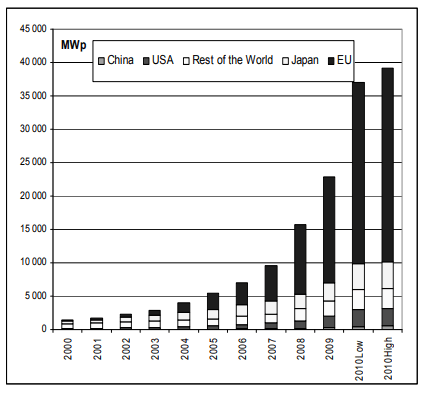
Given the lack of detailed data on the world installed capacity in 2010, Fig. 2 presents the estimates at two levels (low and high). The estimates of the growth range within 121,400 MWp and 15,700 MWp. This means ca. 100% increase in new installed capacity compared to the year 2009. The range of the estimates of the installed capacity in 2010 results from the uncertainty of the data in recent months in several world countries which are of key importance to PV market [6].
New investments in worldwide photovoltaic market in 2009 were dominated in 80% by the market of the European Union’s states (see Fig. 3). Despite economic downturn in 2009, an increase in PV capacity by 5,605 MWp was observed in the European Union. This meant the 15% increase compared to the year 2008, which is illustrated by the data in Fig. 5, where similar tendency can be observed in recent years. A significant share in the increase of worldwide photovoltaic capacity was observed in Japan, with 484 MWp and the USA, with 477 MWp. Moreover, Figure 3 shows that the substantial effect on world PV energy sector is from such states as South Korea, with 168 MWp, China, with 160 MWp and Canada, with 70 MWp [4,8].
An unquestionable world leader in development of production and running PV power plants is Germany. In 2009, 3,806 MWp of new PV capacity was installed in Germany, which is presented in Fig. 4. This translates into nearly 70% share of Germany in the EU market. This tendency was also maintained in 2010, where, according to partial data, newly installed PV capacity reached the level ranging from 6,500 to 8,000 MWp. An essential importance to EU market is played by such countries as Italy, with 711 MWp, Czech Republic, with 411 MWp and Belgium, with 292 MWp. Other leading countries with considerable use of PV energy were illustrated in Fig. 4.

The figures 3 and 4 show that the level of capacity installed in PV energy sector is not determined by the size of the country and its economic position or insolation, but energy policies adopted by these countries. One positive example is Czech Republic, which reported a capacity increase comparable with the United States.

Impressing situation is also observed in world PV capacity used for generation of electricity in the recent decade. According to different partial data and tendencies in the development, one can estimate worldwide capacity in 2010 at the level of 37,000 – 39,100 MWp (Fig. 5). The figure presents a particular contribution of the European Union as an organization of the states with the dominant effect on the size and the dynamics of development of PV energy sector. The data from Fig. 3, which concerned the year 2009, seem to be confirmed: they illustrate that a considerable role for PV energy sector was played, apart from Japan and the USA, by Europe. The two estimated levels (low and high) for 2010 were also presented in Fig. 5 (similarly to the Fig. 2) [4]. Assuming that this will be the lowest level of 37,000 MWp, this means over 60% increase in world PV capacity compared to the year 2009. In the whole decade, presented in Fig. 5, mean annual increases in photovoltaic capacities amounted to ca. 45%, which can be compared to the most dynamically developing sectors in world economy, such as IT or biotechnology.
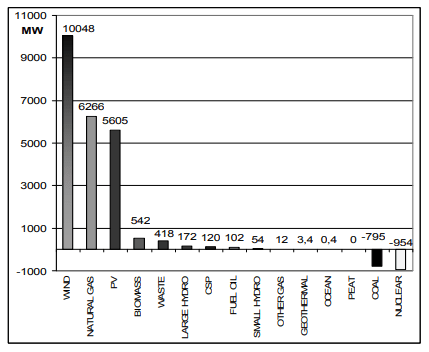
A determinant criterion for the choice of a source of primary energy for electricity generation is the potential profits. The choice of the source is affected by a number of factors, with the key factors including availability and cost of acquisition and technical level of conversion technology. Figure 6 presents the decisions of the investors in the European Union in 2009 and the level of use of the types of sources of energy in conversion into electricity. It illustrates the annual balance of changes in the installed capacity in 27 states of the EU. According to the data [4,8], total newly installed capacity amounted to 13,342.8 MW. At the same time, exclusion of 1,749 MW was also observed. In effect, the year 2009 saw an increase in the electrical capacity in the EU states by 11,593.8 MW.
It is worth noting that the reduction of generated power concerns the power plants based on nuclear energy and coal. This situation is typical of the energy policies adopted by the EU, particularly in the case of the role of fossil fuels, especially coal. In the case of nuclear energy, the essential effect on slowdown in its development is from the concerns over its safety. This tendency, in view of the recent nuclear disaster in Japan, will be deepening. A number of European countries have brought the decisions on new investments to a standstill, and some nuclear power plants have stopped operating. The European energy sector, based on coal, will be reducing its manufacturing potential. There are a number of new investments and, the life cycle of a number of currently used power plants is coming to an end. New clean energy technologies of electricity generation from coal are still at the stage of the research and economic and ecological analyses.
In consideration of the increase in electricity generation potential in the EU, the substantial importance is from the power plants which use renewable sources. The highest increase in the capacity in 2009 (10,048 MW) was reported for wind power plants, followed by those which use biogas (with an increase by 6,266 MW). Photovoltaic power plants, with an increase by 5,605 MWp are third in the comparison of the utilized sources. The next places are taken by biomass-based power plants, being the renewable resources with the share of 542 MW in the newly installed capacity. This quantity is an order of magnitude lower compared to the photovoltaics. In consideration of the previous tendencies in energy development in Europe, one can assume that the dominating power plants among the new installations will be those based on wind and solar energy, i.e. environmentally-friendly sources.
Photovoltaic technology, as a relatively new method used for conversion of solar energy into electricity, is based on the development and use of modern technologies. Over two decades of experiences have shown that the cost curve has been decreasing and will be decreasing in the future. This tendency is presented in Fig. 7. A fast decline in the prices of the electricity generated from PV has been observed since 1990 and insignificant one as forecast for 2040 [8].

Costs of electricity generation from solar sources considerably depend on solar radiation intensity and the time of insolation. Therefore, the figure above presents the two curves which differ in the number of hours of using photovoltaic installations. The upper curve concerns the use for 900 hours a year and is representative of the countries of the Northern Europe. The lower curve, with the lowest costs of electricity production, relates to the countries of the South Europe, where the time of operation of photovoltaic installations is twice longer (1 800 h/year).
Furthermore, Fig. 7 shows the history of changes in the prices of electricity in the European market, obtained mainly from conventional sources. This price has risen in recent decades and the forecast for the year 2040 shows further slow increase. Changes in energy prices were illustrated in the form of the stripes which encompass peak prices of electricity, and maximal and minimal prices in the wholesale market. The highest price in the electricity market which is observed for the hours of peak demand, frequently corresponds to the working hours of photovoltaic installations, which is a situation favourable to the power and heat system.
The cost of electricity generated from PV in the northern countries of Europe in 2010 amounted to ca. 0.32 Є/kWh and exceeded the highest peak market price. For the Southern Europe, the cost of PV energy was lower by 50% in the last year and amounted to 0.16Є/kWh. This cost is maintained within the range of peak market electricity price. It is estimated that this level will be reached in the southern Europe in 2020. The level of wholesale prices for PV electricity in the southern countries of Europe will be reached in 2015, whereas the northern Europe will reach this level a decade later [8].
The tendencies for costs of production and prices of energy in Europe are confirmed in other world regions. Nowadays, in the regions with high insolation and high demand for electricity, photovoltaic energy is competitive. Its competitiveness is higher in decentralized installations, i.e. those where it is produced and used on the spot. Use of PV energy in intelligent energy grids with capacity of managing a number of scattered sources of energy, operating intermittently, might provide a highly effective solution.
Current investment costs of photovoltaic systems make solar energy competitive in relation to the sources of energy in the period of peak demand and in hybrid systems of electricity supply. However, they are not low enough to allow this type of energy to effectively compete with cheaper energy supplied from national grids. Therefore, it is necessary for the development of photovoltaic market to create the effective mechanisms of support for research and development, which would provide opportunities of reduction of costs of the systems and increase in their total efficiency.
These emerging solutions are supposed to account for ca. 7% of world market in 2020 [7].

Figure 7 illustrates that, in the recent 30 years, the market has been dominated by the technologies based on polycrystalline silicon. Over 90% of the photovoltaic market belongs to silicone technologies. Share of amorphous silicon (a-Si), which was used most frequently for consumer applications (e.g. calculators, solar watches), is decreasing in favour of more advanced technologies with different modifications, as monocrystalline, multicrystalline and tape silicone. Development of thin-layer types (CdTe, CIGS) was driven by the insufficiency of high-quality silicon in the market. These technologies are gaining considerable share and, according to EPIA forecasts, they will cover a quarter of world market in 2015 [8]. It is expected that the photovoltaic systems which will be popular in the recent years will include the solutions with concentrators (CPV) and the emerging nanotechnologies.
They will be used mainly in the installations integrated with buildings, especially in the case of climatic zones where solar radiation is composed predominantly of direct radiation. The use of the lens or mirrors focused on PV cell in these technologies will allow for generation of higher amount of electricity from the system compared to the unit surface of the installation.
New advanced investigations in these problems show that in the nearest five years, nano-photovoltaic cells will become competitive compared to silicon solutions, both in terms of necessary investments and their use. A driving force for research, development and implementation of this technology is PLEXTRONICS, a company which cooperates with the Pittsburgh University, USA. In nanophotovoltaic cells, plastics of micrometric (μm) thickness generate electricity directly from solar radiation. These plastics are deposited on films in a liquidized state. Within the third-generation photovoltaic cells, the organic solar batteries are manufactured, with a generic term ‘plastic power’ [7].
The investigations and increase in production of cells and photovoltaic modules leads to the development of modern technologies and infrastructure. A number of funds and companies oriented towards innovation invest in the research in order to reduce the costs of photovoltaic systems and their popularization and reaching a state of grid-parity, i.e. the state when photovoltaic energy will be cheaper without any external support, compared to the electricity generated conventionally from fossil fuels and in nuclear power plants.
Both new materials and technological solutions, growing effectiveness of conversion of solar energy into electricity and rising prices of their acquisition from conventional sources open up great opportunities for photovoltaics.
An advantage of photovoltaics lies in high reliability in crisis situations, such as power failures as a result of electrical breakdown or natural disasters. Photovoltaics, which generate electricity in a decentralized and scattered manner, play a key role in development of a sustainable system of energy management.
REFERENCES
[1] Kurzak L., Tendencies In development of renewable energy sektor and energy-saving civil engineering in the European Union, Wydawnictwo Wydziału Zarządzania Politechniki Częstochowskiej,Częstochowa, (2009), 1-92
[2] Kurzak L., Ecological Aspects of Solar Thermal Energy Developmentin the European Union, Manufacturing Engineering, Published by Technical University of Kosice – Faculty of Manufacturing Technologies with a seat in Presov, (2011) nr. 2 Volume X, 55-60
[3] Koldenhoff W.B., 2009, The solar thermal market, StatusTechnologies-Perspectives, Inter Solar, San Francisco, (2009)
[4] Market Outlook 2010. European Photovoltaic Industry Association. 2010
[5] Klugmann-Radziemska E., Rozwój fotowoltaiki na świecie i w Polsce, Energetyka Cieplna i Zawodowa, (2009) nr. 9, 45-48
[6] Pietruszko S. M., Rozwój rynków fotowoltaiki na świecie, Czysta Energia, (2011) nr. 2, 22-25
[7] Kotowski W., Trzecia generacja baterii słonecznych. Dzięki “nanobranży”, Energia Gigawat, (2009) nr.6
[8] Solar Photovoltaic Electricity Empowering the World. European Photovoltaic Industry Association, Greenpeace International, http://www.epia.org, (2011)
[9] Photovoltaic Barometerhttp://www.energiesrenouvelables.org/observer/stat_baro/observ/baro202.pdf
Author: dr hab. inż.Lucjan Kurzak professor of Czestochowa University of Technology, Faculty of Building, 3 Akademicka Street, 42-200 Czestochowa, e-mail: lkurzak@bud.pcz.czes.pl
Source & Publisher Item Identifier: PRZEGLĄD ELEKTROTECHNICZNY (Electrical Review), ISSN 0033-2097, R. 87 NR 12b/2011.
 Power Quality Blog