Published by Aziz HAFFAF*1, Fatiha LAKDJA1,2, Rachid MEZIANE1, Djaffar OULD ABDESLAM3
Electro-Technical Engineering Laboratory, Faculty of Technology, Saida University, Algeria (1) Sidi-Bel-Abbes University, Algeria (2) IRIMAS laboratory, Haute Alsace University, Mulhouse, France (3)
Abstract. In this research paper, solar energy and LED technologies as a street lighting demand side management SLDSM option are carried out. The economic feasibility of using solar energy in street lighting system SLS and the comparison between conventional high pressure sodium HPS and proposed LED technologies was discussed. The village of Brabra in M’sila, Algeria located at 35.39o N and 04. 54o E with 120 lamps was selected as a case study. HOMER software is used for system feasibility analysis over the project lifetime based on the economic and technical evaluation criteria such as total net present cost TNPC, COE and energy bill cost. From the results, LED technology and on-site solar photovoltaic generation were viewed as a DSM tool in the public street lighting sector. SLS based PV-LED reduce annual energy consumption, installation system and annual electricity bill costs, in addition to their economic and ecological nature.
Streszczenie. W artykule zaprezentowano system zarządzania oświetleniem ulicznym z wykorzystaniem lamp LED wykorzystujący źródła fotowoltaiczne na przykładzie miasta Brabra w Algerii. .. Porównan ten z system z tradycyjnie stosowanym systemem wykorzystującym sodowe HPS. Zarzadzanie oświetleniem ulicznym wykorzystującym lampy |LED i zasilanie fotowoltaiczne.
Keywords: Demand side management- Strategic conservation- Solar street lighting- LED technology- TNPC.
Słowa kluczowe: oświetlenmie uliczne, lampy LED, zasilanie fotowoltaiczne.
Introduction
Global electricity consumption has increased rapidly in recent years and this is due to the technological advances, rapid industrial and household energy demand growth. The depletion of fossil fuel resources and the low efficiency of current energy systems have led engineers and planners to think about and find solutions to use energy sources other than fossil fuels. Solar energy, wind energy, biomass, mini-hydroelectricity are some of the resources used worldwide to produce energy depending on available resources [1, 2].
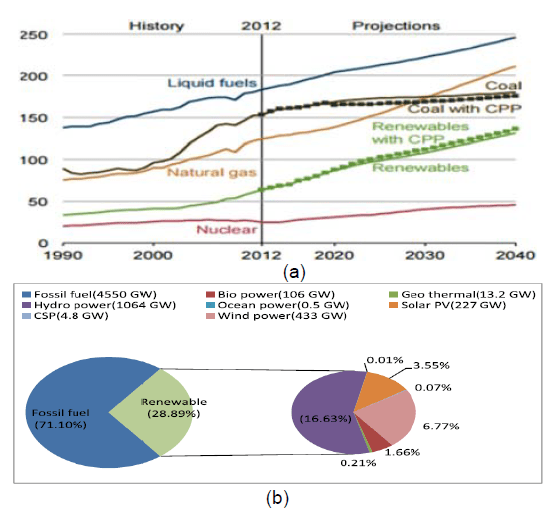
The energy consumption of the different energy sources as illustrated in Fig. 1(a), indicating that there would be a significant increase in renewable energy, liquid fuels and coal by 2040 [3]. Noted that the renewable energies are the fastest growing energy source in the world and it is estimated that their consumption will increase from 2012 to 2040 by about 2.6% per year [4]. The world electricity production in 2015 is shown in Fig. 1(b), which shows that 1849 GW of the total energy produced 6399 GW, i.e. 23.70% of the world’s electricity is produced by renewable energy sources [2].
Since the current energy production capacity in Algeria is dominated by power plants that use natural gas, which represent more than 95% of the installed capacity, the new objective of the Algerian energy and environmental strategy as shown in Fig. 2(a) is to achieve a share of 40% based renewable energies by installing up to 22,000 MW by 2030 [5].

In terms of solar energy potential, Algeria receives an average sunshine duration of 3000 h/yr, particularly in the Sahara region and has the largest solar potential in the Mediterranean basin, i.e. 169440 TWh/year. The average solar energy received are 1700 kWh/m²/yr, 1900 kWh/m²/yr and 2650 kWh/m²/year in coastal regions (surface 4%), in the highlands (10%) and in the Sahara (86%), respectively.
As shown in Fig. 2(b), the annual average daily solar irradiation was ranged from 5 to 7 kWh/m²/day on inclined surfaces at optimal angles [5, 6].
Similarly, due to economic growth and demographic trends, Algeria’s electricity demand is growing rapidly with an average of 9.5% per year, and according to a report from the Ministry of Energy, it is expected to double by 2030 or even triple by 2040. As a result, electricity generation capacity must increase by up to two times over the next decade. It should be noted that the energy consumed by households represents more than 60% of the energy consumed, while 98% of electricity is produced from natural gas [1, 2, 5]. Lighting accounts for a major part of this consumption. Speaking at the national conference on energy efficiency which is organized by the National Agency for the Promotion and Rationalization of Energy Use (APRUE), the Minister of Energy, said that “Public lighting represents 40% of national energy consumption, or 6500 MW of the 14500 MW consumed. Street lighting consumes a large part of each municipality’s budget and the local authorities’, where the street lighting bill is estimated at 13 billion dinars per year.
So, this is makes it necessary to rationalize electricity uses by considerably reducing this type of consumption [7]. So, it is necessary to launch the “awareness plan on the use of LED lamps, which is an ambitious program to exploit solar energy in electricity production” for the rational use of electrical energy with energy-efficient components as an important subject in public lighting sector. Lighting is one of the fundamental needs of modern society used in different applications and fields (such as roads, car parks and streets). Street lighting is a source of lighting used to maintain the comfort and safety of road users during the night time, consequently could reduce the number of accidents [8].
Public lighting in Algeria generally uses electrical energy as an energy source, the use of old HPS lamp technologies developed in the 1960s that contains two ratings which are 400 watt and 250 watt, has led to the high electricity consumption due to the increasing number of public street lamps [9]. Solar street lighting (SSL) is defined as a lighting that uses solar sunlight as an energy source, this type of lighting is becoming more popular as a means of reducing installation, maintenance and operating costs [10]. Why photovoltaic solar energy ?, because the PV system is one of the main sources of renewable energy with its many advantages such as non-polluting, very promising, unlimited source, and requires a little maintenance [11].
Recently, many studies have been conducted on the feasibility of introducing and using solar photovoltaic energy into the SLS lighting sector in terms of sizing and efficiency analysis of power systems, few studies have examined load management of street lighting in terms of technical feasibility, economic viability and savings achieved. The concept of demand side management (DSM) or load management (LM) was invented in the late 1970s, and defined as the planning and implementation of activities to modify consumer energy use so as to modify the shape of the consumption curve in terms of time pattern and the load magnitude by one of the DSM techniques that are: peak clipping, load shifting, valley filling, strategic conservation, strategic load growth technique, and flexible load shape strategy [12]. In addition, many researchers have studied the efficiency of PV and hybrid power systems in different area and locations for different applications. By way of example in the Algerian country context, a few studies have investigated the use of renewable energies in public lighting. On this basis, this research paper addresses the technical feasibility and economic performance analysis of solar-powered LED lighting systems in comparison with conventional HPS lighting one. The reason and objective of this research paper is to draw attention to the enormous potential of demand side management DSM in the street lighting sector, the advantage of using LED technology, and to draw attention to the generation of solar energy in the country that can be exploited in different applications from a few kW to a large scale use.
Supply side and demand side management in street lighting
As a part of this research, a feasibility study on the use of LED technology powered by a small integrated solar photovoltaic generator as a street lighting demand side management was presented and analysed. So, the objectives is to combine the two optimization processes, the first one, considering strategic conservation as one of the load management techniques on the demand side, and secondly the consideration of supply side management through the use of solar energy on the public lighting supply side. The description of this two concept is given as follows.
Lighting demand side management
Due to the large amount of energy consumed by street lighting load, energy-efficient programme in this field are very welcome, since the possibilities for energy savings in street lighting are numerous, some of them are discussed in this section. One of these means is the directive that requires and enforces the outdoor and road lighting sector to replace the most inefficient lighting technologies with more energy-efficient ones.
A new lighting technology has been developed in the form of light-emitting diodes (LEDs) that are based on the physical phenomena of the semiconductor material were discovered as early as the 1900, their use on a large scale was only possible after the appearance of the white LED in 1990 [13]. LED has many advantages as shown in Fig. 3, such as high brightness intensity, low power consumption, and long life cost effective, can be 10 times more efficient than older conventional incandescent lamps [14, 15].

Lighting supply side management
In this paper, the concept of supply side management in the public lighting sector SSMPLS is ensured by the promotion of small-scale distributed photovoltaic generation (SDPG). The use of supply side management strategies in the public lighting system makes it possible to:
• Reduce energy consumption and decrease the system life-cycle costs.
• Street lighting powered by decentralized photovoltaic (autonomous system) can reduces the installation and transmission line costs.
• Reducing energy consumption by using LEDs in PSL implies that the conductor losses can also be reduced.
Case study
Location and solar resource data
The system will be supplying a street lighting load of 120 lamps in Brabra village at M’sila situated at (35,39° N latitude, 4.54° E longitude, and average elevation from sea level of almost 442 m). The solar radiation (SR) data for the studied location are taken from the solar energy database and the surface meteorology (NASA) [16]. Table 1 shows the average monthly solar radiation profile with an annual average of 4.56 kWh/m2/day and an average clearness index of 0.504.
Table 1. Solar radiation data and clearness index

From Table 1, solar radiation for this location becomes very important between March and September, the average monthly daily global radiation varies from 2.62 kWh/m2/day in December to 8.02 kWh/m2/day in July month.
Electric load development
In this paper, a stand-alone photovoltaic system will be considered to light a street in Brabra village, M’sila as a case study. The lights will illuminate the street for 12 hours from 6 PM to 6 AM. The average daily energy consumption of street lighting load can is calculated by using Eq. (1).

Where; Lp is the luminary power (W), Do is the average daily operation (Hours) and N is the total number of luminaries.
The annual lighting energy consumption AEC is given by the following expression.

The annual total energy consumption for total 120 lamps is calculated using Eq. (3)

where; AEC, TAEC are the annual energy consumption per lamp and total annual energy consumption of total lamps in (kWh).
The comparison between three different loads, i.e. SHP (400 W), SHP (250 W), and LED lamps (100 W) for each light is discussed. The total numbers of lights are 120 lights. The daily load, peak load and profile for one lamps for the three types of lamp is indicated in Table 2 and Fig. 4.
Table 2. Electric load information data


System components sizing and modeling
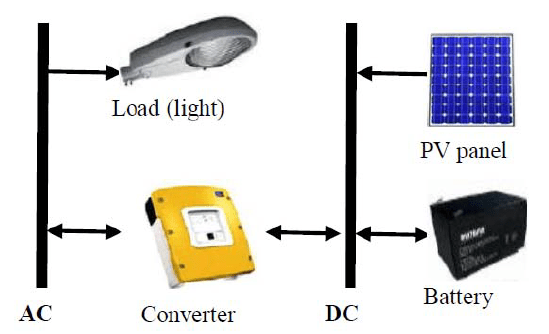
Fig. 5 shows a sample configuration schema of solar photovoltaic powered public street lighting system, which is consist of three main components includes:
• Energy generator (PV panel)
• Electricity storage system (battery)
• Power converter for the conversion of energy from direct current (DC) to alternating current form (AC) [17].
Depending on the energy consumption needs of the lamps to be used, the road lighting system requires an appropriate design, sizing and modeling of solar module and storage battery. The system components modeling is discussed as follow.
Solar PV array
The primary energy sources in this system are the PV panels which receive solar irradiation and convert it into DC electricity. The electricity generation of PV panel (PVoutput) is based on the PV modules specifications as in the following equation [18].
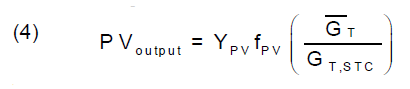
Where; YPV (kW) is the power output under standard test conditions in, fPV (%) is the PV de-rating factor, GT (kW/m2) and GT,STC (1 kW/m2) are the solar radiation incident on the PV array and at standard test conditions, respectively. There is no tracking system included in this PV system. In terms of PV panel sizing, the following equation can be used [19].

Where; PVP is the PV peak power in (kWp), El is the electrical energy required by the load (Wh/d), Ensol is the duration of the most unfavorable month, ηconv (%) is the converter efficiency, and f is a factor reflecting losses and adjustments.
Storage system modeling
Storage energy system SES, which is the battery in this case is used to store and provide energy for the load when PV sources are not available and do not produce electrical energy.
The process is as follows: the photovoltaic generator produces DC energy depending on the weather conditions during the day time, and then charges the storage batteries. During the night, the energy coming from the battery is used to supply the lighting load [20]. The nominal capacity of the batteries is given by the following equation [21].

Where; Cb is the nominal capacity of the batteries (Ah), Ed is the daily energy requirements (Wh), Aut is the number of days of autonomy, Ubat is the nominal voltage of the batteries (V), ηb is the energy efficiency of batteries and Db is the batteries depth of discharge.
The chosen battery in this study is Hoppeck 16 OpzS 2000, has a nominal capacity of 2000 Ah, voltage of 2 V, and lifetime throughput of 6,803 kWh with 30% minimum state of charge.
Power converter
In this system, an inverter is used to convert electrical energy from DC direct current to alternating current (AC). The technical properties of the converter are as follows, the expected life of a unit is taken as 15 years and an efficiency of 90%.
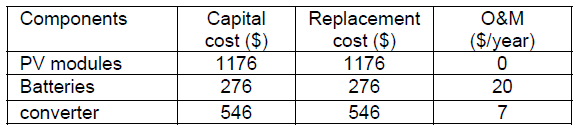
Economic details of the hybrid system components in terms of investment, replacement cost, annual operating and maintenance costs are summarized as in Table 3.
Table 3. Street lighting system components prices inputs [22]
Formulation of evaluation criteria
The choice and selection of an efficient street lighting system is linked to many important factors includes electricity consumption, price and lifetime.
In this study we based on a new way of thinking: which is the economic point of view, i.e. in terms of the minimum investment and life cycle costs and a reduced electricity bill cost.
To this end, the evaluation, analysis and performance comparison of the HPS and LED street lighting technologies is carried out, which is based on the following three criteria that are used for the comprehensive economic assessment.
Total net present cost TNPC which is the basic factor in the optimization step by the HOMER software. The TNPC can be calculated by using Eq. (7) [23].

Where; CNPC ($) is the total net present cost, CAT ($/year) is the total annualized cost, CRF is the capital recovery factor expressed by Eq. (8).

Where; ir is the interest rate in (%), Nproj is the project life time in years (20 year).
The Levelized Cost of Energy (LCOE) is the second optimization factor used in Homer software which is the unit cost of kilowatt-hour ($/kWh) [24]. The Eq. (9) gives the levelized cost of energy expression.

Where; Ctot and Etot are the total annualized cost of the system and the total electricity consumption per year, respectively.
The annual electricity bill cost Aebc is calculated by using the Eq. (10).

Where; Aebc is the electricity bill cost ($), AEC is the annual energy consumption (kWh) and the LCOE is the cost of one kilowatt-hour produced in ($/kWh).
Simulation results and discussion
HOMER software simulates different configurations of system based on the inputs data such as: solar resources, load data, components and equipment costs, etc. Then it displays all possible configurations according to the total net present cost value TNPC.
Table 4 summarizes the technical simulation results of the optimal configuration for each lamp of the public lighting system. Economic results per lamp of LED solar lighting technology and a system lighting based HPS lamp are also presented in this table.
A detailed results description in term of total net present cost (TNPC) and annualized cost (AC) by components type for the three simulated type of lamps is shown in Fig. 6.
Table 4. Technical and economic optimization results


From the technical and economic results, which are summarized in Tables 4, the following points are drawn:
• For the total energy consumption (120 lamps), the use of LED lamps in place of the old lamps leads to a significant reduction in the amount of energy consumed of 171360 kWh for HPS lamps (400 W) and 110280 kWh for HPS lamps (250 W) to 52080 kWh when using LED lamp.
• Each 100 W LED solar powered road lighting system unit includes a 0.8 kW PV module, 2 batteries and a converter capacity of 0.5 kW. The operating cost of system is 62 $/year. The total net cost is 2,456 $ and the energy cost is 0.442 $/kWh.
• The result of system with the HPS lamp (250 W), indicates that the optimized system consists of 0.9 kW photovoltaic panels, 2 batteries bank and 1 kW inverters with a minimum energy cost (LCOE) of 0.258 $/kWh and a net present cost of 3,063 $.
• For HPS lamps (400 W), the optimal system is as follows: 1.5 kW PV power, 2 batteries and a 1 kW converter, with an operating cost, total net present cost and the energy cost of 117 $/year, 4,158 $ and 0.228 $/kWh, respectively.
• Application of street lighting demand side management SLDSM by the use of LEDs technology is led to a great savings, i.e. 45 $ and 133 $ in the annualized cost and 607 $ and 1702 $ in the total net present cost compared to the system without DSM using SHP (250 W) and SHP (400 W), respectively.
The total annual electricity bill cost, which is 23019.36 $, 28452.24 $ and 39070.08 $, respectively for LED lamp, HPS (250 W) and HPS (400 W), noted that the use of LED lamps as a load management measure leads to a reduction in energy consumption, consequently a significant reduction in the electricity bill cost, i.e. a saving of 5432.88 $ (19.09%) and 16050.72 $ (41.08%) compared to the system with HPS (250 W) and the HPS (400 W), respectively.
Conclusion
In this research paper, the technical-economic effect of the application of demand side management activities DSMA to the public lighting system was presented, focusing on the economic feasibility study of using LED technology in combination with a small solar photovoltaic generator as a power source using the HOMER optimization model.
As we know, mercury lamps are the most widely used types in the street lighting system in Algeria, and this is the reason of this research paper to quantify the savings achieved by replacing conventional high pressure sodium HPS lamp with LED technology in terms of energy consumed, the investment cost of lighting system and the electricity bill cost.
The study shows that the potential for using LEDs and renewable solar energy as a means of managing the demand for SLDSM street lighting cannot be ignored. It is expected that this study and its results will encourage the use of LED technologies in this sector and increase the use of photovoltaic renewable energies in this region and for various applications.
As a comparison between the three types of loads (lamps), the following conclusions can be derived:
• The most economical system is the use of LED lamps, with a minimum TNPC of 270,867 $ but at a high energy cost of 0.442 $/kWh.
• The second most economical decentralized system is when using HPS lamp of 250 W, with LCOE and TNPC of 0.258 $/kWh and 3,063 $ respectively.
• The system with HPS of 400 W is the third most economical system with a high TNPC of 4,158 $ and the lowest cost of energy 0.228 $/kWh.
• The system with LED technology implies that the annual electrical energy consumption can be reduced by about 52.77% compared to the system with HPS lamps, and a saving of about 20% in the TNPC and the annual electricity bill costs.
It is noted that the LED-solar lighting type is an economical and ecological alternative for the following two reasons. Firstly, using LED lamps can last very long and also consume much less energy. In other hand, the PV energy source is environmentally friendly. In addition, independent solar lighting is a promising solution in some remote areas where the power grid is not available.
REFERENCES
[1] Mohammadi, M., Noorollahi, Y., Mohammadi-Ivatloo, B., Yousefi, H., 2017. Energy hub: from a model to a concept-a review. In Renewable and Sustainable Energy Reviews, vol.80, pp. 1512–27.
[2] Bourahla N. A., Benghanem, M., Doumbia M., Bouzeboudja, H., 2019. The economic feasibility analysis of generated photovoltaic energy in the USTO campus. In Przegląd Elektrotechniczny, vol. 95, no. 5, pp.147–152.
[3] IEO. International Energy Outlook. 2016. U.S. Energy Information Administration, page 1– DOE/EIA-0484, May 2016.
[4] Renewable REN 21. 2016. Global Status Report. REN Secretariat, Paris, France, 2016.
[5] Nacer, T., Hamidat, A., Nadjemi, O., Bey, M., 2016. Feasibility study of grid connected photovoltaic system in family farms for electricity generation in rural areas. In Renewable Energy, vol.96, pp. 305–318.
[6] Djoudi-Gherbi, A., Hadj-Arab, A., Salhi, H., 2017. Improvement and validation of PV motor-pump model for PV pumping system performance analysis. In Solar Energy, vol. 144, pp.310–320.
[7] AMEM. Algerian Ministry of Energy and Mining. 2015. [online].[Retrieved 03.05.2019]. Retrieved from:
https://www.hotelsinvictoria.net/mem-algeriaorg/.
[8] Maghreb Emergent. 2019. [online]. [Retrieved 03.05.2019]. Retrieved from: https://maghrebemergent.info.
[9] SONELGAZ. Electricity Production Company. 2014. [online]. Retrieved [03.05.2019]. Retrieved from:
https://www.sonelgaz.dz.
[10] Algerie-eco. 2019. [online]. [Retrieved 03.05.2019]. Retrieved from: https://www.algerie-eco.com/.
[11] Tahiri, F. E., Chikh, K., Khafallah, M., Saad, A., Breuil, D., 2017. Modeling and performance analysis of a solar PV system under irradiation and load variations. In the 14th International Multi-Conference on Systems, Signals & Devices (SSD), IEEE, pp. 234–238.
[12] Gellings, C. W., 2017. Evolving practice of demand-side management. In Journal of Modern Power Systems and Clean Energy, vol. 5, no. 1, pp. 1–9.
[13] Tähkämö, L., Halonen, L., 2015., Life cycle assessment of road lighting luminaries – comparison of light-emitting diode and high-pressure sodium technologies. In Journal of Cleaner Production, vol. 93, pp. 234–242.
[14] Masoud, M. I., 2015. Street lighting using solar powered LED light technology: Sultan Qaboos University Case Study. In 2015 IEEE 8th GCC Conference and Exhibition, GCCCE 2015 [7060015] Institute of Electrical and Electronics Engineers Inc. https://doi.org/10.1109/IEEEGCC.2015.7060015
[15] Dixit, A., Pathak, G., Sudhakar, K., 2015. Comparative study of life cycle cost of modern light sources used in domestic lighting. In International Journal of Science, Environment and Technology, vol. 4, no. 2, pp. 364–370.
[16] NASA Surface meteorology and solar energy. 2019. [online]. [Retrieved 03.05.2019]. Retrieved from:
http://eosweb.larc.nasa.gov/sse/.
[17] Amar-Bensaber, A., Benghanem, M., Guerouad, A., Amar Bensaber, M., 2019. Power flow control and management of a Hybrid Power System. In Przegląd Elektrotechniczny, vol. 95, no. 1, pp. 186–190.
[18] Adaramola, S. M., Agelin-Chaab, M., Paul, S. S., 2014. Analysis of hybrid energy systems for application in southern Ghana. In Energy Conversion and Management, vol. 88, pp.284–295.
[19] Ricaud, A., 2005. Modules photovoltaïques: Aspects technicoéconomiques, Techniques de l’ingénieur. In Génie électrique, 7 (D3941). 2005.
[20] Syed, M. I., 2017. Near-optimal standalone hybrid PV/WE system sizing method. In Solar Energy, vol. 157, pp. 727–734.
[21] Singo, A. T., 2010. Système d’alimentation photovoltaïque avec stockage hybride pour l’habitat énergétiquement autonome. Doctoral dissertation, Nancy 1. 2010.
[22] Dekkiche, M., Tahri, T., Ahmed B., Belmadani, B., 2016. Sizing and optimization of a standalone hybrid system for electrification of a remote site at Ouled fares, Algeria. In Advances in Materials and Processing Technologies, pp. 125–134.
[23] Singh, P., Baredar, B., Gupta, B., 2017. Techno-economic feasibility analysis of hydrogen fuel cell and solar photovoltaic hybrid renewable energy system for academic research building. In Energy Conversion and Management, vol. 145, pp.398–414.
[24] Bątkiewicz-Pantuła, M., 2019. Comparative analysis of production costs of electricity generated from various renewable energy sources. In Przegląd Elektrotechniczny, vol.95, no. 2, p. 71–74.
Authors: PhD student, Aziz Haffaf, Electro-Technical Department, Electro-Technical Engineering Laboratory, Saida University, E-mail: Haffaf.aziz28@gmail.com; prof. Fatiha Lakdja, Electro-Technical Department, Saida University, Intelligent Control and Electrical Power System Laboratory (ICEPS), Djillali Liabes University Sidi-Bel-Abbes, E-mail: flakdja@yahoo.fr; prof, Rachid Meziane, Electro-Technical Department, Electro-Technical Engineering Laboratory, Saida University, E-mail: meziane22@yahoo.fr; prof, Djaffar Ould Abdeslam, IRIMAS laboratory, Haute Alsace University, Mulhouse, France, E-mail:djaffar.ould-abdeslam@uha.fr
The correspondence address is: E-mail: Haffaf.aziz28@gmail.com
Source & Publisher Item Identifier: PRZEGLĄD ELEKTROTECHNICZNY, ISSN 0033-2097, R. 96 NR 4/2020. doi:10.15199/48.2020.04.06
 Power Quality Blog