Published by Paweł SZMITKOWSKI1, Sylwia ZAKRZEWSKA1, Agnieszka GIL2, Paweł ŚWIDERSKI1
Siedlce University, Social Science and Security Institute (1), Siedlce University, Institute of Mathematics and Physics (2)
Abstract. The Polish energy infrastructure is very diverse, both in terms of the distribution of power plants in particular regions of the country, as well as the fuels used in them, or the energy production technologies. The greatest problem of the Polish power industry is the age of its elements, and thus their sensitivity to threats. Despite numerous efforts in their modernization, there are concerns about the possibility of ensuring the continuity of electricity supply, especially in the face of the constantly growing demand for it.
Streszczenie. Polska infrastruktura energetyczna jest bardzo zróżnicowana, zarówno pod względem rozmieszczenia elektrowni w poszczególnych obszarach kraju, jak również wykorzystywanych w nich paliwach, czy stosowanych technologiach produkcji energii. Największym problemem polskiej energetyki jest wiek jej elementów, a co za tym idzie ich wrażliwość na zagrożenia. Mimo licznych starań w zakresie ich modernizacji, rodzą się obawy o możliwość zapewnienia ciągłości dostaw energii elektrycznej, szczególnie w obliczu permanentnie rosnącego popytu na nią (Potencjał polskich elektrowni – perspektywy i zagrożenia).
Keywords: electro-energy, power plants in Poland, production capacity, energy capabilities
Słowa kluczowe: elektroenergetyka, elektrownie w Polsce, moce wytwórcze, potencjał energetyczny
Introduction
The characteristics of the power plants capabilities in Poland and their sensitivity to possible failures can be carried out on the basis of several main criteria. These include: date of creation, fuel used for energy production, possessed production capacities, total contribution to the energy market, and modernization and refurbishment. In order of a comprehensive description, which will reflect both, the situation in a national scale, as well as present the specific features of the power supply system for individual voivodships, the characteristics will be based both, on aggregated data and divided into individual regional systems.
Polish electrical capabilities in 2016
In the scope of the production capabilities of the Polish energy system, according to the Energy Regulatory Office (ERO), the volume of gross domestic electricity production in 2017 stood at a higher level than in the previous year and amounted to 165 852 GWh (increase by 1.98%). In the same period, the gross domestic electricity consumption had level of 168 139 GWh and increased almost 2.13% compared to 2016. The rate of growth of domestic electricity consumption was lower than the GDP growth in 2017, which according to preliminary estimates of the Central Statistical Office gained 4.6%.
The installed capacity in the National Power System (NPS) amounted to 43 421 MW, and the capacity of 43 332 MW. It is an increase of 4.9% and 5% in relation to 2016. The average annual power demand was 22 979.7 MW, with a maximum demand of 26 230.6 MW, which means respectively an increase of 2.2% and 2.7% compared to 2016 [1]. It is worth mentioning that the highest power demand in the history of the NPS occurred on 28.02.2018 at 18:30 and was equal 26 448 MW, while the lowest energy consumption in 2018 was recorded on 24.06 at 4:45, being equal 12 211 MW [2].
It is worth mentioning that the reduction of the network loss rate in transmission and distribution of energy would contribute to a significant improvement in energy efficiency [3]. It is important to increase the level of integration of environmental aspects in the issue of improving energy efficiency [4].
In order to make a more detailed analysis of the elements of the power system in Poland, it is worth considering its structure in each voivodships. The data presented below comes from the websites of individual power plants and is the result of disscussions with the management staff.
Energy potential in regions of Poland Lower Silesia Voivodship
The Lower Silesian Voivodship is currently supplied by six power plants. They are fed with coal (Czechnica and Elektrociepłownia Zawidawie Heat and Power Plant, part of the Zespół Elektrociepłowni Wrocławskich KOGENERACJA S.A.), coal and biomass (Wrocław, Turów), as well as hydropower system (Pilichowice, Oława). Electricity production in this area ranges from 1488.8 MW (3.62% of domestic production), generated by the Turów Power Plant, created in 1962, up to 0.58 MW (0.001% of domestic production), produced by the company built in 1993 Oława hydropower plant. The oldest in the voivodship is Elektrociepłownia Wrocław (1901), and the most interesting from a historical point of view is the Pilchowice hydropower plant (1912). The design of the first of them began at the end of the XIX century, and the construction of the power plant itself lasted about a year. In the last months of the Second World War, it was destroyed in 60% due to the actions of the Soviet troops, but soon it was rebuilt and modernized to work as a combined heat and power plant [5]. The construction of the second of them was part of the implementation of the West Sudeten anti-flood program, which was simultaneously electrifing this area. Works related to the construction of an artificial dam reservoir, railway line and power plant were made only by the strength of human muscles. Emperor Wilhelm II made the opening ceremony of the dam, arriving there by train. The last installation in this area was established in 1993 and it is Mała Elektrownia Wodna Oława II, while in 1999 Zespół Elektrociepłowni Wrocławskich KOGENERACJA SA was created, including Elektrociepłownie Wrocław, Czechnica and Zawidawie, from the beginning of the XX century.
The modernization carried out in relation to the existing energy infrastructure covers mainly the ongoing repairs after the breakdowns, adaptation of the objects to environmental protection standards, development of heating units and (in one case) the creation of new hydroelectric turbines (2004 in Oława).
Kuyavian-Pomeranian Voivodeship
There are nine power plants installed in the Kuyavian- Pomeranian Voivodeship. Four of them are hydroelectric, coal, biomass and fuel oil, solar energy (Czernikowo), fuel oil (Toruń), and even energy produced from citizens wastes.
The highest amount of power is produced by the Bydgoszcz S.A. Power Plant set up in 1929, being equal 252,4 MW of energy (0.6% of domestic production). The smallest contribution in the production has the hydropower plant Mewat built in 1906 in Czersk Polski (0.945 MW – 0.002% of domestic production). The power plants in this regions was constructed at the beginning of the XX century, as well as in the ‘70s, ‘80s of XX century and the beginning of the XXI century. The oldest one has 116 years (hydroelectric power plant Smukała in Bydgoszcz, 1902) and the youngest 3 years (Photovoltaic farm Czernichowo and Zakład Termiczny Przemysłu Odpadów Komunalnych – Heat and power plant in Bydgoszcz, both from 2015).
The modernization and repairs carried out mainly in order to the repair of defects and the development and reconstruction of the infrastructure in Czersk Polski. In the years 2000-2005, the Kujawska Power Plant on the Mill Island was modernized. Recently, the refurbishment of the Włocławek power plant (2015) here carried out, and in 2017, a new heat and power plant in Toruń has been opened.
Lublin Voivodship
Five power plants are located in the Lublin province. Two of them are fed with coal (Lublin-Megatem, Świdnik), while the remaining ones are powered by the wind (Lubartów), high-methane natural gas and coal (Lublin- Wrotków) and solar energy (Bordziłówka). The largest contribution in energy production comes from the Lublin- Wrotków built in 1973 (235MW – 0.56% of domestic production), while the smallest from a photovoltaic power plant built in 2014 in Bordziłówka (1.4 MW – 0.003% of domestic production). In this case, the oldest power plant is 68 years old (Elektrownia w Świdniku, 1950) and the youngest 3 years old (Lubartów Wind Farm, 2015). It is one of three voivodships, next to the Kuyavian-Pomeranian and Greater Poland voivodships, having the youngest power plants in Poland.
Modernizations made in power plants were related to the development, aimed at increas of energy production. They were implemented gradually from the 1960s. The last of them were carried out in 2002 (Lublin-Wrotków) and in 2016 (Lublin-Megatem).
Lubusz Voivodship
At present, only three power plants operate here, and their age ranges from 79 to 4 years. These are Gorzów Heat and Power Plant built in 1939, Zielona Góra Heat and Power Plant established in 1974 and Gubin power plant from 2014. The first one is fed with nitrogen-rich natural gas and hard coal and produces 243.3 MW of energy (0.58% of domestic production). The second one as a fuel uses nitrogen-rich gas and light fuel oil and produces 198 MW of energy (0.47% of domestic production). The third one uses solar energy and produces 1.5 MW of electric power (0.003% of domestic production).
The modernizations implemented so far covered only the development of Gorzów power plant and fusion in 2010 with Zakład Energetyczny Gorzów.
Lodzkie Voivodship
The Lodz Region is supplied in energy by six power plants. The fuel used by them is coal (Bełchatów, Zgierz), wind energy (Łowicz, Kamieńsk), coal (Zduńska Wola) and coal, biomass and gas (Łódź). The Bełchatów Power Plant, built in 1975, produces the greatest amount of energy (5 472 MW – 13.21% of domestic production). The smallest, working from 2007, wind farm in Łowicz (0.5 MW – 0.001% of domestic production). A large contribution in domestic energy production is generated by power plants from the 1970s and 1990s. But there is also the oldest, a 111-yearold installation, which is Veolia Energia Łódź (1907) and the youngest wind power plants in Łowicz and Kamieńsk, built in 2007. The first power plant in Łódź was the established by German Electric Lighting Association, which in 1906 started construction works, and at the end of the following year launched the functioning of the professional power industry in this city. Two world wars contributed to significant damage and deportation of power plants to Germany. Strenuous work undertaken after 1945 allowed for the restoration of the power plant to work, as well as the commissioning of a combined heat and power plant. Currently, the electric power available at Veolia Energy Lodz is 403.85 MW [6].
Repairs and modernization of the power plant in this area consisted of development and the ongoing maintenance repairs. The expansion was made only at the Łódź cogeneration plant, where in the 1970s the new block of the combined heat and power plant and at the Boruta power plant in Zgierz were added, where in 2002-2003 a second series of carburizing in the oblique bridge was created. In addition, stations 110/15/6 and a fluid-particle system were modernized there (2001-2002), and current repairs were carried out in relation to other power plants.
Lesser Poland Voivodeship
Ten power plants are currently operating in the province. They are powered by coal (Kraków, Trzebinia, Skawina), water energy (Czchów, Kraków (2 waterways), Niedzica, Rożnów), coal and biomass (Andrychów) and solar energy (Wierzchosławice). The highest amount of power (546 MW – 1.31% of domestic production) is generated by the Siersza power plant built in 1958 in Trzebinia. The smallest is produced by the Wierzchosławice photovoltaic power plant (1 MW – 0.002% of domestic production), which is the youngest power plant in the Lesser Poland Voivodship built on 2011. The oldest power plant – the Rożnów power plant, launched in 1941, has been operating continuously for 77 years. The construction of the dam and the power station located in its center began in 1935, and the reservoir was completely filled in 1943. As a result of damming Lake Rożnowskie was created [7]. Other power plants are from the 1940s (1 power plant), ’50s (5 power plants), ‘60s (1 power plant) and ‘70s (1 power plant).
According to the available data, the repairs and upgrades made in the most cases were just service repairs. Only in Elektrociepłownia Kraków another chimney was built.
Masovia Voivodship
Electricity in the Masovia Voivodship is currently produced by seven power plants, fired by coal (Kozienice, Warsaw-Siekierki, Warsaw-Żerań, Warsaw-Pruszków), coal and biomass (Ostrołęka) and water energy (Dębe, Goryń). The largest energy producer in the voivodship is Kozienice power plant established in 1968, which produces 2673 MW of energy (6.45% of total domestic production). The second in terms of production level is Ostrołęka power plant, which produces 681 MW of energy (1.64% of domestic production). The smallest amount of energy is produced by the youngest hydroelectric power plant Goryń, built in 2011 (0.08 MW). The remaining power plants come from the ‘50s and ‘70s of the XX century, including the oldest of them, a power plant in Warsaw’s Żerań established in 1954.
Renovation and modernization of individual power plants indicates mainly replacement of boilers, with successive new units (Kozienice 1979 – 500 MW), installation of flue gas desulphurisation systems and modernization of electrical systems. It is also planned, which should be emphasized, that in 2018 the power unit in the Ostrołęka power plant (with the capacity of about 1000 MW) and in Kozienice Power Plant (with the capacity of 1075 MW) will be opened.
Opole Voivodship
In the Opole Voivodeship, four power plants are installed, powered by coal (Opole), water energy (Kędzierzyn Koźle) and wind energy (Lipniki, Pągów). The largest energy producer is Opole power plant, which was created in 1975 and has a capacity of 1532 MW (3.7% of domestic production). The smallest power producer is Lipniki Wind Farm from 2011 (30.75 MW – 0.07% of domestic production). The oldest in the voivodship is Blachownia power plant in Kędzierzyn Koźle, which was built in 1975. The youngest, of course, are power plants using renewable energy sources, located in the aforementioned Lipniki and Pągów, from 2011 and 2012, respectively.
Renovation and modernization of the power plants in this province consisted of the modification of control systems, the construction of new blocks, and waste disposal systems, as well as their utilization. Ash produced as a result of this process is used as an element of a mixture used for road construction. The largest and, at the same time, the most important extension covered the Opole power plant, where in 2014-2017 two new blocks were created, increasing its capacity to 3300 MW. The Lipniki Wind Farm is also developed and till 2020 will reach 800 MW.
Subcarpathia Voivodeship
In the Subcarpathia Voivodeship there are currently five power plants. With coal and biomass used for production (Stalowa Wola), gas (Rzeszów), gas and coal (Mielec), water energy (Solina-Myczkowce) and solar energy (Cieszanów). The largest producer is the oldest in the voivodship built in 1939 the Stalowa Wola power plant (300 MW – 0.72% of domestic production). A significant contribution in the production of energy is also possessed by the Solina-Myczkowce hydroelectric power plants built in 1961 (200 MW – 0.48% of domestic production). Traditionally, the smallest and the youngest energy producer is the Cieszanów power plant from 2014 (2 MW – 0.004% of national production). The three remaining power plants operating in the province are also quite young, as they were built in the ‘90s of the XX century.
Renovation and modernization of power plants in this voivodship consisted primarily in the replacement of turbines, boilers and the ongoing operational repairs [8].
Podlaskie Voivodeship
In the Podlaskie Voivodship, the power infrastructure used for energy production includes three power plants. These are Białystok power plant built in 1910, powered by coal and biomass, the Wiżajny Wind Farm and the photovoltaic power plant in Kolno, opened in 2014. The first one, built by the Germans and destroyed by them after the First World War, then became a public property [9]. Later modernizations equipped it with the current capacity of 530 MW (1.28% of domestic production). The remaining two power plants produce 1.8 MW of energy, or 0.004% of domestic production.
Modernizations were conducted only in Białystok power plant and included its gradual extension. The last stage was completed in 1991.
Pomeranian Voivodeship
Currently, there are five power plants in the province, supplied with coal and biomass (Gdańsk and Gdynia), wind energy (Swarzewo), water energy (Żarnowiec), gas (Władysławowo), and solar energy (Przejazdowo). The largest amount of energy is produced in Żarnowiec hydroelectric power plant (3600 MW – 8.69% of domestic production) built in 1983 and the smallest in photovoltaic power plant Przejazdowo (1.64 MW – 0.003% of domestic production) from 2014. There is also located one of the oldest power plants in the country, Ołowianka Power Station. In 1896, the city authorities decided to build it, and the project was implemented by a German company. It operates from 1898. Warfare led to its significant damage, but soon it was restored and expanded. In 1996, a decision was made to turn off Ołowianka and two other oldest power plants in the region (Gdynia I Power Plant from 1936 and Gdynia II Heat and Power Plant from 1942), and their functions were taken over by the Gdańsk Heat and Power Station since 1970 and since 1974 heat and power plant Gdynia III. In 1998, the historical Ołowianka building was transformed into the Polish Baltic Philharmony named of Fryderyk Chopin in Gdańsk [10]. An interesting object located in this area is also the power plant in Władysławowo, whose source of power is gas, which is a by-product of the process of extracting oil from the Pomerania B3 deposit. The process of energy production using this technology takes place in two stages. Initially, the gas supplied from the platform is subjected to the separation of heavy hydrocarbon fractions. The product of this process is propane-butane liquid gas, natural gas condensate and dry gas. Then dry gas is used to produce electricity and heat [11].
Silesian Voivodeship
There are fifteen power plants in the province of Silesia. This is due to the relatively easy access to the most common fuel used to generate electricity, which is coal. Thus, eleven of the plants operating here are supplied with coal (Bytom, Bielsko-Biała, Chorzów, Rybnik, Dąbrowa Górnicza, Jaworzno, Katowice, Będzin, and Zabrze). Others use coal and biomass (Łaziska, Radlin, Tychy) and water (Międzybrodzie Bialskie). The largest amount of electricity is generated by Rybnik power plant built in 1972-1974 (1775 MW – about 4.3% of domestic production). The least is the Katowice-Szopienice combined heat and power plant (3 MW – 0.007% of domestic production). The oldest power plant in Zabrze, the oldest in the province, but also in the country, is 122 years old. For the first time, the current flowed from there to the residents in December 1897, in the period when Zabrze did not yet possess city rights. After the wartime destruction and plundering, the power plant was rebuilt and now a modern multi-fuel heat and power plant is being built in its vicinity to produce ecological heat and energy [12]. The newest EC Nowa Heat and Power Plant in Dąbrowa Górnicza was built in 2001 and supplies with energy Huta Katowice. The remaining power plants were built at the end of the XIX and the beginning of the XX century. These include: Chorzów Heat and Power Plant, built by a German company in 1898 and equipped with a huge 840 kW power [13], Jaworzno Power Plant, also created in 1898 to illuminate the mine [14], Elektrociepłownia Będzin, was established in 1913 to satisfy the growing demand for electricity of the inhabitants of Sosnowiec [15], Łaziska Power Plant, established in 1918 as part of the Hindenburg Plan, aimed at saving Germany from defeat in the First World War [16] and the Szombierki Heat and Power Plant, which was established in 1920, called the industrial cathedral because of the similarity to a castle, which at that time also had defensive functions [17]. In the 1950s, three power plants were built, in the 1960s – one, in the 1970s – three, in the ‘80s – one, ’90s – one and at the beginning of the XXI century – one.
The repairs and modernizations carried out in them included the development and construction of new turbine sets, replacement of boilers and the construction of flue gas desulphurisation equipment. Even in the case of the oldest heat and power plant in Zabrze, modernization and development took place in the inter-war period, and after the Second World War, only its reconstruction took place.
Świętokrzyskie Voivodeship
Two coal and biomass-fired power plants are currently installed in the Świętokrzyskie Voivodeship. These are the Połaniec power plant built in 1979-1983 with a significant contribution in the national energy production (1882 MW, or 5% of domestic production), and in 1987 the Kielce power plant, producing only 316 MW of energy (0.76% of domestic production).
Modernization works carried out in both facilities included modification of exhaust gas cleaning systems, construction of new blocks and a chimney [18].
Warmian-Masurian Voivodeship
Only one coal-fired power plant is located in Elbląg. It started its activity in 1928 and until the outbreak of World War II it was one of the largest power plants on the Coast. It’s operation was resumed already in 1946, and in the 1960s, it was modernized and transformed into a combined heat and power plant [19]. The currently installed capacity is 74 MW, thus representing 0.1% of the domestic energy production.
Its modernizations were carried out many times in the ‘30s, ‘40s, ‘50s and ‘60s of the XX century. They resulted in an increase in power from 18 MW to the current nominal value.
Greater Poland Voivodeship
It is one of the three provinces with the largest number of power plants. Currently, there are 12 of them, and as a fuel for energy production they use coal (Zespół Elektrowni Konin-Pątnów, Pątnów II, Poznań-Garbary, Kalisz- Piwonice), coal and biomass (Turek, Konin-Adamów, Konin, Poznań), wind power (Nowy Tomyśl, Ostrów Wielkopolski, Margonin), solar energy (Ostrzeszów) and coal and mazut (Poznań-Karolin). The highest power was fitted out in 1958. The Pątnów-Adamów-Konin Power Plant (2512 MW – 6.06% of domestic production), the smallest, 2 MW, of course has the youngest, photovoltaic power plant in Ostrzeszów built in 2015 (0.004% of domestic production). A significant part of the energy infrastructure in this area is from the 1950s, 1960s and 1970s. The individual power stations are from the 1930s (Elektrociepłownia Kalisz- Piwonice, launched in 1932 and currently adapted to the ecological production of energy from biomass combustion [20]), 4 were put into service at the beginning of the 21st century, while the oldest, Poznań-Garbary Heat and Power Plant is from 1929. Currently, its production functions were taken over by Poznań-Karolin power plant, while the power plant itself, located in an attractive part of the city, was sold to a private investor, and on its premises, according to conjecture, a new residential district will be created.
The renovation and modernization of energy infrastructure carried out so far was mainly aimed at development and modernizing of existing systems [21].
Westpomeranian Voivodeship
In the Westpomeranian Region, fourteen power plants currently produce electricity, nine of them use wind power (Cisowo – 2 farms: Cisowo I and Cisowo II, Jarogniew- Mołtowo, Karścino, Wartkowo, Zagórze, Kukinia, Stramnica, Tychowo, Tymień). The remaining ones are powered by water energy (Żydowo), coal (Zespół Elektrowni Dolna Odra, Szczecin-Pomorzany), coal and biomass (Nowe Czarnowo) and biomass (Szczecin). The largest energy producer is the Dolna Odra Power Plant complex built in 1976 (1564.7 MW – 3.77% of domestic production). The smallest power was provided by the Stramnica wind farm established in 2011 (4.6 MW – 0.01% of domestic production). Most of the energy infrastructure was built at the turn of the XX and XXI centuries. Few power plants are from the 1970s and even from the 1940s, and the oldest 102-year-old power plant in Szczecin began its work in 1916. The decision to build it was made in 1911, and in 2012 it was equipped in Poland’s largest fluid bed boiler with a stationary bubble bed for biomass combustion, which allows for generating 440 000 MWh of energy and 1 900 000 GJ of heat during the year, at the expense of 550 000 tonnes of biomass. The last installation in this area was built in 2013 and it is the Kukinia Wind Farm.
Modernizations and renovations carried out so far concerned current repairs and development of the power plant. In this case, it is justified due to the relatively low age of most of them.
Summary
The energy security of the country is the state of enabling current coverage and prospective customers’ demand for energy in a technically and economically justified manner, with maintaining the protection requirements environment, at the same time [22]. responsibility for ensuring safety rests with the President of ERO, who monitors the operation of the PPS in the field of security of electricity supply on the basis of the provision resulting from art. 23 sec. 2 point 20f of the Energy Law Act, based on information from the National Power System operation – elaborated and transmitted daily by the transmission system operator [23].

Summing up, based on the gathered data, it should be noted that there are 129 conventional power plants in the national energy system with sub-units of different power, various age and power sources. Accordingly, 33 of them (25.58%) use coal as fuel, 17 (13.17%) coal and biomass, 20 (15.50%) water, 15 (11.62%) wind, 1 (0.77%) gas, 2 (1.55%) coal and gas, 25 (19.37%) solar energy. In other cases (10%), power plants are fueled by a combination of fuels (Fig. 1). These include the following groups:
• coal, biomass and gas;
• coal and mazout;
• coal, biomass and fuel oil;
• municipal waste;
• fuel oil;
• gas and coal;
• had coal;
• biomass;
• coal and natural gas
The age of the power plants operating in Poland starts at the end of the XIX century (1896) until 2015. The main fuel used in power plants from the years 1950-1980 of the last century is coal. It is worth emphasizing that Chojnacka and Chojnacki (2018) [24] predict that the percentage of hard and brown coal used in the electricity production will continue to grow. However, newer power plants increasingly base their production on alternative, including renewable energy sources.
The number of power plants in individual voivodships is as follows (Fig. 2):
• Silesian – 15;
• Westpomeranian – 14;
• Greater Poland – 12;
• Lesser Poland – 10;
• Kuyavian-Pomeranian – 8;
• Masovia – 7;
• Lower Silesian – 6;
• Łódź – 6;
• Pomeranian – 5;
• Subcarpatian – 5;
• Lublin – 5;
• Opole – 4;
• Podlaskie – 3;
• Lubusz – 3;
• Świętokrzyskie – 2;
• Warmian-Masurian – 1.
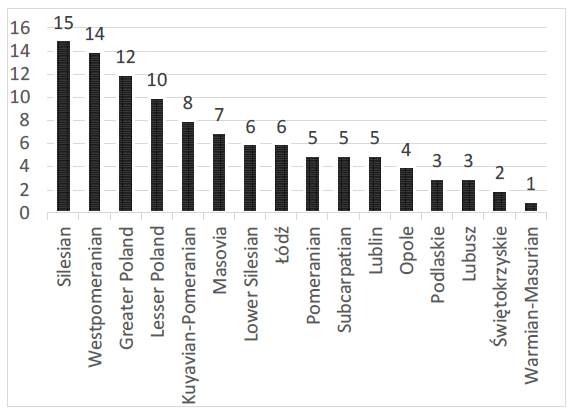
It should be noted that in the case of two leading voivodships (in terms of the number of power plants), one of them is dominated by traditional coal-fired power plants: Silesian Voivodship, while in the latter, power plants using renewable energy sources, mainly wind and water dominate: West Pomeranian Voivodeship. The region also has the latest infrastructure for generating energy from renewable energy sources, from the years 1999-2013. It is satisfactory that most of the currently operating power plants (20), were created in the 2000s. It is caused by significant socio-economic development, which generates a constantly growing demand for electricity. In the ‘90s, ‘80s and ‘70s of the XX century, 10, 4 and 16 power plants were built, respectively. Therefore, we use energy generated by only 50 power plants whose age does not exceed 50 years. The remaining 79 power plants were established at the end of the XIX century and in the first half of the XX century, which means that their age reaches even over 120 years. In the 1950s of the XX century. 15 of them were built, in the years ’40s – 2. The power plant from the ’30s are 5, from the ‘20s – 4, and from the beginning of the XX century 10. Figure 3 shows the age structure (the age of the oldest element of a given power plant) in a comparison with the production capacity. According to GUS data the highest installed power in 2017 was registered in the Silesian voivodship (Fig. 4).

Table 1: List of new generation capacities of conventional units
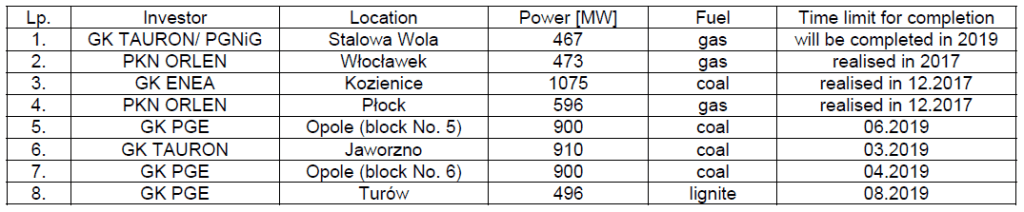
Source: Report on the results of monitoring the security of electricity supply for the period from January 1, 2015 to December 31, 2019, http://www.gov.pl/energia/sprawozdania-z-wynikow-monitorowania-security-energy-electric (29.12.2018)
In the scope of repairs and modernization works related to the current operation of the power plant dominate. As emphasized by Marcewicz, Partyka i Mazur (2016) [25], Polish power industry still needs investments for deep modernization, because a significant percentage of electricity generating equipment (almost 45%) is more than 30 years old. Of course, there are cases of significant renovations and development of infrastructure, however, they are sporadic, and the fact of their occurrence has been signaled above. Usually, repairs and modernizations concerned:
• construction and extension of turbine sets;
• construction or replacement of flue gas desulphurisation systems;
• replacement or installation of boilers;
• construction or replacement of chimneys.
It should be noted here that until 2018, producers declared the construction of new power sources of 10.5 GW (cost PLN 54 billion) and modernization of existing sources (about PLN 12 billion) [26] (Table 1).
Because It is estimated that about 90% of European city residents are exposed to the air in contaminated air: dust, nitrogen dioxide, ozone, benzopyrene [27], it is also worth paying attention to the increase of the contribution of energy from renewable sources. In comparative studies from 2005 to 2017, in power plants using biogas, biomass, solar radiation, wind and hydro-energy as fuel, the production progress is clearly visible. What is more, considering electricity consumers requiring increased delivery reliability, high reliability power supply systems are used [28].
The greatest development can be observed in the relation to wind farms, where the production increase is about 5775 MW. The second are biomass-fired power plants, whose production increased by approximately 1182 MW. The third are power plant using biogas as fuel. The increase in energy production in this case is equal to 206 MW. The next place is occupied by hydropower plants. The last ones are solar power plants, in which energy production was initiated in 2009 and increased in less than 10 years from 0.001 MW to 107.748 MW. In detail, the above data are illustrated by Figure 5.

Acknowledgements: The work was created as part of a project financed by the National Science Center, DEC-2016/22/E/HS5/00406.
REFERENCES
[1] Sprawozdanie z Działalności Prezesa Urzędu Regulacji Energetyki w 2017 r., Warszawa 2018, s. 43-45.
[2] http://www.pse.pl/dane-systemowe/funkcjonowanie-kse/raportymiesieczne-z-funkcjonowania-kse/raporty-miesieczne, (20.12.2018)
[3] Dołęga W., Efektywność energetyczna w aspekcie bezpieczeństwa dostaw energii i bezpieczeństwa ekologicznego, Rynek Energii, 2 (2014); Zawada M., A. Pabian, R. Kucęba, F. Bylok, Rola efektywności w polityce energetycznej Unii Europejskiej, Logistyka, 6 (2015), 546-551
[4] Dołęga W., Wybrane aspekty efektywności energetycznej, Polityka Energetyczna, 4 (2017), T. 20, 67-78
[5] http://www.kogeneracja.com.pl/pl/o-grupie/historia-spolki/, (26.06.2018)
[6] http://www.energiadlalodzi.pl/o-nas/historia, (26.06.2018)
[7] http://www.tauron-ekoenergia.pl/elektrownie/energia-wodna/ewkrakow/Strony/elektrownia-wodna-roznow.aspx#ad-image-0, (26.06.2018)
[8] http://www.monitoruj.podkarpackie.pl/e.html, (26.06.2018)
[9] http://www.pge-obrot.pl/O-Spolce/Historia-Spolki/Oddzial-w-Bialymstoku, (26.06.2018)
[10] http://www.media.energa.pl/file/attachment/13797/…/historia-gpzolowianka-i-stacji-motlawa.pdf, (26.06.2018)
[11] http://www.energobaltic.com.pl/24/produkcja/technologia, (26.06.2018)
[12] http://www.fortum.pl/media/2017/12/elektrocieplownia-zabrze-majuz-120-lat, (26.06.2018)
[13] http://www.mojchorzow.pl/p,s,historia_dzielnicy_chorzow_stary.html, (26.06.2018)
[14] http://www.tauronwytwarzanie. pl/oddzialy/jaworznoiii/Strony/historia.aspx, (26.06.2018)
[15] http://www.ecbedzin.pl/firma/historia, (26.06.2018)
[16] http://www.tauronwytwarzanie. pl/oddzialy/laziska/Strony/historia.aspx, (26.06.2018)
[17] http://www.bytomski.pl/historia/21774-historia-elektrocieplowniszombierki, (26.06.2018)
[18] http://www./eckielce.pgegiek.pl/Technika-i-technologia/Urzadzeniawytworcze, https://www.enea.pl/pl/grupaenea/o-grupie/spolkigrupy-enea/polaniec/informacje-o-spolce/wstep, (28.06.2018)
[19] http://www.energa-kogeneracja.pl/s9-historia, (28.06.2018)
[20] http://www.energa-kogeneracja.pl/s57-elektrocieplownia_kalisz, (28.06.2018)
[21] http://www.przetargi.egospodarka.pl/zamawiajacy/Elektrocieplownia-Kalisz-Piwonice-S-A.html, (28.06.2018)
[22] Dołęga W., Rola wojewodów i samorządu terytorialnego w świetle obowiązujących regulacji prawnych w aspekcie bezpieczeństwa energetycznego kraju, Biuletyn Urzędu Regulacji Energetyki, 5 (2009)
[23] Raport Krajowy Prezesa URE 2018, Warszawa 2018
[24] Chojnacka K., A. Chojnacki, Struktura wytwarzania energii elektrycznej w Polsce w kontekście wykorzystania nośników energii – stan obecny i prognoza, Przegląd Elektrotechniczny, 94 (2018), nr 5, 173-178
[25] Marcewicz T., J. Partyka, M. Mazur, Elektrownie fotowoltaiczne w Polsce – rozwiązania techniczne na przykładzie istniejących obiektów, Przegląd Elektrotechniczny, 92 (2016), nr 8, 151-154
[26] Raport Najwyższej Izby Kontroli, Informacja o wynikach kontroli. Zapewnienie Mocy Wytwórczych w Elektroenergetyce Konwencjonalnej, Warszawa 2015, 8
[27] Herbuś B., Niska emisja – wysokie zagrożenie, Energetyka cieplna i zawodowa, 2 (2017)
[28] Piotrowski P., Wybrane aspekty techniczne i ekonomiczne zasilania odbiorców energii elektrycznej wymagających zwiększonej pewności dostaw energii z uwzględnieniem wykorzystania odnawialnych źródeł energii, Elektro Info, 1-2 (2018), Cz. 1, 16-21
Authors: dr Paweł Szmitkowski, Uniwersytet Przyrodniczo- Humanistyczny w Siedlcach, Instytut Nauk Społecznych i Bezpieczeństwa, ul. Konarskiego 2, 08-110 Siedlce, E-mail: szmitek@op.pl; mgr Sylwia Zakrzewska, Uniwersytet Przyrodniczo- Humanistyczny w Siedlcach, Instytut Nauk Społecznych i Bezpieczeństwa, ul. Konarskiego 2, 08-110 Siedlce, E-mail: sylwia.zakrzewska01@gmail.com; dr Agnieszka Gil, Uniwersytet Przyrodniczo-Humanistyczny w Siedlcach, Instytut Matematyki i Fizyki, ul. Konarskiego 2, 08-110 Siedlce, E-mail: gila@uph.edu.pl; mgr Paweł Świderski, Uniwersytet Przyrodniczo-Humanistyczny w Siedlcach, Instytut Nauk Społecznych i Bezpieczeństwa, ul. Konarskiego 2, 08-110 Siedlce, E-mail:pswiderek@wp.pl
Source & Publisher Item Identifier: PRZEGLĄD ELEKTROTECHNICZNY, ISSN 0033-2097, R. 95 NR 5/2019. doi:10.15199/48.2019.05.44
 Power Quality Blog