Published by Olga Pilipczuk, University of Szczecin ORCID: 0000-0001-7078-2544
Abstract. Currently, edge computing supports many solutions in the energy industry and has attracted the research interest of many researchers. The edge computing concept is relatively novel, the first impactful works were noticed in 2014-2015 years. Thus, there is a lack of studies summarizing the research progress on edge computing in the energy industry. The overview of current research on edge computing is substantial for comprehensive understanding of the research status and future perspectives in this field. The aim of the study was to define and present the current state of research on edge computing applications in the energy sector. To analyse the research trends and perspectives in scientific works development, the bibliometric approach was used. The data were extracted from Web of Science and Scopus platforms. The results comprise the keywords analysis, research field analysis, geographic distribution overview, time trends analysis, as well as author and their affiliation analysis. Additionally, the analysis of the most cited paper has been provided and showed by means of word cloud image. The findings of this research allowed to define the perspectives and future directions for edge computing in the energy sector.
Streszczenie. Obecnie przetwarzanie brzegowe wspiera wiele rozwiązań w branży energetycznej i wzbudza zainteresowanie wielu badaczy. Koncepcja obliczeń brzegowych jest stosunkowo nowa, pierwsze znaczące prace zauważono w latach 2014-2015. Brakuje jednak opracowań podsumowujących postęp badań nad przetwarzaniem brzegowym w energetyce. Przegląd aktualnych badań nad przetwarzaniem brzegowym jest istotny dla kompletnego zrozumienia stanu badań i przyszłych perspektyw w tej dziedzinie. Celem podjęcia badań było określenie i przedstawienie aktualnego stanu badań nad zastosowaniami obliczeń brzegowych w energetyce. Do analizy kierunków badań i perspektyw rozwoju prac naukowych wykorzystano podejście bibliometryczne. Dane zostały pobrane z platform Web of Science i Scopus. Wyniki obejmują analizę słów kluczowych, analizę pola badawczego, przegląd dystrybucji geograficznej, analizę trendów czasowych, a także analizę autorów i ich afiliacji. Dodatkowo przedstawiono analizę najczęściej cytowanych prac, którą przedstawiono za pomocą obrazu chmury słów. Wyniki tych badań pozwoliły określić perspektywy i przyszłe kierunki rozwoju obliczeń brzegowych w sektorze energetycznym. (Przegląd zastosowań obliczeń brzegowych w energetyce)
Keywords: edge computing, energy sector, bibliometric analysis
Słowa kluczowe: przetwarzanie brzegowe, sektor energetyczny, analiza bibliometryczna
Introduction
Although the term edge computing (EC) is a relatively novel concept, it is becoming a popular alternative to IoE and IoT applications [1]. In brief, EC is a new computing model that analyzes and processes portions of data using compute, storage, and network resources distributed in paths between data sources and cloud data centers [2]. Edge computing focuses on short-term real-time data analysis on the device side and can better support real-time local analysis and enterprise intelligent processing [3]. Meanwhile, it has several useful features, such as decentralization, low latency, high efficiency, and reduced traffic pressure, making it more efficient and secure compared to simple cloud computing [3]. It can also be useful for smart home and smart city applications based on collaborative edge [2].
Edge computing brings many advantages to emerging problem solutions. Edge computing in pare with fog computing are attractive solutions to the problem of data processing on the Internet of Things [4]. Edge computing enables a new generation of intelligent applications that can take advantage of the latest advances in artificial intelligence and machine learning. It brings the many benefits of cloud computing to the world of OT, including containerization, virtualization, and modern approaches to application orchestration and updates [5].
New edge computing solutions can also revolutionize the energy industry [5]. Edge-enabled, high-voltage products will build the foundation for the Internet of Energy (IoE) [6]. Nowadays, energy efficiency has become one of the most significant topics for both cloud servers and mobile devices [7]. Though energy efficiency in cloud data centres has been thoroughly investigated, energy efficiency in edge computing is largely left investigated due to the complicated interactions between edge devices, edge servers, and cloud data centres [7]. EC can reduce the amount of data traversing the network. It moves the processing power from the cloud to a point closer to the end user or device. EC enables smarter grids and allows enterprises to better manage their energy consumption.
EC has a key role in supporting smart grid applications such as demand management and grid optimization. Sensors and IoT devices connected to edge platforms in factories, plants, and offices are used to monitor energy consumption and analyse energy levels in real time [8]. By tracking and monitoring energy consumption in real time and visualizing it through dashboards, companies can better manage their energy consumption and take preventative measures to limit energy usage [8]. This article is meant to serve as a survey of recent advancements in Edge computing highlighting the core applications.
Summarizing all the above, many works were published on the EC topic. However, there is a lack of publications on bibliometric analysis on EC in the energy sector. Thus, the aim of this paper is to present the current state of research on edge computing applications in the energy sector and define the main perspectives and challenges.
The paper is structured as follows: after the introduction section the materials and methods are described. Next, the results extracted from WoS and Scopus databases are presented and the discussion on the main findings is provided. In the final part of the paper, the conclusions and future work perspectives are presented.
Research
The research procedure was planned as follows. The procedure begins with the research field identification. After that, the research data base was selected. For above mentioned in this part reasons, the bibliometric study presented was focused on the Web of Science and Scopus databases separately. The following key words were used: “Edge computing” AND “energy”.
The following bibliometric parameters were analysed: publication type, research fields, years, countries, affiliations and authors, funding sources.
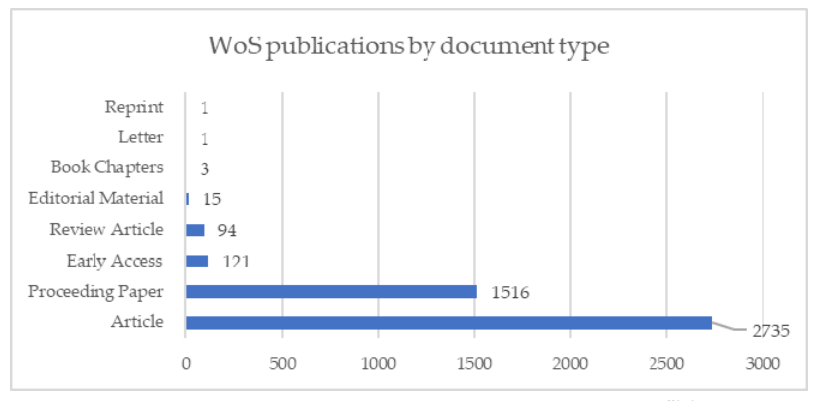
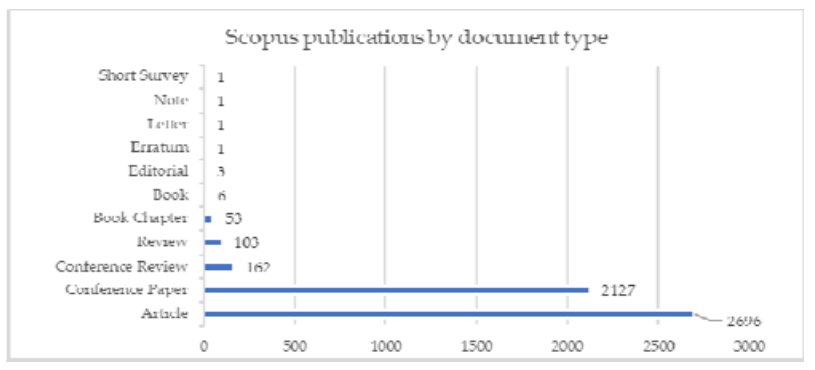
First, the analysis by publication type was conducted. The most popular type of publication was original article and conference/proceedings paper according to both databases (see Fig. 1, 2). Moreover, according to WoS the 53 book chapters, 162 conference reviews, 103 reviews and six books were published as well. The number of book chapters occurring in Scopus database was smaller. 0 books and just 3 book chapters were published. The number of review articles was similar and counted 94 papers.
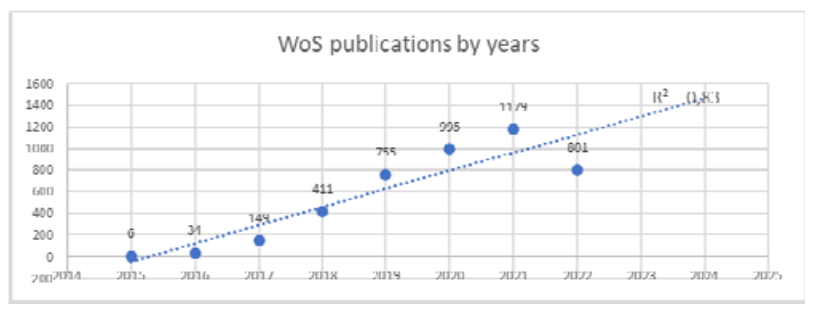
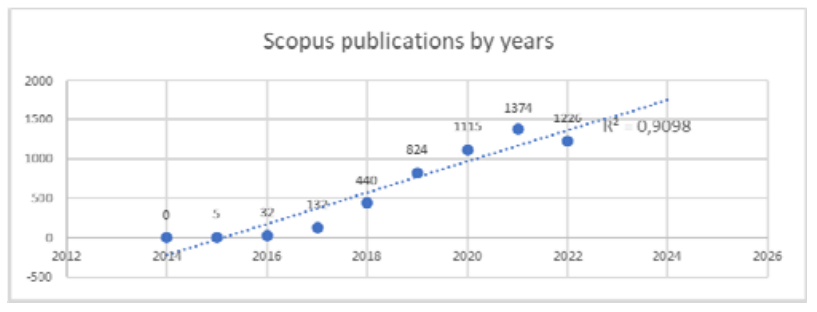
In the next step, the publication analysis in dynamics from 2014 to 2022 was done together with the prediction till 2024 year by forecast linear trend line application (see Fig. 3,4). Although the beginning of the publication period in the WoS and Scopus databases was recorded only in 2015, the increase in number of publications was rapid. In 2021, it exceeded 1 thousand papers.
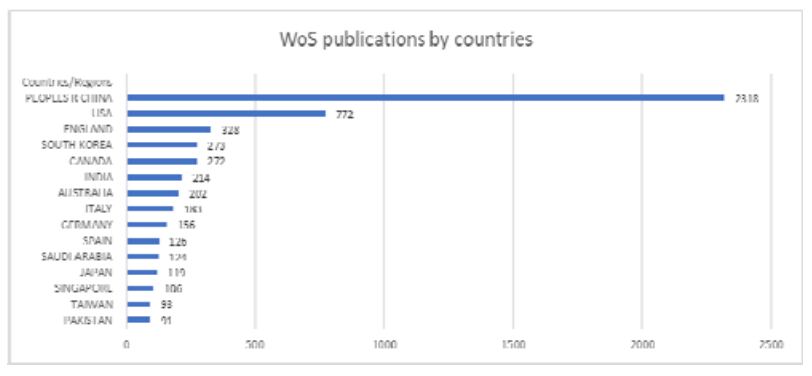
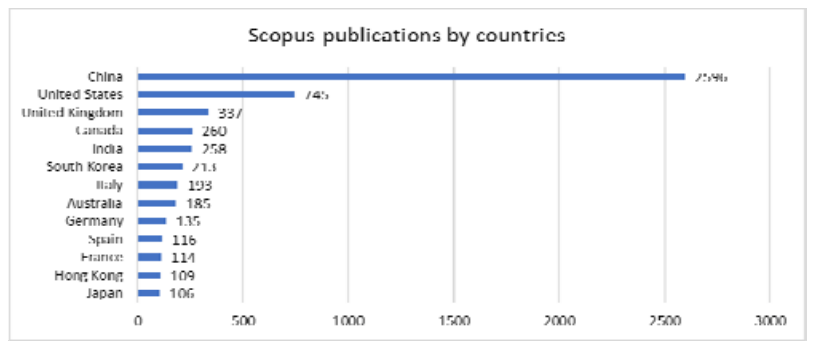
Analyzing the publications by countries, the comparable results were extracted from both databases (see Fig.5,6). The huge advantage of China was noticed; more than 2300 publications. Its contribution was several times greater than other countries. The second place obtain the USA, the third – England/United Kingdom.
In the next step, the publication analysis in dynamics from 2014 to 2022 was done together with the prediction till 2024 year by forecast linear trend line application (see Fig. 3).
Although the beginning of the publication period in the WoS and Scopus databases was recorded only in 2015, the increase in number of publications was rapid. In 2021, it exceeded one thousand papers.
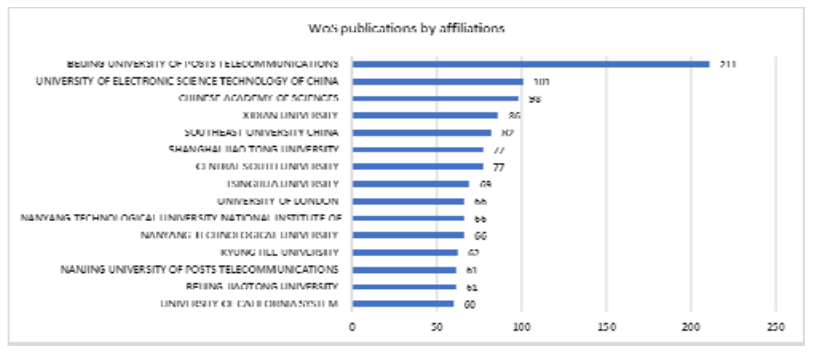
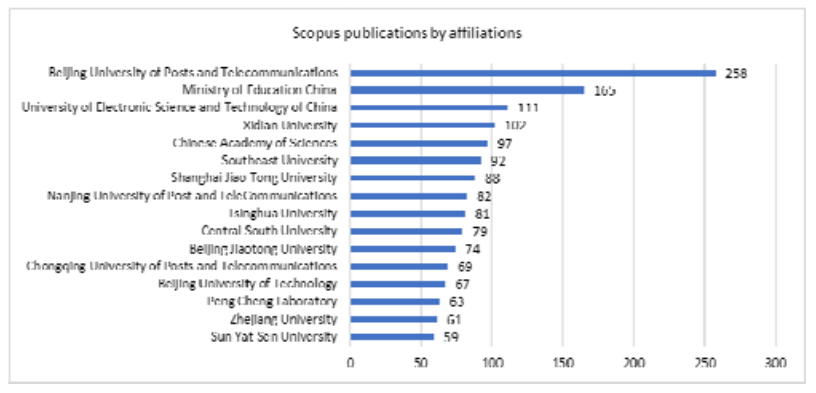
China’s scientific institutions were also the leaders in category by affiliations (see Fig.7,8). The leading position obtain the Beijing University of Posts and telecommunication with more than two hundred publications, which is approximately one tenth of the total number of Chinese publications.
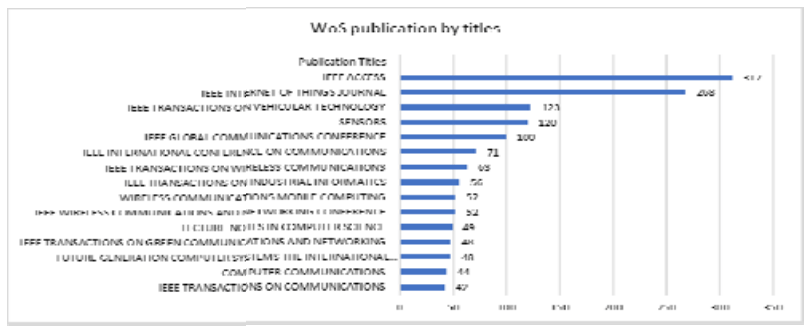
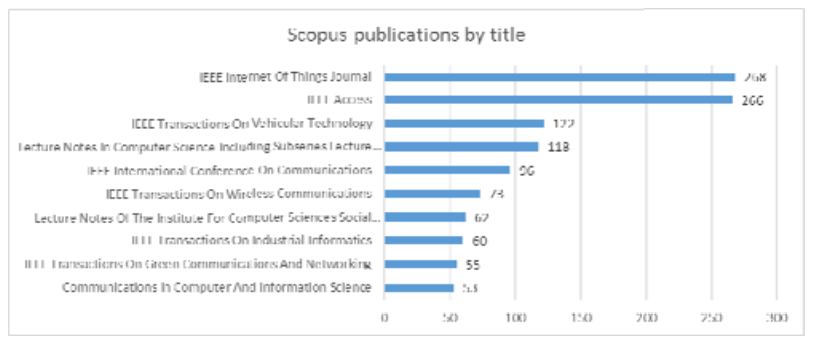
The most publications occurred in IEEE Society journals such as “IEEE Access,” “IEEE Internet of Things” journal, “IEEE transactions on Vehicular technology,” “IEEE Transactions in Wireless Communications”, and others. Among other publishing houses, the two MDPI journals were popular, namely “Sensors” and “Electronics” (see Fig. 9,10). Among others, Elsevier, Hindawi and Wiley publishing houses were popular. Lecture notes in Computer science by Springer were the popular choice for conference papers.
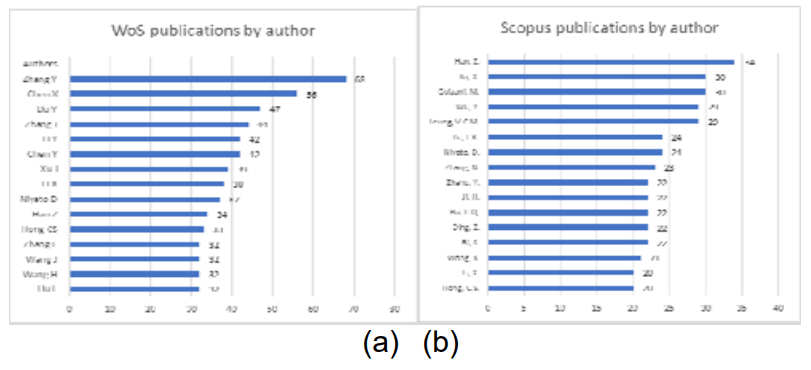
The author analysis reveals significant differences between WoS and Scopus databases (see Fig. 11). In WoS database, three leading positions were obtained by Zhang Y, Chen X and Liu Y. In Scopus database, the leading positions were obtained by Han Z, Xu X., Guizani M. In Scopus, Zhang Y obtained the ninth position. And, vice versa, in WoS Han Z obtained the 10th position.
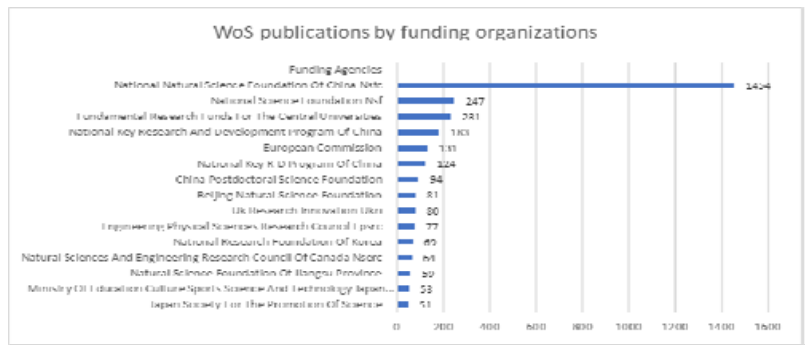
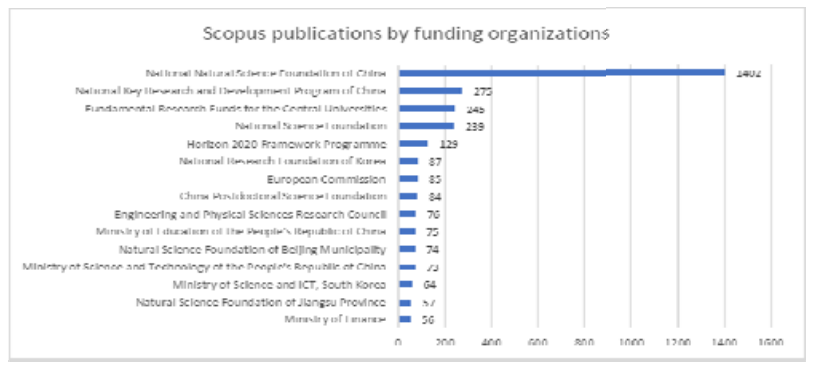
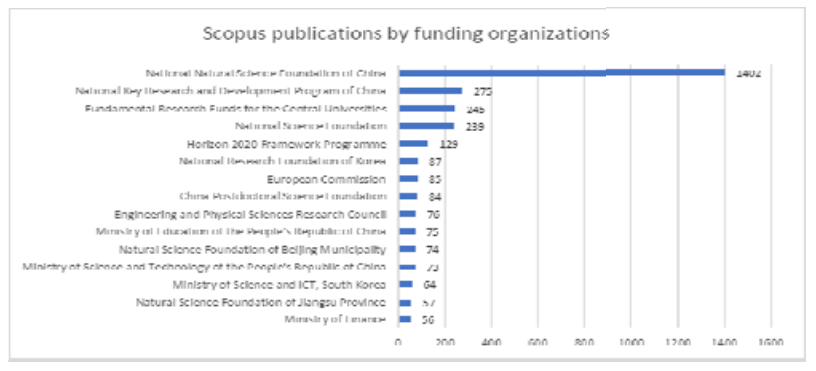
Due to fact that most of the works were published by China, the great amount of research was funded by Chinese organizations. The advantage of National Natural Science Foundation was noticed in WoS database as well as in Scopus database.
A great amount of research was funded by Chinese organizations such as the National Natural Science Foundation, National Key Research Development Program, China Postdoctoral Science foundation, Beijing Natural Science foundation etc. (see Fig.12,13). The huge advantage of the National Natural Science Foundation was noticed. 247 papers were funded by the National Science Foundation from the USA. More than one hundred research were founded by European Commission. 129 of Scopus publications were funded in terms of the Horizon 2020 Framework Program.
At the last step the following keywords were extracted for keyword cloud construction (Figure 14): “mobile edge computing”, “fog computing”, “mobile cloud computing”, “computation offloading”, “resource management”, “green computing”, “mobile network architecture”, “computation offloading”, “allocation of computing resources”, “mobility management”, “standardization”, “use-cases”, “Internet of Things”, “enabling technologies”, “security and privacy, and applications”, “energy harvesting”, “dynamic voltage and frequency scaling”, “power control”, “QoE”, “Lyapunov optimization”, “non-orthogonal multiple access”, “resource allocation”; “modelling and simulation”, “survey”, “partial computation offloading”, “dynamic voltage scaling”, “collaboration between communication and computation resources”, “mobile edge caching”, “D2D”, “SDN”, “NFV”, “content delivery”, “energy minimization”, “small cells”.
Discussion and conclusion
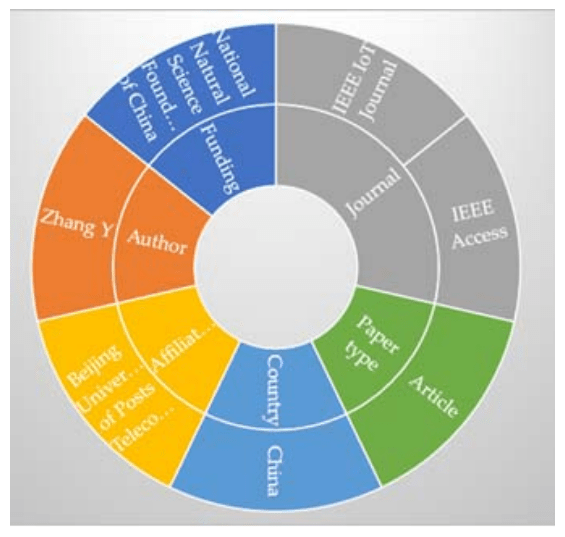
To create the overview of state of art on EC in the energy sector the obtained results were presented using tree map showed on Figure 15. The figure described the most popular type of paper, journal, the most productive author, university, founding organization and country which have leading position in the field.
It should be mentioned that this research has several limitations. First, the data was analysed by means of WoS and Scopus databases analyses tool are restricted to their capabilities of analysis. On the other hand, it allows to avoid several difficulties and challenges mentioned in materials and method section. Another limitation is that the research includes publications in English, and it is recommended that future research include documents published in other languages.
Despite the quick speed of increasing the number of publications on EC, it is still in its infancy stage in many countries. The small number of scientific publications on bibliometric analysis of EC is owed to its novelty in comparison to other emerging technologies such as AI, big data etc.
However, the current research concentrates around several counties and affiliations creating challenges in EC widespread.
The data extracted from WoS and Scopus databases allowed to define the following findings:
• The research history on EC starts from 2014.
• The research on EC was concentrated in several countries, several institutions and research teams.
• A small number of scientific publications on bibliometric analysis on Edge Computing due to its novelty in comparison to other emerging technologies such as AI, Big data etc.
• Quick speed of increasing the number of publications on EC.
The keyword cloud together with the literature study allow to define the current most popular publication trends on EC applications in energy industry. It was founded that the main future directions for edge computing development in energy industry are the following: mobile edge computing, sustainability issues in edge computing, smart grids, security and privacy issues, green edge computing and IoE, smart cities. Moreover, to make the research areas on EC more sustainable the more research should be funded in other geographic regions, especially in EU countries.
REFERENCES
[1] Shi, W.; Cao, J.; Zhang, Q.; Li, Y.; Xu, L. Edge Computing: Vision and Challenges. IEEE Internet Things J. (2016), 3 (5), 637–646. doi:10.1109/jiot.2016.2579198
[2]] Liu, D.; Liang, H.; Zeng, X.; Zhang, Q.; Zhang, Z.; Li, M. Edge Computing Application, Architecture, and Challenges in Ubiquitous Power Internet of Things. Front. Energy Res. (2022), 10:850252. doi: 10.3389/fenrg.2022.850252
[3] Gupta, H; Dastjerdi, AV; Buyya, R. iFogSim: A toolkit for modeling and simulation of resource management techniques in the Internet of Things, Edge, and Fog computing environments, (2017)
[4] New edge computing solutions set to revolutionize the power industry, By Guest Contributor -Aug 1, 2022 https://www.smart-energy.com/industry-sectors/newtechnology/new-edge-computing-solutions-set-torevolutionise-the-power-industry/ Accessed on 28.09.2022
[5] https://www.siemens-energy.com/global/en/offerings/powertransmission/innovation/edge-technology.html Accessed on 27.09.2022
[6] Stead, M.; Gradinar, A.; Coulton, P.; Lindley, J. Edge of Tomorrow: Designing Sustainable Edge Computing. In: Proceedings of the Design Research Society Conference (2020), 1. Proceedings of the Design Research Society Conference (2020), 1. Design Research Society, Brisbane, 88-110. ISBN 9781912294374
[7] Pasqualetti F., Towards a Digital Renaissance, February 4, 2021 https://www.capgemini.com/insights/expertperspectives/towards-a-digital-renaissance/ Accessed on 21.09.2022
[8] Edge computing: Changing the balance of energy in networks” STL Partners https://stlpartners.com/articles/edgecomputing/edge-computing-changing-the-balance-of-energyin-networks/ Accessed on 22.09.2022
[9] Edge Innovations in the Utilities Industry, https://www.cio.com/article/193606/edge-innovations-in-theutilities-industry.html Accessed on 22.09.2022
[10] Oyinlola, T. Energy Prediction in Edge Environment for Smart Cities, 2021 IEEE 7th World Forum on Internet of Things (WF-IoT), (2021), 439-442, doi: 10.1109/WFIoT51360.2021.9595460.
[11] Hamdan, S.; Ayyash, M.; Almajali, S. Edge-Computing Architectures for Internet of Things Applications: A Survey. Sensors (2020), 20, 6441. https://doi.org/10.3390/s20226441
[12] Tikito, I., Souissi, N., “Smart Data Collection in Mobile Edge Computing Environment,” 2020 International Conference on Intelligent Systems and Computer Vision (ISCV), (2020), 1-7, doi: 10.1109/ISCV49265.2020.9204277.
[13] Zaiwar Ali, Ziaul Haq Abbas, Ghulam Abbas, Abdullah Numani, Muhammad Bilal, Smart computational offloading for mobile edge computing in next-generation Internet of Things networks, Computer Networks 2021, Volume 198, 108356, https://doi.org/10.1016/j.comnet.2021.108356.
[14] Zhang, L., Zhou, W., Xia, J. et al. DQN-based mobile edge computing for smart Internet of vehicle. EURASIP J. Adv. Signal Process. (2022), 45. https://doi.org/10.1186/s13634-022-00876-1
[15] Wang, J.; Zhao, L.; Liu, J.; Kato, N. Smart Resource Allocation for Mobile Edge Computing: A Deep Reinforcement Learning Approach. IEEE Transactions on Emerging Topics in Computing. (2021), 9(3), 1529-1541. https://doi.org/10.1109/TETC.2019.2902661
[16] Liu, Tianyi; Luo, Ruyu; Xu, Fangmin; Fan, Chaoqiong; Zhao, Chenglin. Distributed Learning Based Joint Communication and Computation Strategy of IoT Devices in Smart Cities. Sensors (2020), 20. 973. 10.3390/s20040973.
[17] Mahmood, O.A.; Abdellah, A.R.; Muthanna, A.; Koucheryavy, A. Distributed Edge Computing for Resource Allocation in Smart Cities Based on the IoT. Information (2022), 13, 328. https://doi.org/10.3390/info13070328
[18] Xu, Minxian; Gao, Chengxi; Ilager, Shashikant; Wu, Huaming; Xu, Cheng-Zhong; Buyya, Rajkumar. Green-Aware Mobile Edge Computing for IoT: Challenges, Solutions and Future Directions (2021). 10.1007/978-3-030-69893-5_7.
[19] Mukherjee, A., Panja, A.K., Obaidat, M.S., De, D. 6G Based Green Mobile Edge Computing for Internet of Things (IoT). In: De, D., Mukherjee, A., Buyya, R. (eds) Green Mobile Cloud Computing. Springer, Cham. (2022) https://doi.org/10.1007/978-3-031-08038-8_13
[20] Deng, Y., Chen, Z., Yao, X., Hassan S., and A. M. A. Ibrahim, Parallel Offloading in Green and Sustainable Mobile Edge Computing for Delay-Constrained IoT System, IEEE Transactions on Vehicular Technology, (2019), vol. 68, no. 12, 12202-12214, Dec. 2019, doi: 10.1109/TVT.2019.2944926.
[21] Anqi Meng, Guandong Wei, Yao Zhao, Xiaozheng Gao, Zhanxin Yang, Green resource allocation for mobile edge computing, Digital Communications and Networks, (2022), https://doi.org/10.1016/j.dcan.2022.03.001.
[22] Anwit, R., Jana P., and Tomar, A, “Sustainable and Optimized Data Collection via Mobile Edge Computing for Disjoint Wireless Sensor Networks,” in IEEE Transactions on Sustainable Computing, (2022), vol. 7, no. 2, 471-484, 1 April-June, doi: 10.1109/TSUSC.2021.3120003.
[23] Andrawes, A.; Nordin, R.; Albataineh, Z.; Alsharif, M.H. Sustainable Delay Minimization Strategy for Mobile Edge Computing Offloading under Different Network Scenarios. Sustainability (2021), 13, 12112. https://doi.org/10.3390/su132112112
Authors: dr Olga Pilipczuk, Uniwersytet Szczeciński, Instytut Zarządzania, ul. Cukrowa 8, Szczecin, olga.pilipczuk@usz.edu.pl
Source & Publisher Item Identifier: PRZEGLĄD ELEKTROTECHNICZNY, ISSN 0033-2097, R. 100 NR 5/2024. doi:10.15199/48.2024.05.45
 Power Quality Blog