Published by 1. Petro LEZHNIUK, 2. Yulia MALOGULKO, 3. Ihor PROKOPENKO, Vinnitsa National Technical University, Ukraine. ORCID. 1. 0000-0003-0338-2131, 2. 0000-0002-6637-7391, 3. 0000-0001-6050-9413
Abstract. The paper considers the possibility of providing services from the automatic reserve of frequency recovery and the provision of balancing services. Determined the relationship between the price indices of additional service market and technical and economic characteristics of the battery energy storage system. The target function is offered in the mathematical model of operation of the battery energy storage systems, which takes into account the reduced costs for the accumulation of a unit of electricity, maintenance and income from the provision of services on market.
Streszczenie. W artykule rozważono możliwość świadczenia usług z automatycznej rezerwy odzyskiwania częstotliwości oraz świadczenie usług bilansujących. Określono zależność między wskaźnikami cen rynku usług dodatkowych a charakterystyką technicznoekonomiczną baterii akumulatorów. Funkcja celu jest oferowana w matematycznym modelu pracy akumulatorowych systemów magazynowania energii, który uwzględnia zmniejszone koszty akumulacji jednostki energii elektrycznej, usługa i dochodów ze świadczenia usług na rynku. (Modelowanie matematyczne baterii akumulatorów na rynku usług dodatkowych Zjednoczonego Systemu Elektroenergetycznego Ukrainy)
Keywords: additional service market; battery energy storage system; frequency support reserve; frequency recovery reserve.
Słowa kluczowe: rynek usług dodatkowych; system magazynowania energii baterii; rezerwa wsparcia częstotliwości; rezerwa odtworzenia
Introduction
A significant increase in the generation of renewable energy sources (hereinafter – RES), which significantly depends on changing weather conditions, as well as a significant degree of aging of the main generating equipment of thermal power plants (TPP) forces industry to reconsider the structure of generating capacity [1].
High occupancy schedule of the integrated power system of Ukraine (hereinafter – IPS of Ukraine), the basic generation of nuclear power plants (hereinafter – NPP), with a gradual decrease in the generation of hydropower and storage power plants (hereinafter – HPP and SPP, respectively), forces industry to reconsider generating capacity of the power system of Ukraine.
The introduction of a new model of the electricity market has made it possible to divide the product (electricity) into certain products provided in different market segments, which have different prices depending on demand at a particular hour [2,3]. The financial result of work in the market significantly depends on the ability to manage one’s own source of generation or consumption [4-7]. The introduction of a new model of the electricity market has made it possible to divide the product (electricity) into certain products provided in different market segments, which have different prices depending on demand at a particular hour [2,3]. The financial result of work in the market significantly depends on the ability to manage one’s own source of generation or consumption [4-7].
Thus, in [8], it is noted that today to ensure the operational safety of the IPS of Ukraine it is necessary to introduce at least 400 MW of “flexible” generating capacity. As a result, the Transmission System Operator (hereinafter referred to as the TSO) introduced a number of auctions for the purchase of power reserves for primary, secondary and tertiary frequency control.
The transmission system operator determines the volumes of services and products on the market of ancillary services (hereinafter – MAS), which are necessary for the stable operation of the electricity system. The Law of Ukraine on the Electricity Market defines 5 main products that can be traded on the MAS [9,10], in particular:
frequency and active power regulation in UES of Ukraine:
– Frequency support reserve (FSR). The process of frequency maintenance is to keep the frequency and reduce frequency deviations from the nominal value, regardless of the cause and location of the imbalance in the synchronous zone, by activating the frequency maintenance reserves;
– Frequency recovery reserve (FRR). The process of frequency recovery is to return the frequency to the nominal value while returning interstate exchanges to the planned values (in synchronous operation with power systems of other countries) by reducing the error of the control area to zero during the frequency recovery time (not more than 15 minutes) FSR by activating frequency recovery reserves. The time of commissioning (full activation) of FSR is not more than 15 minutes; stable delivery of microwave at least 60 minutes;
– Replacement reserve (RR). In order to maintain the set values of HF and HF and restore these reserves in case of their use in the process of frequency regulation in the UES of Ukraine / control unit / synchronous region, the process of replacement of reserves should be carried out and replacement reserves should be created. Time of commissioning (full activation) of RH is not more than 30 minutes; stable delivery of RH is not limited in time.
to maintain the parameters of reliability and quality of electricity in the UES of Ukraine:
– voltage and reactive power regulation service. The purpose of Voltage and reactive power control in synchronous compensator (SC) mode is to maintain voltage levels at transmission control points within certain allowable limits in order to maintain the stability and safety of the power system (control area) by providing and using use of the reserve of reactive power of generating units capable of switching to the mode of SC;
– service to ensure the restoration of the UES of Ukraine after system accidents. The purpose of the service is the possibility of starting the generation unit in the absence of voltage in the external network and electrical location in the network, which allows the transfer of energy to own needs NPPs (TPPs) taking into account electricity losses in the network, as well as the presence of a generation unit in the recovery plan of UES of Ukraine / Burstyn TPP Island after a special system accident (and / or regional recovery plans).
Potentially, one of the main participants in the MAS in terms of providers of frequency and active power regulation services in the UES of Ukraine may be energy storage system operators (hereinafter – BESS).
However, to date, regulations do not regulate the connection of electrical installations of this type to the networks of system operators, as well as there is no definition – energy storage system. Within the framework of this article, referring to the Draft Law on Amendments to the Law of Ukraine “On the Electricity Market” (on energy security, balancing of the energy system and energy storage system), we understand that:
– energy storage system – a technological complex connected to the transmission or distribution system for the purpose of selection, accumulation, including by conversion (physical, inertial, chemical, hydrogen and other technologies) of previously produced electricity, its storage and subsequent release;
– energy storage system operator – an entity that uses the electricity storage system to buy and sell electricity in the electricity market, and provides ancillary services and is responsible for the safe operation and maintenance of such energy storage system.
Thus, today, for the implementation of a new entity in the electricity market – the operator of the storage system, the task of developing a mathematical model of BESS in the market is relevant. This task is technical and economic, which should take into account changes in the market price of ancillary services UES of Ukraine and determine such a schedule of BESS in the market that will bring maximum profitability to its owner and minimize penalties for noncompliance with the commands of the dispatcher TSO.
Aim of the research
The aim of the article is to develop a mathematical model of the energy storage system in the market of ancillary services, which will ensure maximum profitability of the energy storage system.
Main materials of the research
In accordance with the provisions of the Law of Ukraine “On Electricity Market“ Article 8, economic activity on production, transmission, distribution of electricity, supply of electricity to consumers, trading activities, performing the functions of market operator and guaranteed buyer is carried out on the electricity market subject to obtaining a license.
Clause 1.6 of the Licensing Conditions for Conducting Business Activities for Electricity Production, approved by the Resolution of the National Commission for Electricity Market Regulation of December 27, 2017 №1467 (hereinafter – License Conditions) provides that the license applicant shall be provided electricity.
In this case, in accordance with paragraph 1.4. License conditions:
– electric generating equipment – a set of functionally interconnected equipment that produces electricity and consists of one or more generators or other equipment used to convert energy resources of any origin into electricity;
– means of economic activity – electricity generating equipment located at the power facility, and other functionally interconnected equipment and facilities intended for the production of electricity.
It should also be noted that the energy storage system is an electrochemical system in which the functions of electrical energy storage devices are implemented. Energy storage systems as a source of electrical energy are used in devices, apparatus or systems, the operation of which is based on the autonomous principle of operation, ie regardless of the presence in the immediate vicinity of the electrical network. In batteries, during charging, electrical energy is converted into chemical energy and the system is in equilibrium as long as even a very small current flows between the electrodes. When connecting the contacts of the energy storage system to the consumer of electrical energy (element with finite electrical resistance) is the reverse process: chemical energy is converted into electricity – and part of it is converted into heat.
Thus, the peculiarities of energy storage systems is that, depending on the mode of operation, it can be both a consumer of electricity and the supply of electricity to the network, and therefore unambiguously attribute the energy storage system to the generating unit is not possible.
Given the above, the Law of Ukraine “On the Electricity Market” does not clearly define the activities related to the accumulation, storage and further sale of electricity of the electricity storage system. In accordance with the current License Terms, licensing of economic activity of the electricity storage system is not provided. In addition, according to the Codes of Distribution and Transmission Systems approved by the NKREKP Resolutions of 14.03.2018 №309 and 310, the provision of distribution system by the operator, or transmission of services for connection to electricity networks of energy storage system is not provided, which in turn makes such systems in the electricity market and the provision of relevant services.
Legislative support for the implementation of electricity storage systems should be carried out in compliance with the principles of European policy and legislation. Thus, when the General Recommendations on the 2030 Target Policy for the Energy Community Contracting Parties, one of which is Ukraine, were adopted in December 2018, the Energy Community Council of Ministers announced the start of work on the incorporation of the 4th Energy Package (Clean Energy Package) into the legislation of the Energy Community acquis, which will become mandatory for transposition and implementation by the Contracting Parties.
Directive (EU) 2019/944 of the European Parliament and of the Council of 05 June 2019 on common rules for the internal market in electricity (hereinafter – the Directive), which is part of the Clean Energy Package, sets out the basic requirements on the development and participation of storage systems in the electricity market.
Mathematical model of SSE work on organized market segments
Taking into account the provisions of the Directive, the key issue in the legislative support of the introduction of electricity storage systems: unconditional compliance with market principles of development and participation of electricity storage systems in the electricity market, avoidance of creating unjustified economic and regulatory benefits.
The target function should be aimed at achieving maximum profit for the reporting period. Total profit in general consists of income and expenses and is formed in such a way as to determine the optimal working conditions of the BESS in different scenarios of pricing of services provided:

where: ps – the probability of a scenario with a corresponding price for BESS services;; Rs(t)DAM – income from the provision of services at DAM in the scenario s in hour t ; Rs(t)MAS – income from the provision of services at MAS in the scenario s in hour t ; Ctdp – the cost of using the battery on DAM / IM and MAS; CtDOD – the cost of degradation of the battery at the allowable depth of discharge and below the allowable level; CtMC – service costs.
Thus, the accumulation system operator can predict a number of market price scenarios in advance and estimate the different probabilities of such scenarios ps , using data from previous and current billing period t . This approach makes it possible to predict the technical and economic performance of the energy storage system.
Income from the sale of electricity on the market for the day ahead or intraday market Rs(t)DAM is achieved through the purchase of electricity at night, when the market has a surplus of generation (ie the price is low) and sales during the day when the price is high. Another source of income is the provision of MAS services Rs(t)MAS , denoting the income from the sale of services for primary, secondary and tertiary regulation of the relevant scenario s in hour t , respectively.
The cost part (1) consists of the cost of using the battery on DAM / VDR and MAS – Ctdp when providing appropriate services, the cost of degradation of the battery at the allowable depth of discharge and below the allowable level CtDOD , as well as maintenance costs – CtMC .
Revenues from the sale of services on MAS and DAM are determined by formulas 2 and 3, respectively.

where ps(t) – the probability of a scenario s ; Ws(t) – financial result from the purchase and sale of electricity on the market in a period of time Δt .

where Ws(t)MAS – the total amount of electricity sold / purchased in the ancillary services market;; Ps(t)MAS – the price of electricity for MAS in the scenario s in hour t ; Rs(t)redMAS – fee for readiness to provide services in the market of ancillary services; btreg – payment for the amount of electricity sold on the market of ancillary services.
The cost of using BESS capacity in the markets on DAM / IM and MAS Ctdp when providing relevant services, which is proportional to the amount of electricity that was used by the battery (both in charge and discharge mode), according to (5).

where Cop – the price of using the BESS when buying and selling a unit of electricity; e sell bte.sell – electricity sold on the electricity market over a period of time Δt ; bte.buy – electricity purchased on the electricity market over a period of time Δt .
Cost, taking into account the deterioration of the v-th battery, which is controlled by the operator of the distributed BESS – CtDOD , is defined according to expressions (6-9):
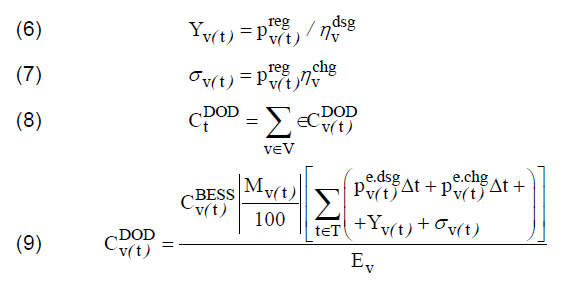
where Ev – full capacity of BESS, kW * h; ηvdsg та ηvchg – charge and discharge efficiency of the v-th battery, respectively; pv(t)reg – command to adjust (discharge/charge) in the period t ; pv(t)e.dsg – power at which for time t the v-th BESS will be completely discharged; pv(t)e.chg– power at which for time t the v-th BESS will be completely charged; σv(t) – the amount of electricity, according to the unloading command, which charges the v-th BESS, during the time series t ; Yv(t) – the amount of electricity, according to the command to download, which discharges the v-th BESS, during the time series t ; Сv(t)BЕSS – the cost of the v-th battery, taking into account the level of its degradation – Mv(t) .
The cost of service of the v-th BESS СMC depends on the service price per unit of BESS capacity and the total capacity of distributed BESS – Pmax defined as

where сom – service price per unit of BESS capacity, UAH; Pv,max – rated power of the v-th battery.
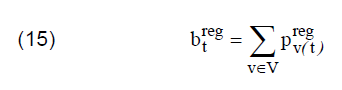
The total price for electricity is determined by the sold and bought electricity, which is illustrated in expression (12). v-th battery for a certain period of time t cannot be charged and discharged at the same time, therefore pv(t)e.dsg and pv(t)e.chg both cannot be positive. However, due to the fact that there are many distributed BESS, it is technically possible for the storage system operator to sell and buy electricity at the same time, provided that for a certain period of time t , one part of the batteries will be charged and the other will be discharged. Ideally, the total price of electricity should be distributed among the batteries, as shown in (13) and (14). The total volume of trades on MAS is given in (15).

Modeling of BESS work on MAS
When the BESS is connected to the MSO networks and participates in the balancing market and the market of ancillary services, the main use of the BESS operator’s capacity will be aimed at providing a symmetric 80% aFRR service. This ratio is taken into account the technical characteristics of batteries based on LiFePO4 for them, the depth of discharge (Depth of Discharge, DOD) is taken at 80%, which provides the optimal number of cycles.
The general principle of balancing OS disturbances with the use of SOEs is shown in Fig. 1
To date, an analysis of the electricity market for August 2020 has been published on the NEC Ukrenergo website. In fig. 2 shows the results of the MAS. In the UES of Ukraine, the purchase of frequency support reserves (FSR) averages 21 MW per hour. The purchase of aFRR (automatic frequency recovery reserves) during the month was volatile due to insufficient supply of market participants. 31% – 71% of the auction needs were purchased for loading aFRR (on average 53%), from 10% to 95% for unloading (on average – 58%). [11]

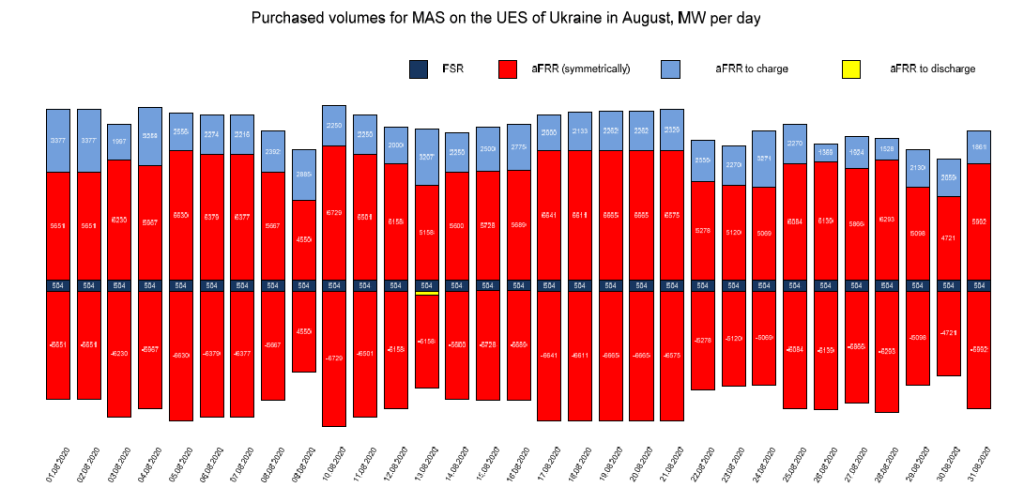
Based on the above information, the customer’s BESS will participate in the MAS using ± 0.4Sn to provide aFRR service. When submitting an application for symmetric FRR and aFRR services, the volume is indicated only in one of the directions, and the price should not exceed the value that represents the sum of the marginal prices for loading and unloading (512.27 + 289.27 = 801.54). Given that today there is an insufficient level of proposals for aFRR, the price for this service is accepted as the maximum, 801.54 (UAH/MW excluding VAT).
Purchase and sale of electricity will be carried out on the balancing market [12, 13] in accordance with the Rules of the electricity market of Ukraine [14, 15], at imbalance prices, IMSP (UAH / MWh) [12], transmission and distribution fees (Vinnytsia area) is 24 and 15 kopeck/kWh, respectively.
It is assumed that BESS with a capacity of 5 MWh and DOD 80% will operate on symmetric services as follows:
– 00:00 – 01:00 at the first connection to the BESS network with “empty” batteries is the charge of the installation by purchasing electricity on BM 3,255 MWh. As a result, the BESS capacity will be 3.1 MW. 3,255 MWh consists of – 2 MWh – symmetric electricity at DOD 80%, ie 5*0.8/2=2 MWh, which will be used to use the aFRR reserve;
– 1 MWh – to provide residual electricity in batteries at DOD 80%, ie 5 * (1-0.8) = 1 MWh;
– 0.155 kWh – 5% loss from 3.1 MWh in charge mode. – 01:00-02:00 on the command of the dispatcher there is an involvement of a reserve of aFRR in a network BESS issues 2 MWh at cost of BR with receipt of a payment for readiness. Taking into account 5% of losses in the inverter with ESS, 2.1 MWh will be used. As a result, the BESS capacity will be 1 MWh.
– 02:00-03:00 the installation is charged by purchasing electricity at BM 2,205 MWh (0.105 MWh is 5%). As a result, the BESS capacity is 3.1 MWh.
In the following hours, the BESS operates cyclically with an hourly discharge / charge until the end of the day, similar to the period described from 01:00 to 03:00. The full calculation is shown in Figure 3.
The balance of flows for the first day is – 3.51 MWh and for the second and all subsequent days – 2.46 MWh. Due to the fact that the BESS on the first day starts from scratch. For BESS of this capacity and capacity, the daily income is UAH 19,114.90 including VAT. According to the calculations, the average daily balance of flows is 2,495 MWh.


Conclusions
Prerequisites for the introduction of energy storage systems are the constant growth of unguaranteed generation of RES and the actual end of its park resource a significant part of thermal generation, which today, together with hydropower plants are the main means of balancing the energy system. Such factors significantly affect the operational safety of the UES of Ukraine.
Since the introduction of new technologies requires investment, the paper developed a mathematical model of battery operation in the market for the day ahead, balancing and ancillary services market, which allows to determine the payback period of such a project when providing ancillary services to the transmission system operator.
REFERENCES
[1] Lezhnyuk P. D. Otsinyuvannya yakosti elektropostachannya v mistsevykh elektrychnykh systemakh z riznotypnymy vidnovlyuvalʹnymy dzherelamy enerhiyi / P. D. Lezhnyuk, V. O. Komar, S. V. Kravchuk, I. V. Kotylko, I. O. Prokopenko // Visnyk Kharkivsʹkoho natsionalʹnoho tekhnichnoho universytetu silʹsʹkoho hospodarstva imeni Petra Vasylenka. – 2018. – Vyp. 195 – S. 23-25. – Rezhym dostupu: http://nbuv.gov.ua/UJRN/Vkhdtusg_2018_195_10
[2] Blinov I.V., Parus YE.V., Ivanov H.A. Doslidzhennya orhanizatsiyi konkurentnoyi modeli rynku elektroenerhiyi Ukrayiny z urakhuvannyam merezhevykh obmezhenʹ v OES Ukrayiny. Pr. In-tu elektrodynamiky NAN Ukrayiny. 2016. Vyp.45. S. 34 – 39.
[3] Kyrylenko O.V., Blinov I.V., Parus YE.V. Otsinka roboty elektrostantsiy pry nadanni dopomizhnykh posluh z pervynnoho ta vtorynnoho rehulyuvannya chasto v OES Ukrayiny. Tekhnichna elektrodynamika. 2013. № 5. S. 55 – 60.
[4] Feng L, Zhang JN, Li GJ et al (2016) Cost reduction of a hybrid energy storage system considering correlation between wind and PV power. Prot Control Mod Power Syst 1(1): http://doi.org/10.1186/s41601-016-0021-1.
[5] Chen Q, Liu D, Lin J et al (2015) Business models and market mechanisms of energy internet (1). Power Syst Technol 11(39): doi 10.1109/HICSS.2001.927035
[6] Li H, Abinet TE, Zhang JH et al (2017) Optimal energy management for industrial microgrids with high-penetration renewables. Prot Control Mod Power Syst 2(1): https://doi.org/10.1186/s41601-017-0040-6
[7] K. Vatanparvar and M. A. Al Faruque, “Design Space Exploration for the Profitability of a Rule-Based Aggregator\Business Model Within a Residential Microgrid,” in IEEE Transactions on Smart Grid, vol. 6, no. 3, pp. 1167-1175, May 2015, doi: 10.1109/TSG.2014.2380318.
[8] R. Hidalgo-León et al., “A survey of battery energy storage system (BESS), applications and environmental impacts in power systems,” 2017 IEEE Second Ecuador Technical Chapters Meeting (ETCM), 2017, pp. 1-6, doi: 10.1109/ETCM.2017.8247485.
[9] D. Wu, Q. Gui, W. Zhao, J. Wang, S. Shi and Y. Zhou, “Battery Energy Storage System (BESS) Sizing Analysis of Bess-Assisted Fast-Charge Station Based on Double-Layer optimization Method,” 2020 IEEE 3rd Student Conference on Electrical Machines and Systems (SCEMS), 2020, pp. 658-662, doi: 10.1109/SCEMS48876.2020.9352324
[10] Faktychni hranychni tsiny na DP na 2020 rik [Elektronnyy resurs] // NEK Ukrenerho: [ofitsiynyy veb-portal]. – Rezhym dostupu: https://ua.energy/wpcontent/uploads/2020/04/Granychni-tsiny_2020_red3.pdf
[11] Reyestr odynytsʹ nadannya dopomizhnykh posluh na 30.09.2020 // NEK Ukrenerho: [ofitsiynyy veb-portal]. – Rezhym dostupu: https://ua.energy/wp-content/uploads/2020/09/Reyestr-PDP-_30.09.2020.pdf
[12] Detali auktsioniv za dopomohoyu Hrafika provedennya auktsioniv // NEK Ukrenerho: [ofitsiynyy veb-portal]. – Rezhym dostupu: https://ua.energy/uchasnikam_rinku/balansuyuchyjrynok-ta-rynok-dopomizhnyh-poslug/dopomizhniposlugy/auktsiony-na-dopomizhni-poslugy-2020-j-rik/
[13] Rezulʹtaty rynku dopomizhnykh posluh za serpenʹ 2020 roku (OES Ukrayiny + Burshtyn) // NEK Ukrenerho: [ofitsiynyy vebportal]. – Rezhym dostupu: https://ua.energy/peredacha-idyspetcheryzatsiya/dyspetcherska-informatsiya/dopomizhniposlugy/
[14] Faktychni tsiny nebalansiv // NEK Ukrenerho: [ofitsiynyy vebportal]. – Rezhym dostupu: https://ua.energy/uchasnikam_rinku/rezultaty-balansuyuchogorynku-2/#1590479495816-2c212666-d2fa
[15] Robota rynku elektroenerhiyi za serpenʹ 2020 roku https://www.slideshare.net/Ukrenergo/2020-238748424
[16] Kodeks systemy peredachi. (Postanova NKREKP vid 14.03.2018 № 309).
[17] Pravyla rynku (Postanova NKREKP vid 14.03.2018 № 307).
Authors: professor, Doctor of Technical Sciences Petro Lezhniuk Vinnytsia National Technical University, Khmelnytsky Hwy, 95, 21021 Vinnitsa, Ukraine, E-mail: lezhpd@gmail.com. Senior Lecturer, Doctor of Technical Sciences Yulia Malogulko Vinnytsia National Technical University, Khmelnytsky Hwy, 95, 21021 Vinnitsa, Ukraine, E-mail: malogulko.y.v@vntu.edu.ua. Ihor Prokopenko, Vinnytsia National Technical University, Khmelnytsky Hwy, 95, 21021 Vinnitsa, Ukraine, E-mail: delfin11071994@gmail.com.
Source & Publisher Item Identifier: PRZEGLĄD ELEKTROTECHNICZNY, ISSN 0033-2097, R. 97 NR 10/2021. doi:10.15199/48.2021.10.05
 Power Quality Blog