Published by Szymon BANASZAK1, Eugeniusz KORNATOWSKI2, Zachodniopomorski Uniwersytet Technologiczny w Szczecinie, Katedra Elektrotechnologii i Diagnostyki (1), Zachodniopomorski Uniwersytet Technologiczny w Szczecinie, Katedra Przetwarzania Sygnałów i Inżynierii Multimedialnej (2)
Abstract. The paper presents an example of transformer tested with complementary tests methods: Frequency Response Analysis and Vibroacoustic Measurement. Methods applied together allow for higher quality of mechanical condition of transformer active part assessment. Presented results show that in some cases application of only one method would be completely misleading. In discussed example a construction of radiators is a source of unexpected vibroacoustic response.
Streszczenie. W artykule przedstawiono przykład transformatora poddanego badaniom komplementarnymi metodami FRA (analiza odpowiedzi częstotliwościowej) i VM (pomiar wibroakustyczny). Zastosowanie obu metod do wspólnej diagnostyki pozwala na zwiększenie trafności oceny stanu mechanicznego części aktywnej transformatora. Przedstawione wyniki wskazują, iż stosowanie tylko jednej z metod może prowadzić do błędów. W omawianym przypadku radiatory są źródłem nieoczekiwanej odpowiedzi wibroakustycznej. (Wpływ konstrukcji radiatorów na pomiar wibroakustyczny transformatora energetycznego).
Słowa kluczowe: FRA, wibroakustyka, transformator, część aktywna, radiator.
Keywords: FRA, vibroacoustic measurement, transformer, active part, radiator.
Introduction
In transformer diagnostics one important issue is assessment of active part’s mechanical condition. The structure of the active part of the transformer must be resistant to various mechanical forces, especially caused by short-circuit currents. Strength of the structure depends on proper connection of all elements, core packages pressure and windings clamping. However, by the time the mechanical structure of the windings and the core deteriorates due to aging of the insulation and cumulative effects of network events or mechanical forces (e.g. transport). The winding can be deformed by the radial and axial forces. Early deformation detection allows for avoiding serious failures and planning of operation and repairs. For the assessment of mechanical condition authors of the paper proposed using two complementary methods: Frequency Response Analysis (FRA) and Vibroacoustic Measurement (VM) [1]. Each of mentioned methods is based on different physical phenomenon, therefore analysis of test results coming from two methods gives much higher quality of assessment. The first assumptions and results were based on laboratory tests and experiment performed on the small unit, which led to first industrial applications. At present the complementary method FRA+VM is introduced into industrial practice in Poland in one of diagnostic companies. However it was found, that in some cases, VM results may not be clear to interpret.
Test object and measurements methodology
The example of such case is transformer TORc 16000/115, 115/16.5 kV, 16 MVA, produced in 2014, and measured one week after installation. It was tested with both methods – FRA and VM – and it was found that they give contrary results. The measurements performed with FRA method are based on the standard introduced in December 2012 [2].
The equipment used for measurements was FRAnalyzer from Austrian company Omicron. The device is equipped with three concentric cables (source, reference and measurement). Screens of the cables were grounded on both sides; in the device and along the bushing with the shortest. The latter is very important for repeatability of test results in high frequencies. The frequency spectrum and number of measurement points were set to allow high resolution of results. The analysis of test results was performed in logarithmic scale by visual comparison of three phases and by application of author’s algorithm. FRA method is capable to detect physical shifts of windings, therefore frequency response results are used mainly for assessment of windings integrity. This method could detect bend winding, which is still clamped (VM will not detect such case), but FRA cannot detect loose winding with lost clamping, when there is no actual physical shift of coils and therefore all capacitances and couplings are unchanged. From this reason the second method was introduced, capable of detecting loose elements due to their mechanical vibrations, which concerns both windings and the core.
The vibroacoustic measurements were done with accelerometric sensor attached to the tank, in the half of its height, while transformer was powered without load. Both transient and steady states were recorded and analyzed. The accelerometric sensor was attached in the middle height of the tank, on the side of the transformer. The sensor and acquisition device was SVAN 958 vibrometer. The methodology of measurement was typical [3, 4], however the analysis of test results was conducted with modified tools.
The conception of VM methodology is based on two main assumptions:
a) In the steady state of transformer operation without load dominant source of vibrations is magnetostriction. The acceleration of magnetostriction vibrations of the core is proportional to the square of power voltage and does not depend from the current value (which is many times smaller than nominal current with load). The analysis of this signal of vibrations allows for assessment of mechanical quality of the core.
b) The analysis of vibrations in the transient state, during the first several dozens of seconds from energizing transformer without load allows for assessment of the technical conditions of the active part. Main sources of vibrations in this case are magnetostriction and windings vibrations caused by interwinding electromagnetic forces. The acceleration of magnetostriction vibrations is, similarly to the point a), proportional to the voltage value, while acceleration of vibrations caused by electrodynamic forces between turns is proportional to the square of the current.
The condition of vibrations in steady state was assessed with author’s method based on the analysis of relative vibrations power in frequency domain ar(f) [1, 8], defined as follows:

where: P(f,f1) – vibrations power for frequency range from f to f1, P(0,f1) – total vibrations power, from 0 Hz to frequency f1.
In the VM analysis presented in experimental part of the paper for steady state it was assumed that f1 = 2.5 kHz. This limit comes from the fact, that above this frequency amplitudes of harmonic frequencies of acceleration signal were negligible small.
The analysis of vibrations in the steady state was performed with two separate tools: in time domain and in frequency-time domain.
The first method is based on the analysis of the envelope of the vibrations signal acceleration [1]. This signal does not fulfil conditions for signal with amplitude modulation (AM) [7], so there cannot be applied typical AM detector, based on Hilbert transform definition. There was used modified AM detector, which is described in [8]. The construction of such modified amplitude detector, similarly to the standard one, is based on the algorithm for calculation of analytical signal module. The basic difference is that in modified detector real and imaginary part of analytical signal is digitally low-pass filtered. This action removes from the amplitude spectrum high frequency components. In addition, input signal is decimated – sampling frequency is lowered N-times if compared to the original sampling frequency. On graphs presented in the paper the envelope of the tank vibrations acceleration signal is described as arz(t).
The time-frequency analysis was performed with spectrogram, however the vibroacoustic signal was preliminary applied to the Spectral Subtraction Method algorithm (SSM). SSM was described in Przegląd Elektrotechniczny in 2014 [6]. This method allows for reduction of the magnetostriction influence on the measurement, which results in more detailed conclusions coming from vibroacoustic phenomena caused by current impulse during energizing the transformer without load.
Results of experimental research
FRA results did not show any unexpected differences between phases – see Fig. 1. Visible differences in low frequency range for the middle phase are typical and are a results of different flux distribution in the core (side phases vs middle one) [5]. The second region with visible changes is 10-20 kHz, which is typical for given transformer construction (confirmed by comparison to similar units). There was no possibility to refer these results to previous ones, recorded e.g. before transportation or after installation on-site.
The VM tests in steady state were performed according to the methodology described in [1], there was prepared a graphs presenting normalized spectral acceleration power density (of the signal recorded with accelerometer) of tank vibrations in frequency function ar(f) . The character of this value changes shows the mechanical integrity of the core. It can be seen (Fig. 2a) that – if compared to perfect case of the core – values of ar(f) stay high up to 0.4-0.6 kHz, which in theory should be an effect of core problems.
Figures 2b and 2c show the process of vibrations stabilization in transient state, after energizing unloaded transformer. VM diagnostics results shown on Fig. 2b prove that vibrations amplitude stabilization is preceded by many oscillations of tank vibration signal envelope. This phenomenon may be caused by damaged winding clamping system elements or loosening of the core.


The spectrogram presented on Fig. 2c is prepared with SSM. The shape of the spectrogram shows that there are damages in the active part of given transformer. Time of vibrations stabilization exceeds 30 second, which if compared to current impulse (shorter than 0.5 s) is extremely long. In addition, results presented on the spectrogram from Fig. 2c have very rich frequency amplitude spectrum. Vibrations having spectrum up to 6000 Hz last for 15 second, while the amplitude of vibrations at 1 kHz drops to level of -60 dB after 32 seconds.
The latter is completely contrary to FRA results. Its vibroacoustic response gave results, which could be compared to old, aged units. Taking under consideration age of the unit (only one week of operation!) and results of both methods, authors started to analyze what could be the real source of vibrations. It was found that transformer radiators have insufficient mechanical support and stability. They were not connected together with outer metal stabilizers, as it is usually done, and there could be observed vibrations even after mechanical excitation with bare hand. Such construction of radiators was suspected to be the source of unexpected vibrations. An experiment was planned to confirm these assumptions. All radiators were bound together around the transformer with two ratchet cargo tapes – see Fig. 3.
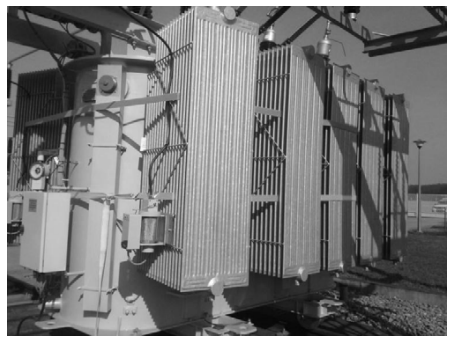
The measurements of vibroacoustic response were repeated and the results were quite different (Fig. 4). With radiators stiffed with the ratchet tape the results of vibroacoustic analysis showed that the transformer’s active part is not in bad condition.
Results of steady state analysis (Fig. 4a) show that mechanical integrity is much better than in previous measurement. The curve ar(f) drops rapidly at 0.3 kHz (previously at 0.6 kHz). Currently above the frequency 800 Hz the total vibrations power does not exceed 5% of total power. Similar conclusions can be drawn from transient state analysis (Fig. 4b, c). From comparison of Figs. 2b and 4b it can be seen that with transformer construction stiffened (radiators) the oscillations of the signal envelope are much lower in the first seconds after energizing the transformer. There are also significant differences in spectrograms (Figs. 2c and 4c). Before stiffening with cargo tapes the time of transformer’s tank vibrations stabilization was over 30 seconds, while now stabile vibrations in steady state start approx. after 20 seconds. This clearly indicates that the source of previous vibrations were radiators, not the active part of the transformer.

Summary
The experiment with additional tapes mounted around the radiators showed that vibrations of external constructional elements of the transformer may lead to mistakes in vibroacoustic analysis. However this additional connection cannot be used as a remedy for correct diagnosis. Vibrations of radiators are still the source of VM mistakes, but in smaller scale. This can be observed e.g. in oscillations in transient state (Fig. 4b), which could suggest problems with windings clamping. This example has clearly showed that assessment of the mechanical condition of the active part based only on VM results may be drastically misleading. There is a need for verification with additional method based on different physical phenomenon. In this case the best method is FRA, introduced into complementary FRA+VM analysis. Each of these methods is limited in a different way, so there is a little chance to perform a wrong diagnosis of results coming from two different methods.
REFERENCES
[1] Kornatowski E., Banaszak S., Diagnostics of a Transformer’s Active Part With Complementary FRA and VM Measurements, IEEE Transactions on Power Delivery, 29 (2014), n.3, 1398-1406
[2] IEC 60076-18: Power transformers – Part 18: Measurement of frequency response, International standard
[3] Borucki S., Cichoń A., Subocz J., Kornatowski E., The technical assessment of core and windings in a transient state of power transformer operation, Przegląd Elektrotechniczny, (2010), n.11b, 22-25
[4] Borucki S., Time-frequency analysis of mechanical vibrations of the dry type power transformer core, Acta Physica Polonica A, 120 (2011), n.4, 571-574
[5] Mechanical-Condition Assessment Of Transformer Windings Using Frequency Response Analysis (FRA), Report of CIGRE Working Group A2.26, 2008
[6] Kornatowski E., Application of SSM method in vibroacoustic diagnostics of power transformers, Przegląd Elektrotechniczny, (2014), n.10, 121-124
[7] Zieliński T.P., Cyfrowe przetwarzanie sygnałów. Od teorii do zastosowań, Wydawnictwo Komunikacji i Łączności, Warszawa 2009
[8] Kornatowski E., Cyfrowe przetwarzanie sygnałów wibroakustycznych w bezinwazyjnej diagnostyce transformatorów energetycznych, Wydawnictwo Uczelniane ZUT w Szczecinie, Szczecin 2014
Authors: D.Sc.Eng. Szymon Banaszak, West Pomeranian University of Technology, Department of Electrotechnology and Diagnostics, ul. Sikorskiego 37, 70-313 Szczecin, E-mail: szymon.banaszak@zut.edu.pl,
D.Sc.Eng. Eugeniusz Kornatowski, West Pomeranian University of Technology, Department of Signal Processing and Multimedia Engineering, ul. Sikorskiego 37, 70-313 Szczecin, E-mail: eugeniusz.kornatowski@zut.edu.pl.
Source & Publisher Item Identifier: PRZEGLĄD ELEKTROTECHNICZNY, ISSN 0033-2097, R. 92 NR 8/2016.doi:10.15199/48.2016.08.10
 Power Quality Blog