Published by M. S. Arjun1, N. Mohan1, K. R. Sathish2, Arunkumar Patil3, G. Thanmayi4.
1Department of Electrical and Electronics Engineering, JSS Science and Technology University, Mysore, India
2Department of Electrical and Electronics Engineering, ATME College of Engineering, Mysore, India
3Department of Electrical Engineering, Central University of Karnataka, Kalaburagi (Gulbarga), India
4M. Tech-Energy System and Management, Department of Electrical and Electronics Engineering, JSS Science and Technology University, Mysore, India
ABSTRACT: Global warming has led to the widespread adoption of electric vehicles (EV). With the increasing use of electric vehicles, it is very important to understand the impact of electric vehicle charging. Electric vehicle charging station has a serious effect on the power quality of the local power distribution network, and it cannot be ignored. The electric vehicle charger is a type of non-linear load. This non-linearity introduces harmonics into the charging station. Therefore, a high-efficiency charger in the power grid is required. This research work aims to build a charging station model to analyze the effect of EV chargers on power quality and then shunt active power filter (SAPF) based on P-Q theory and synchronous reference frame (SRF). Theory is implemented in the system to suppress harmonics. The simulation will be carried out under two cases, without active power filter (APF) and with APF when number of chargers associated to the charging station. The simulation results of both the methods will be compared and verify the effectiveness of proposed method. The simulation will be done using the MATLAB/Simulink software.
Keywords: Charging station, Electric vehicle, Power quality, P-Q theory, SAPF, SRF theory
1. INTRODUCTION
Due to huge development in transportation sector by considering environment protection and depletion of fossil fuel, traditional vehicles shift to electric vehicle. Electric vehicles (EVs) are less environment pollution, cheaper mode of transportation and growth in battery technology it gaining much attention in the market. There are three main types of electric vehicles within the worldwide [1].
The continuous development of EVs can have adverse effect on distribution network. EV chargers contain electronic devices similar to non-linear load which causes harmonic problem and affecting power quality in the system [2], [3]. Huge EV charging load’s impact on the three-phase power system is analyzed for different parameter on chargers, number of chargers. It is concluded in that APF+PI repetitive control can efficiently suppress the current harmonics and improve power quality [4], [5]. In the concept of vehicle-to-grid (V2G) is studied and analyzed parameters like frequency stability, voltage stability, and power quality are discussed for different penetration level of plug-in electric vehicles (PEV) [6], [7].
Fujun et al. [8] analyzed the influence of harmonic on load by fast charging station, where it is concluded that when the fast-charging station has a large capacity, harmonics have a greater impact on load. The researchers investigated the impact of harmonic distortion on EV charging station based on the measured data and actual test, result was simulated in MATLAB/Simulink software [9]–[11].
Woodman et al. [12] simulated the harmonic caused by non-linear load in IEEE 13 node test feeder that used to verify the VHDL-AMS model and their effects. In the switched filter compensator (SFC) are used to solve the problem of harmonic distortion network [13], [14]. It compensates reactive power to improve power factor, the results were analyzed and compared with and without SFC. This study examines how more EV charging stations affect power quality is examined using MATLAB/Simulink software. Active power filter (APF) based P-Q theory and synchronous reference frame (SRF) theory is adopted to reduce the harmonic in the system for different load conditions.
This paper is organized as:
i) Section 1 provides introduction;
ii) Section 2 detailed problem formulation for EV charging station is explained;
iii) Section 3 presents proposed methodology and brief review of shunt active power filter (SAPF);
iv) Further analysis of simulation results is discussed in section 4; and
v) Followed by conclusion in section 5.
2. PROBLEM FORMULATION
With the higher penetration of electric vehicle day-by-day it has so many disadvantages. The EV charger is a non-linear load, that introduces harmonics into the system. This will influence the power quality of the framework. The research work evaluates the harmonic contamination in the electric system due to EV chargers. The charging station model connected to shunt active power filter [P-Q] theory and synchronous reference frame theory is implemented and simulated in MATLAB/Simulink software. Here the current harmonics are determined for different load conditions.
3. PROPOSED METHODOLOGY
The proposed work is carried out on shunt active power filter using two methods i) synchronous reference frame (D-Q) theory and ii) instantaneous reactive power (P-Q) theory, to suppress the harmonic distortion and improve the power quality in the distribution system. In the modelling phase following are the assumptions, three-phase source with the rating of 400 V 50 Hz AC and lithium-ion battery which is used in almost all the battery EVs.
3.1. Charging station using P-Q theory-based shunt active power filter
The most reason of the shunt active power filter is to generate compensation currents of the same magnitude but in opposite phases to suppress current harmonics [15]. In this research work P-Q theory method is implemented, also known as instantaneous reactive power theory, and creates a simulation model using MATLAB/Simulink. Figure 1 shows a block diagram of an electric vehicle charging station connected to SAPF. To generate compensating reference current, Clarke transformation is used to convert the, source voltage and current from a-b-c coordinates to alpha-beta coordinates, as shown in [16]–[18].
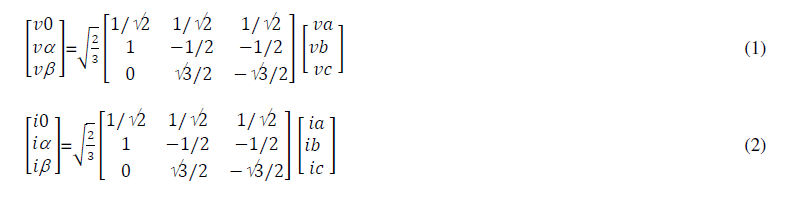
Here zero sequence component is absent as α and β axes make no contribution to zero component. Hence it can be easily eliminated from the system.

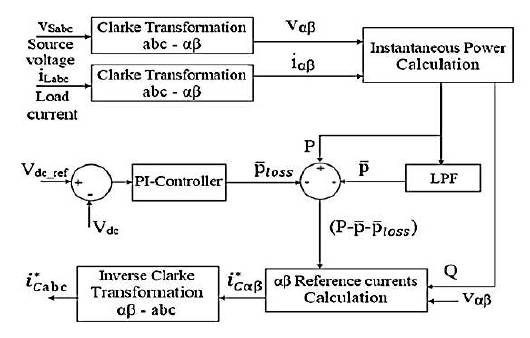
To generate harmonic reference current active power component (𝑝̅𝑎𝑐), total reactive component (q) and real power (𝑝̅𝑙𝑜𝑠𝑠) from 3Φ AC source is required given as (4).

Generated compensating current are then transformed from α-β-0 to 3Φ a-b-c frame by inverse Clarke transformation as shown in (5).

3.2. Charging station using synchronous reference frame theory-based active power filter
A rotating coordinate system’s ability to cause harmonics to change frequency is the foundation of the synchronous reference approach. The reference current has nothing to do with the supply voltage and it is directly derived from the actual load current [19], [20]. An electric vehicle charging station connected to an SRF-based active power filter is shown in block diagram from Figure 2.

To generate the compensating reference current, the 3-phase supply current ia, ib, and ic are transformed into 2Φ (α-β) current in the stationary frame [21]–[25].

Next the α-β plane converted into D-Q rotating frame, the phase locked loop (PLL) circuit is applied to generate sine and cosine signals to properly synchronize the current with the voltage. The current expression is given by (7).

Here the produced d-axis and q-axis component consist of both dc and ac component. The AC component goes through the low pass filter to remove the harmonic component, and the PI controller is used to reduce each harmonic component’s steady state error.

Once the desired harmonic elements are removed from the distorted load current, the D-Q rotating frame is converts back to the a-b-c stationary frame.

The extracted reference current is transferred for generation of switching pulses for the inverter.
4. RESULTS OF THE SIMULATION
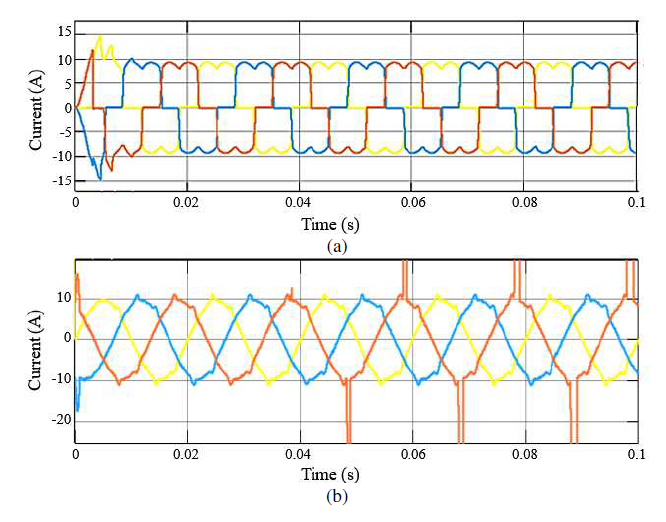
In this study, a simulation model is created in the simulation toolbox MATLAB2018b to analyze the harmonics produced during the charger’s charging stage. The simulation parameters utilized in this model are displayed in Table 1. By analyzing the total harmonic distortion (THD) content of the two charging stations, comparing the THD values of the two charging stations and analyze which charging station has the lowest THD content. According to the simulation results, the current control approach can deliver the optimum results. Figure 3(a) displays the source side current waveforms before the current is compensated and Figure 3(b) displays the source side current waveforms after the current is compensated.
Table 1. Simulation parameters used for design

4.1. Charging station using SAPF
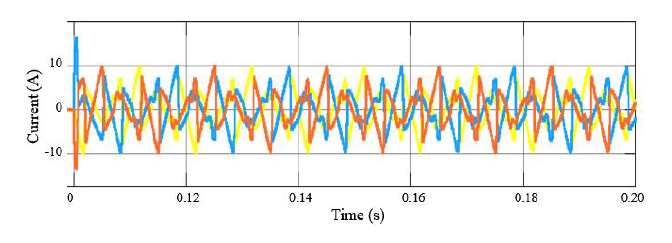
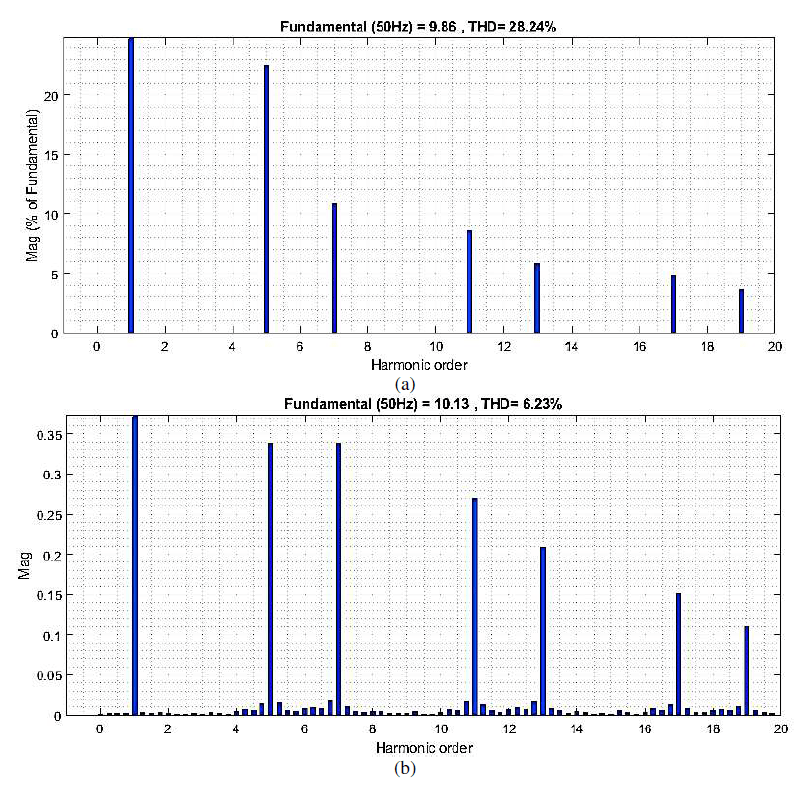
Figure 4 shows the generated compensation currents required for elimination of harmonic distortion present in the system. The algorithm is carried out MATLAB/Simulink software. The fast Fourier transform analysis in Figure 5 fast Fourier transform (FFT) analysis of source current Is, Figures 5(a) and 5(b) shows the source current Is is before compensation, after compensation and total harmonic distortion reduced from 28.24% to 6.23% using APF based on P-Q theory.
4.2. Charging station using SRF theory
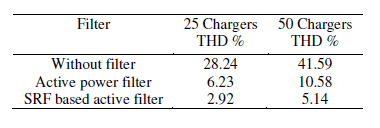
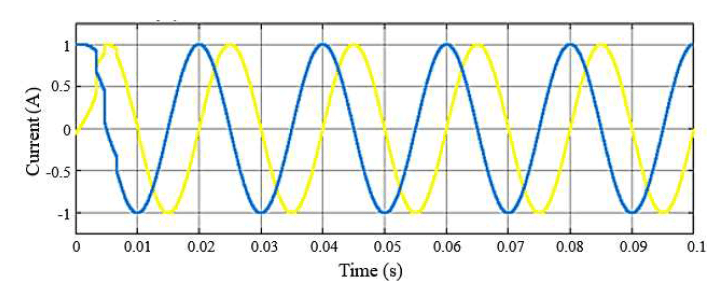
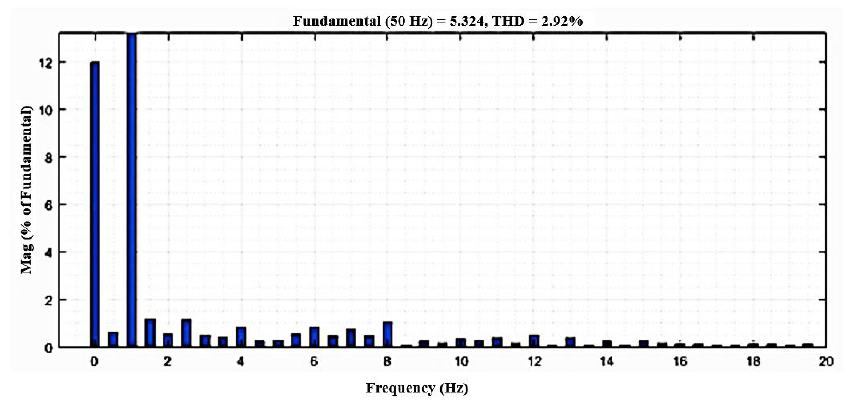
Figure 6 shows the output waveform of the sine and cosine signals used for synchronization and generate the required reference current signal. Figure 7 shows that the total harmonic distortion is only 2.92%, which is an acceptable value compared to the IEEE standard of 5% limit. Table 2 shows the comparison based on the connection of filter under different load condition.
Table 2. Percentage THD comparison
5. CONCLUSION
This work proposes a solution to mitigate the effect of the increase in EV charging stations on power quality. The simulation model of the electric vehicle charging station is created in the MATLAB/Simulink software. To analyze the harmonic contamination, charging station with P-Q theory based shunt active power filter and SRF theory-based active power filter was simulated. Both the charging station with the same parameters and the batteries are used as a load during charging. The charging station with SRF theory has a lower THD value than the charging station with a P-Q theory-based power filter and without a filter. Synchronous reference theory model can viably relieve the harmonic distortion. The generated reference signal is not distorted in the SRF approach, which improves performance and it has good compensation result for harmonic currents.
REFERENCES
[1] A. K. Karmaker, S. Roy, and M. R. Ahmed, “Analysis of the impact of electric vehicle charging station on power quality issues,” in 2019 International Conference on Electrical, Computer and Communication Engineering (ECCE), Feb. 2019, pp. 1–6. doi: 10.1109/ECACE.2019.8679164.
[2] S. Deb, K. Kalita, and P. Mahanta, “Impact of electric vehicle charging stations on reliability of distribution network,” in 2017 International Conference on Technological Advancements in Power and Energy (TAP Energy), Dec. 2017, pp. 1–6. doi: 10.1109/TAPENERGY.2017.8397272.
[3] L. Durante, M. Nielsen, and P. Ghosh, “Analysis of non-sinusoidal wave generation during electric vehicle charging and their impacts on the power system,” International Journal of Process Systems Engineering, vol. 4, no. 2–3, pp. 138–150, 2017, doi: 10.1504/IJPSE.2017.084751.
[4] F. Chen, L. Ruijie, and L. Guanhua, “Research on harmonic analysis and harmonic suppression measures of electric vehicle
charging station,” in 2019 IEEE 2nd International Conference on Automation, Electronics and Electrical Engineering (AUTEEE), Nov. 2019, pp. 71–75. doi: 10.1109/AUTEEE48671.2019.9033199.
[5] M. Falahi, H.-M. Chou, M. Ehsani, L. Xie, and K. L. Butler-Purry, “Potential power quality benefits of electric vehicles,” Sustainable Energy, IEEE Transactions on, vol. 4, no. 4, pp. 1016–1023, 2013, doi: 10.1109/TSTE.2013.2263848.
[6] E. Alghsoon, A. Harb, and M. Hamdan, “On stability and power quality impacts of vehicle to grid (V2G),” Applied Solar Energy, vol. 53, pp. 100–108, Apr. 2017, doi: 10.3103/S0003701X17020037.
[7] S. Shao, M. Pipattanasomporn, and S. Rahman, “Demand response as a load shaping tool in an intelligent grid with electric vehicles,” IEEE Transactions on Smart Grid, vol. 2, no. 4, pp. 624–631, Dec. 2011, doi: 10.1109/TSG.2011.2164583.
[8] T. Fujun, X. Ruiheng, C. Dong, R. Lijia, Y. Quanning, and Z. Yan, “Research on the harmonic characteristics of electric vehicle fast charging stations,” in 2017 2nd International Conference on Power and Renewable Energy (ICPRE), Sep. 2017, pp. 805–809. doi: 10.1109/ICPRE.2017.8390645.
[9] Y. Zhang, D. Yu, G. Zhang, H. Wang, and J. Zhuang, “Harmonic analysis of EV charging station based on measured data,” in 2020 IEEE/IAS Industrial and Commercial Power System Asia (I&CPS Asia), Jul. 2020, pp. 475–480. doi: 10.1109/ICPSAsia48933.2020.9208498.
[10] A. Lucas, F. Bonavitacola, E. Kotsakis, and G. Fulli, “Grid harmonic impact of multiple electric vehicle fast charging,” Electric Power Systems Research, vol. 127, pp. 13–21, Oct. 2015, doi: 10.1016/j.epsr.2015.05.012.
[11] A. Pan, Y. Zhu, L. Ren, T. Chen, S. Wen, and W. Yun, “Harmonic research of electric vehicle fast chargers,” in 2016 IEEE PES Asia-Pacific Power and Energy Engineering Conference (APPEEC), Oct. 2016, pp. 2545–2549. doi: 10.1109/APPEEC.2016.7779947.
[12] N. Woodman, R. B. Bass, and M. Donnelly, “Modeling harmonic impacts of electric vehicle chargers on distribution networks,” in 2018 IEEE Energy Conversion Congress and Exposition (ECCE), Sep. 2018, pp. 2774–2781. doi: 10.1109/ECCE.2018.8558207.
[13] M. H. Mohamed, M. N. Abdelwahab, and A. A. Abdelsalam, “Mitigation of electric vehicle distortion impact on distribution networks,” in 2019 21st International Middle East Power Systems Conference (MEPCON), Dec. 2019, pp. 921–926. doi: 10.1109/MEPCON47431.2019.9008040.
[14] J. C. Gomez and M. M. Morcos, “Impact of EV battery chargers on the power quality of distribution systems,” IEEE Transactions on Power Delivery, vol. 18, no. 3, pp. 975–981, Jul. 2003, doi: 10.1109/TPWRD.2003.813873.
[15] A. Panchbhai, S. Parmar, and N. Prajapati, “Shunt active filter for harmonic and reactive power compensation using p-q theory,” in 2017 International Conference on Power and Embedded Drive Control (ICPEDC), Mar. 2017, pp. 260–264. doi: 10.1109/ICPEDC.2017.8081097.
[16] A. A. Imam, R. S. Kumar, and Y. A. Al-Turki, “Modeling and simulation of a PI controlled shunt active power filter for power quality enhancement based on P-Q theory,” Electronics, vol. 9, no. 4, p. 637, Apr. 2020, doi: 10.3390/electronics9040637.
[17] J. L. Afonso, C. Couto, and J. S. Martins, “Active filters with control based on the p-q theory,” Institute of Electrical and Electronics Engineers (IEEE), vol. 47, no. 3, pp. 5–10, 2000, [Online]. Available: https://hdl.handle.net/1822/1921
[18] S. Round, H. Laird, R. Duke, and C. Tuck, “An improved three-level shunt active filter,” in 1998 International Conference on Power Electronic Drives and Energy Systems for Industrial Growth, 1998. Proceedings., 1998, vol. 1, pp. 87–92. doi: 10.1109/PEDES.1998.1329995.
[19] P. Dey and S. Mekhilef, “Synchronous reference frame based control technique for shunt hybrid active power filter under nonideal voltage,” in 2014 IEEE Innovative Smart Grid Technologies – Asia (ISGT ASIA), May 2014, pp. 481–486. doi: 10.1109/ISGT-Asia.2014.6873839.
[20] C. Jiang, R. Torquato, D. Salles, and W. Xu, “Method to assess the power-quality impact of plug-in electric vehicles,” IEEE Transactions on Power Delivery, vol. 29, no. 2, pp. 958–965, Apr. 2014, doi: 10.1109/TPWRD.2013.2283598.
[21] S. Musa, M. Radzi, H. Hizam, N. Wahab, Y. Hoon, and M. Zainuri, “Modified synchronous reference frame based shunt active power filter with fuzzy logic control pulse width modulation inverter,” Energies, vol. 10, no. 6, p. 758, May 2017, doi: 10.3390/en10060758.
[22] M. U. Kumar and R. S. Rao, “Simulation of SRF control based shunt active power filter and application to BLDC drive,” International Journal of Latest Technology in Engineering & Management (IJLTEM), vol. 1, no. 1, pp. 14–22, 2016.
[23] N. S. Rao and H. J. Jayatheertha, “Modeling and simulation of various SRF methods for shunt active power filter and application to BLDC drive,” International Journal of Advanced Engineering Research and Studies, vol. 1, no. 4, pp. 18–22, 2012.
[24] A. Shah and N. Vaghela, “Shunt active power filter for power quality improvement in distribution systems,” Shunt active power filter for power quality improvement in distribution systems, pp. 22–26, 2005, [Online]. Available: https://www.ijedr.org/papers/IJEDR1302005.pdf
[25] V. Khadkikar and A. Chandra, “Three-phase and single-phase p-q theories applied to three-phase shunt active power filter under different operating conditions: a comparative evaluation,” International Journal of Emerging Electric Power Systems, vol. 11, no. 2, Feb. 2010, doi: 10.2202/1553-779X.2308.
BIOGRAPHIES OF AUTHORS
M. S. Arjun received the B.E., Master of Technology and pursuing Ph.D. degree in the field of electrical and electronics engineering. He is currently working as Assistant Professor, Department of Electrical and Electronics Engineering, JSS Science and Technology University (SJCE) Mysuru, Karnataka, India. His area of interest is on electric vehicles, power electronics, and renewable energy sources. He can be contacted at email: arjunms@jssstuniv.in.
Dr. N. Mohan received the B.E, Master of Technology and Ph.D. degree in the field of electrical and electronics engineering. He is currently working as Associate Professor, Department of Electrical and Electronics Engineering, JSS Science and Technology University (SJCE) Mysuru, Karnataka, India. His area of interest is on power system network, and electric vehicles. He can be contacted at email: mohan.eee@jssstuniv.in.
Dr. K. R. Sathish received the B.E, Master of Technology and Ph.D. degree in the field of electrical and electronics engineering. He is currently working as Assistant Professor, Department of Electrical and Electronics Engineering, ATME College of Engineering, Mysuru, Karnataka, India. His area of interest is on power system and power electronics. He can be contacted at email: dr.sathish21@gmail.com.
Dr. Arunkumar Patil has received the B.E. Master of Technology and Ph.D. degree in the field of electrical and electronics engineering. He is currently working as Assistant Professor, Department of Electrical engineering, Central University of Karnataka, Kalaburagi, Gulbarga, Karnataka, India. His area of interest is on power systems, renewable energy, WAMS, AI and data science. He can be contacted at email: arun201085@gmail.com.
G. Thanmayi has received the B.E and Master of Technology degree in the field of electrical and electronics engineering. Master of Technology Specialization is Energy System and Management. Her area of interest is on power systems, renewable energy, energy system and management, energy and environment. She can be contacted at email: thanmayigrani98@gmail.com.
Source & Publisher Item Identifier: International Journal of Applied Power Engineering (IJAPE). Vol. 13, No. 1, March 2024, pp. 186~193. ISSN: 2252-8792, DOI: 10.11591/ijape.v13.i1.pp186-193
 Power Quality Blog