Published by Joanna KOZIEŁ1, Michał MAJKA1, Andrzej WAC- WŁODARCZYK1, Krzysztof NAGLAK2,
Department of Electrical Engineering and Electrotechnology, Faculty of Electrical Engineering and Computer Science, Lublin University of Technology(1), Faculty of Electrical Engineering and Computer Science, Lublin University of Technology(2),
ORCID: 1. 0000-0003-1682-2589, 2. 0000-0002-7153-040X 3. 0000-0002-6272-9249
Abstract. The article presents methods of wind farm optimization through the use of PV installations and the use of pumped storage power plants. Optimization criteria are listed. The method of arranging a PV installation on a wind turbine and the way of arranging it as a separate installation are presented. Existing solutions in the German city of Galidorf with a water reservoir and in the Spanish Albacete are presented. Polish pumped storage power plants and their capacities were presented.
Streszczenie. W artykule przedstawiono metody optymalizacji farmy wiatrowej poprzez zastosowanie instalacji PV i wykorzystanie elektrowni szczytowo- pompowych. Wymieniono kryteria optymalizacji. Zaprezentowano sposób ułożenia instalacji PV na turbinie wiatrowej, oraz sposób ułożenia jako oddzielna instalacja. Przedstawiono istniejące rozwiązania w niemieckim mieście Galidorf ze zbiornikiem wodnym, oraz w hiszpańskiej Albacete. Wymieniono polskie elektrownie szczytowo-pompowe oraz ich moce. (Optymalizacja struktury farmy wiatrowej poprzez zastosowanie instalacji PV i wykorzystanie elektrowni szczytowo-pompowych).
Słowa kluczowe: odnawialne źródła energii, farmy wiatrowe, instalacja fotowoltaiczna, elektrownie szczytowo- pompowe.
Keywords: renewable energy sources, wind farms, photovoltaic installation, pumped storage plants.
Introduction
The developing technology provides access to new solutions, replacing the existing possibilities and improving many factors taken into account during the operation of the device through optimisation. Optimisation is taking action to get the best results. It consists in improving the structure, construction elements or equipment parameters to achieve greater benefits. Optimisation may involve the use of the latest technological solutions or the use of innovative projects. The idea behind making improvements is to improve profits to the highest degree possible with a small financial contribution. When optimising, we can take into account many criteria why it is worth introducing changes.
The criteria include:
• cost minimisation,
• reduction of equipment wear,
• exclusion of unnecessary activities,
• improving the efficiency and performance of devices,
• shortening the production process,
• work load balancing.
Optimisation aims to improve working conditions with minor changes, the cost of which will pay off in a short time, and the solution will bring profits. Optimising the structure of a wind farm may be based on increasing production with the use of cheap or advantageous facilities [1]÷[5]. When optimising the structure of a wind farm in order to improve energy supply, the aim is to store kinetic energy in order to obtain stable operation of wind turbines [6]. Wind turbines are powered from the grid when production is zero. The reason for the poor operation of the turbines may be a weak wind, insufficient for the energy production process, or a failure of the windmill. During this time, the wind turbine receives power from the power grid to maintain measuring and control components. The network is heavily loaded when the machine is started up. A sudden and heavy load during start-up can cause voltage drops or even a failure of the power grid. In order to improve the transmission of electricity in the grid so that it is only based on the delivery of power from the operation of wind turbines, a form of optimisation may be energy storage while production outweighs consumption. As electricity storage, we can use small power plants to supply our own wind turbines.
The construction of wind turbines has its negative sides, in terms of the environment and other factors [7]÷[9].
• the wind farm causes the natural views to be obscured by devices, against the background of the natural landscape, huge turbines are the main point that draw observer attention from a distance of up to 7 km,
• windmills generate noise that may disturb local residents, wind farms are built at a distance from inhabited areas so that they do not interfere with the level of urban noise,
• a problem for birds, tall structures and moving shovels often stand in the way of bird migration and can be a dangerous obstacle for large flocks of birds,
• vibrations caused by the movement of the wings, the movement of the rotor (hub and blades) measuring up to 150 m in diameter may cause vibrations felt at a short distance [16],
• windmills have a negative impact on radars due to electromagnetic disturbances that arise during energy production,
• shading of the area, turbines are placed in places distant from cities. These are mostly agricultural areas where the sun is essential for vegetation,
• hazards related to mechanical failures, fires from lightning strikes or icing of moving parts, do not provide jobs. After completion of the wind farm construction phase, the station is only operated by a specially trained technician. This person is responsible for the diagnosis of failure in the event of its occurrence, draws up reports on the operation of turbines and keeps documentation,
• the service life of the turbine established by the regulations is 25 years, after which the turbine is disposed of.
Production from energy storage can support the grid during the highest electricity consumption by users during the day. Photovoltaic panels and pumped storage power plants can optimise electricity production by providing power to turbine systems and a system for relieving or supporting the power grid. In Poland, wind energy is the best developed method of producing electricity using renewable energy sources. Fig. 1 shows how to install a photovoltaic installation.

After calculating the places in the tower that will be obscured by the moving blades, sunlight will be blocked, and we have an area of approx. 800 m2 for the installation of a PV system on the pillar casing. Panels are installed on each tower and connected directly to the wind turbine installation. Photovoltaic panels in the form of a strip with dimensions of 5986×308 mm were used. The thickness of the panels does not exceed 1 mm [25]. They are easy to install. The modules attached to the side walls of the tower do not interfere with the environment and landscape of the already constructed turbines by using subsequent structures.
Optimisation of the wind farm structure through a PV installation
The National Power System of the Polish Power System is sensitive to power fluctuations arising during the supply of energy from wind turbines. Variation in the direction of the energy flow is unfavorable for the power line, makes it difficult to prepare a power balance and does not ensure the stability of the devices operation. The diversified level of turbine energy production or sudden load caused by the start of the device are the cause of negative actions affecting the power grid [1]. Belong to them:
• fluctuations in power and voltage due to changes in wind speed. Voltage drops can be compensated by reactive power regulation by capacitor banks,
• flicker, mostly old installations. Switching on the generators and rapid changes in power can cause voltage drops, which are the source of flickering lighting,
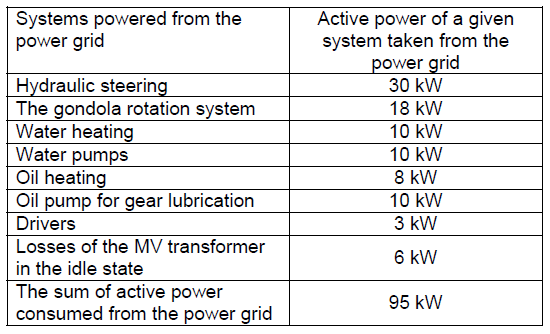
• the higher harmonics produced by the generators are a source of protection and control disturbance. When stopped, the turbine produces no electricity. At the time the energy needed to maintain the turbine is taken from the grid. This condition is called zero generator production. The auxiliary power consumption includes the power supply of selected systems (Tab. 1). The most advantageous solution for wind farms is to design a photovoltaic installation as a source of maintenance for all turbine units. PV installation (PhotoVoltaic) has been recording a high increase in installed active power for several years.
The active power needed to maintain the turbine is approx. 100 kW.
A PV plant capable of supporting a wind turbine has a total power of 10 kWp (kilowatt pic). For a selected wind farm consisting of 16 turbines, the demand for turbine power is 160 kWp. In Polish climatic conditions, 1000 kWh can be produced annually from 1 kWp of a PV installation. Installing 1 kWp without subsidies in Poland amounts to an average of PLN 4764.2 gross [18].
Table.1. Systems and values of active power consumption from the power grid during generator zero production [7]

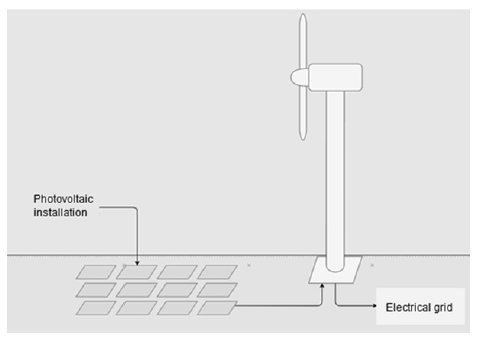
The total investment cost for the selected wind farm is PLN 762,272 gross. 160 kWp of installed power from photovoltaic panels will amount to an annual production of close to 150 MWh. The annual profit from electricity production using the photovoltaic installation on the wind farm will amount to PLN 96,000, with the rate of PLN 0.64 per 1 kWh of electricity. The investment will pay for itself within 8 years. The service life of wind turbines is 25 years. The energy produced from the photovoltaic panels will improve the efficiency of the wind farm, increasing the production with active power that will be generated with the simultaneous operation of the wind turbine and the photovoltaic installation, and powering the units in the wind turbine during its zero production. The benefits of installing photovoltaic modules make the PV installation a very popular solution in households and single-family houses [25]. Fig. 3 shows the method of mounting the photovoltaic installation. After calculating the places of the tower that will be covered by the moving blades, sunlight will be blocked, and we have an area of approx. 800 m2 for the installation of a PV system on the pillar casing.
Panels are installed on each tower and connected directly to the wind turbine installation. The Heliatek company offers photovoltaic panels in the form of a strip with dimensions of 5986×308 mm. The thickness of the panels does not exceed 1 mm [25]. They are easy to install. The modules attached to the side walls of the tower do not interfere with the environment and landscape of the already constructed turbines by using subsequent structures. The photovoltaic installation can be installed as a separate installation on the site of a wind farm or it can be an element of the structure by placing it on turbine poles. One of the first implemented solutions of this type is still operating in Spain in Albacete (Fig. 4.).
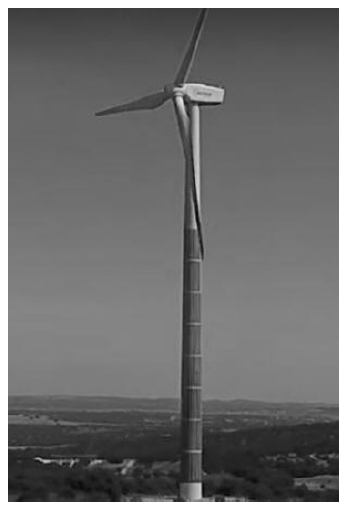
The installation with a capacity of 9.36 kWp satisfies the wind turbine’s own needs. All wind turbines are connected to a PV installation. In the area of the wind farm, an area will be designated for the construction of a photovoltaic installation that will allow for the maintenance of power to all turbines during operation and downtime of the wind turbine.
Farm optimisation through the use of pumped-storage power plants
Another solution for wind farm optimisation is the combination of a pumped-storage power plant with wind turbines. The solution is not suitable for all wind farms as it requires access to a natural water reservoir. The reservoir into which the water is pumped is located higher than the main body of water. The high production of the wind turbine was used to power a water pump that pumps water to the water storage facilities. The support of the energy system is done by emptying the water tanks during poor production of wind turbines. The flow of water produces electricity.
In Poland, the solution may be used in the West Pomeranian Voivodeship. There are many wind farms in this area due to the area’s vicinity to the coast and characterised by the highest average wind speed in Poland.
The solution will increase the share of renewable energy in the country. Water tanks can be built in as part of the tower, a separate water tank next to the turbine, or a tank directly below the turbine, buried in the ground. Figures 5 and 6 show a diagram of the use of water as an energy storage using a water pump.


The stored water tank is part of the turbine system or the tank is located next to the tower. The pump is connected to the turbine’s energy system. Based on the measurements from the nacelle, the system adjusts the operation of the water pump in order to ensure stable operation of the network. Water is supplied through a pipeline from a standing water tank. The power equipment necessary to maintain the turbine is supplied from the energy storage when the power grid is heavily loaded and there is no production during windless weather. The solution discussed was presented in the German town of Gaildorf.
Table 2. Pumped-storage power plants in Poland [data for 2020] [23]
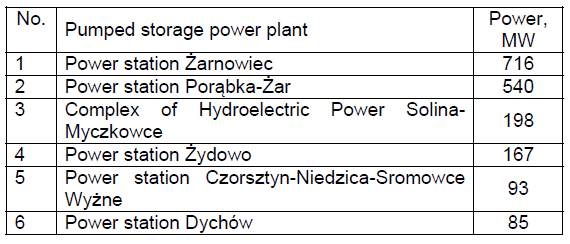
The tanks of four turbines can hold 160,000 m3 of water. This amount of water allows to store energy up to 70 MWh [10],[11], [21]. In Poland, there are pumped-storage power plants with a total capacity of 1800 MW for turbine operation. These are the 6 power plants in Żarnowiec, Porębka-Żar, Solina, Żydowo, Niedzica and Dychów. They do not cooperate with power plants producing electricity using a different method. They can be open to modernisation with wind turbines [23].
Conclusions
The main advantages of optimising the structure of a wind farm include: an increase in the share of renewable energy sources in energy production, stable operation of the power grid and improved efficiency of wind turbines. The main advantages of connecting a wind turbine with a photovoltaic installation are the operation of the power grid based only on the supply of energy from the turbines and the reduction of active power drops and voltages in the power grid. Advantages of PV installations as a source of maintenance of wind farm turbine units [23]: easy and cheap construction cost, installation of photovoltaic modules, inverter, AC and DC side protection, cabling, surge arresters, grounding and assembly with delivery of modules. (The cost will be PLN 40-50 thousand for the selected turbine).
• low maintenance costs related to the repair of panels during failure, versatile installation options,
• lifetime of photovoltaic modules is 25-35 years,
• the user gets a 10 to 20-year product warranty.
REFERENCES
[1] Kozieł J. et al., Analysis of the impact of a wind farm on the quality of electricity in the distribution grid, Przegląd Elektrotechniczny 97(12), p.202-205,DOI: 10.15199/48.2020.12.43.
[2] Kozieł J. et al Analiza pracy wybranej instalacji odnawialnych źródeł energii, Przegląd Elektrotechniczny, 97(12), p.198-201,DOI: 10.15199/48.2020.12.42.
[3] Naglak K., Optymalizacja struktury farmy wiatrowej – magazynowanie energii kinetycznej w celu poprawy niezawodności dostaw energii elektrycznej, Praca dyplomowa inżynierska, Wydział Elektrotechniki i Informatyki Politechniki Lubelskiej, Lublin 2021.
[4] Bandzul W., Energetyka Wiatrowa w Polsce, Polskie Sieci Elektroenergetyczne SA, Nr 3/2005(54)
[5] Bogacz P. et al, Poradnik Małej Energetyki Wiatrowej, Olsztyn, maj 2011
[6] Czachor A. et al., Przegląd istniejących technologii w dziedzinie energetyki wiatrowej- obecnie stosowane rozwiązania pozwalające na pozyskanie energii z wiatru, Politechnika Śląska, Katedra Technologii i Urządzeń Zagospodarowania Odpadów.
[7] Specyfikacja ogólna V112–3.0 MW 50/60 Hz, Class 1 Nr dokumentu: 0011-9181 V06 26.08.2011
[8] Polskie Sieci Elektroenergetyczne, Instrukcja ruchu i
eksploatacji sieci przesyłowej, Cześć ogólna Wersja 1.1 Tekst
jednolity po decyzji Prezesa URE nr DPK-4320-2(16)/2010÷2013/LK z dnia 29 stycznia 2013 r.
[9] Raport WWF Polska, Dostępne i Przyszłe Formy Magazynowania Energii, opracowanie na zlecenie fundacji WWF Polska, Warszawa 2020.
[10] German Wind Energy Association, Installed wind power capacity in Germany, (https://www.windenergie.de/eninfocenter/statistiken/deutschland/installed-wind-powercapacity-germany)
[11] Pfaffel S et al, IWES Annual Report, Windenergie Report Deutschland 2011, 54
[12] Alpha Ventus, Federal Ministry for Economic Affairs and Energy (https://www.alphaventus.de/english/) (accessed 02-01-2021)
[13] Internation Electrotechnical Commission standard DIN EN 61400-1, design requirements, Release 2015.
[14] Roscher B. et al, Modelling of Wind Turbine Loads nearby a Wind Farm, Center for Wind Power Drives, RWTH Aachen, Campus Boulevard 61, 52074 Aachen, Germany.
[15] Internation Electrotechnical Commission standard DIN 50100:2015, Load controlled fatigue testing – Execution and evaluation of cyclic tests at constant load amplitudes on metallic specimens and components, Release 2015,
[16] Fradsen S, Turbulence and Turbulence-generated structural loading in wind turbine cluster, Riso-R-1188, Roskilde, Releas
[17] Michałowska J. et al, Monitoring of the Specific Absorption Rate in Terms of Electromagnetic Hazards, Journal of Ecological Engineering, vol. 21, issue. 1, 2020, DOI: 10.12911/22998993/112878
[18] http:// globenergia.pl/
[19] Komarzyniec G. et al, The calculation of the inrush current peak value of superconducting transformers, 2015 Selected Problems of Electrical Engineering and Electronics, WZEE 2015 27 January 2016 Article number 7394042 Selected Problems of Electrical Engineering and Electronics, WZEE 2015, Kielce, 17 September 2015 – 19 September 2015, DOI 10.1109/WZEE.2015.7394042
[20] https://fotowoltaikaonline.pl/
[21] http://www.instsani.pl/
[22] Michałowska J. et al, Prediction of the parameters of magnetic field of CNC machine tools, Przegląd Elektrotechniczny.- 2019, vol. 95, no. 1, p. 134-136, doi:10.15199/48.2019.01.34
[23] http://wysokienapiecie.pl/
[24] http://app.diagrams.net/
[25] http://www.heliatek.com/
[26] Korzeniewska E., et al. Resistance of metallic layers used in textronic systems to mechanical deformation, Przegląd Elektrotechniczny , Volume 93, Issue 12, Pages 111 – 114, 2017 vol.19, no. 24, DOI: 10.15199/48.2017.12.28
[27] Shepherd D. et al, Wind Farms: Noise, 2020, DOI: 10.1201/9781003043461-22
[28] https://globenergia.pl/moc-zainstalowana-mikroinstalacjefotowoltaika-36-gw-energetyka-pse/
[29] Agrawal M. ,Rao K. V. S. Harnessing Solar Energy from Wind Farms: Case Study of Four Wind Farms, Springer Nature Singapore Pte Ltd. 2022, Sanjeevikumar et al. (eds.),Advances in Renewable Energy and Electric Vehicles,Lecture Notes in Electrical Engineering 767, DOI/10.1007/978-981-16-1642-6_17
Authors: dr inż. Joanna Kozieł, Department of Electrical Engineering and Electrotechnology, Faculty of Electrical Engineering and Computer Science, Lublin University of Technology, Nadbystrzycka Street 38A, 20-618 Lublin, e-mail: j.koziel@pollub.pl, dr hab. inż. Michał Majka, prof. LUT, Department of Electrical Engineering and Electrotechnology, Faculty of Electrical Engineering and Computer Science, Lublin University of Technology, Nadbystrzycka Street 38A, 20-618 Lublin, e-mail: m.majka@pollub.pl, prof. dr hab. inż. Andrzej Wac-Włodarczyk, Department of Electrical Engineering and Electrotechnology, Faculty of Electrical Engineering and Computer Science, Lublin University of Technology, Nadbystrzycka Street 38A, 20-618 Lublin, e-mail: a.wac-wlodarczyk@pollub.pl, inż. Krzysztof Naglak, Faculty of Electrical Engineering and Computer Science, Lublin University of Technology, Nadbystrzycka Street 38A, 20-618 Lublin, e- mail: krzysztof.naglak@pollub.edu.pl
Source & Publisher Item Identifier: PRZEGLĄD ELEKTROTECHNICZNY, ISSN 0033-2097, R. 98 NR 1/2022. doi:10.15199/48.2022.01.14
 Power Quality Blog