Published by Jerzy Stanisław ZIELIŃSKI, Uniwersytet Łódzki, Kat. Informatyki
Abstract: The paper begins with a short presentation of Smart Grid (SG) being the starting element of a chain of developing the idea of “smartness” not only in power but also in all industry branches implying growth of data generation (Big Data problem). Parallel to the smart-and the big data problems, new informatics tools, such as Cloud Computing (CC) and Internet of Things (IoT) are developed. The main part of the paper describes specifics of these new tools, (e.g. Industrial Internet of Things, dew- and fog CC) and their collaboration in terms of solving the big data problem. Final remarks present the Author’s view on further development of these problems.
Streszczenie: Artykuł rozpoczyna się krótką prezentacją sieci inteligentnej zapoczątkowującej ideę „Smart” nie tylko w elektroenergetyce, ale i w innych gałęziach przemysłu, powodując zwiększenie generowania danych (problem Big Data).Równolegle z rozwojem koncepcji „Smart” i Big Data rozwijają się nowe narzędzia informatyczne, jak przetwarzanie w chmurze, Internet rzeczy. Główna część artykułu przedstawia specyfikę tych nowych narzędzi (np. przemysłowy internet rzeczy, odległe/mgliste przetwarzanie w chmurze) i ich zastosowanie w rozwiązywaniu problemu Big Data. Uwagi końcowe przedstawiają pogląd autora na dalszy na dalszy rozwój poruszonych tematów. Czy smart grids potrzebują nowych narzędzi informatycznych?
Keywords: Smart Grid, Industrial Internet of Things, Big Data, Cloud Computing
Słowa kluczowe: sieci inteligentne, przemysłowy internet rzeczy, ogromne dane, przetwarzanie w chmurze
1. Introduction
The idea of Smart Grid (SG) evolved in the late 20th century as a result of blackouts in the USA and other countries [1], which facilitated the development of SG and subsequently smart- buildings, cities, industry, etc. using chip-based devices (such as Smart Meters). Each of the smart entities generates, sends, receives and stores data; according to CISCO’s prediction [2], in 2020, the number of data will be equal to 1018 , which will intensify the already growing Big Data (BD) problem.

The same period Cloud Computing was a matured tool and the Internet of Things completed the stage of infancy and started gaining practical importance. According to [3], in 2015, the value of the IoT market reached $700 milliard, while the forecast for 2020 for this market foresees that this value will reach $ 1.7 billion (Cisco’s CEO has pegged the Internet of Things at a $19 trillion market). The aim of the paper is to present the current state of all of these aspects starting with the problem of Power as a very important part of information society activity and transferring the result to industry (Industrial Internet of Thing).
2. Smart Grid
According to [1] there are following characteristics of Smart Grids:
1. “It is self-healing (from power disturbance events).
2. It enables active participation by consumers in demand response.
3. It operates resiliently against both physical and cyber attacks.
4. It provides quality power that meets the twenty first century needs.
5. It accommodates all generation and storage options.
6. It enables new products, services and markets.
7. It optimizes asset utilization and operating efficiency.”
Now it has been introduced new term “Resilience” which is “…more general (including weather/climate, geomagnetic storm and power disaster and the need for forecasting) than the term self healing” [9].
Smart Grid (SG) cover all Renewable Energy Sources (RES) [4,5,6,7] available in the area of the SG activity, which has impacted and transformed the twentieth century hierarchical and natural monopoly management system into a number of dispersed, however collaborating smaller systems. This has led to an increase in the number of generated-, transmitted-, transformed- and stored data [8]. When we are considering the Power System (PS) we need to remember that for several dozen years the System Control and Data Acquisition (SCADA) has supported the Power System (PS) operation, initially being installed in transmission lines with rated voltage ≥ 220kV and now being applied in distribution (≤110kV) and even low grids. The system consists of remote terminals linked directly with sensors, measurement devices, actuators, etc.
In some countries (the USA, Japan, and Switzerland), Phasor Measurement Units (PMU) are installed to measure basic electrical parameters in the same real time in all remote nodes of the grid – these measurements are performed in the central dispatcher unit. Since the SCADA and the PMU systems deliver data important for technical operation [9] it may turn necessary to build at an individual voltage level separate sensor networks with interfaces to exchange data important for supporting management decisions in the PS. GE in California is a good example of this type of activity: “A couple of years ago, we opened a new Global Software Center headquartered in San Ramon, California, and committed $1 billion over a 3 year period to accomplish our vision for the Industrial Internet. We are developing solutions that help our customers increase productivity and reduce costs, whether they operate power plants, jet engines, or locomotives around the world” [11]. Parameters to perform simultaneous measurements in dispersed power networks are important due to the high propagation velocity of electromagnetic wave, however it will not be necessary to install the PMUs in most industrial facilities. Nevertheless the SCADA operates in some factories, which indicates that it will be possible to install additional sensors.
According to [12] it has to be remembered that power is very important, but only a part of Energy System with gas, petrol and another liquid fuel, steam and hot water etc. which in future would more effectively collaborate, which indicates that an additional source of a huge quantity of data will be necessary.
There are numerous common occasions where these two systems (electricity and gas) have to collaborate, e.g. in the CHP, on the market (where each system can have different businesses targets). Nevertheless both these systems are grid-based, and it is important to investigate common solutions, for instance in the field of the ICT (mobile) automation and management. Application of gas in the power production can provide such significant benefits as high efficiency, flexibility and reliability, low gas emission, etc. Unfortunately, there are certain barriers to using this fuel for the purpose of power production, and they include high costs and unstable import conditions in Poland [12]. One can find publications on research in the area of gas and electricity collaboration, e.g. [11,14,15,16,18,20]. It has to be stressed that gas application involves the problem relating to its explosive properties; a case study of [12] addresses this problem. In order to apply IoT in both systems it will be necessary to build two independent sensor networks due to different key control-related parameters and different velocity between the electromagnetic wave and the gas flow. It will be necessary to apply an interface to exchange data between these two systems.
3. Internet of Things (IoT)
A global infrastructure for the information society, enabling advanced services by interconnecting (physical or virtual) things based on existing interoperable information and communication technologies is called Internet of Things (IoT) by Vermesan and Friess [21]. These authors, as well as the IERC, stated that IoT is “A dynamic global network infrastructure with self-configuring capabilities based on standard and interoperable communication protocols where physical and virtual “things” have identities, physical attributes, and virtual personalities and use intelligent interfaces, and are seamlessly integrated into the information network”. The Digital Agenda for Europe [22] has introduced the following explanation: “Internet of Things (IoT) is a technology and a market development base on the interconnection of everyday objects among themselves and applications. IoT will enable an ecosystem of smart applications and services, which will improve and simplify EU citizens’ lives.” [8]. Studying bibliography one can find many Internet of…, e.g. Internet of Everything (IoE), Internet of Service (IoS), Web of Things (WoT), etc. We will consider only three interesting cases: Industrial Internet of Things (IIoT) Narrowband IoT (NB-IoT) and Internet of Bio- Nano Things [23].
Industrial Internet of Things (IIoT) [24] “… is connecting the physical world of sensors, devices and machines with the Internet and, by applying deep analytics through software, is turning massive data into powerful new insight and intelligence. We are entering an era of profound transformation as the digital world is maximizing the efficiency of our most critical physical assets. Cisco’s CEO has pegged the Internet of Things at a $19 trillion market. The IIoT is a significant sub-segment and includes the digital oilfield, advanced manufacturing, grid automation, and smart cities. We are experiencing incredible innovation around the Internet as it accelerates the connection of objects not only with humans but also with other objects. Every Industry will change. The Industrial Internet of Things (IIoT) is truly the next significant wave of technology adoption in global industrial markets. Armed with data from volumes of sensors and intelligent machines, software analytics will drive efficiency.
Another solution supporting IIoT and especially a wireless application of IoT is Narrowband IoT (NB-IoT). (Technology LTE Car NB1 Release 13, approved in June 2016 by 3GPP (organization defining wireless communication) [25]. This tool is very useful in sending data to Cloud Computing using Fog- or Dew Cloud Computing (see paragraph 4) optimization.
When considering IoE in the macroscale environment, it is worth mentioning its development in nanoscale, i.e. Internet of Bio-Nano Things (IoBNT) [23]. A group of professors from the USA and Finland [23] introduced the idea of IoBNT in their investigations inspired by this concept, in which they tested a nanomaterial (graphen) as a nano technological tool that has enabled to build biologically embedded computer devices developing networks inside the body to control activity of toxic agents and wastes. “Human Neuro-Activity For Securing Body Area Networks: Application of Brain Computer Interfaces To People-Centric Internet Of Things” [20] is another interesting IoT application in the human body.
The lack of standards is one of the key barriers in the practical (IIoT) application [26]. The IEEE Communication Committee considers solutions to the problem, and results of this Committee’s work are published in the Communications Standards – a Supplement to the IEEE Communications Magazine.
4. Cloud Computing, Big Data and Cybersecurity
The need to save expenses on hardware has stimulated the development of Cloud Computing (CC). Bibliography, e.g. [27], contains a lot of information on specific characteristics of CC as well as on its practical use. The growing number of generated data and the need for its storage, processing, etc. imply the use of CC, however at the same time it generates the following problem: where a data source is distant from CC, the so-called “edge computing” problem arises [27] due to the transmission of this data that requires many transmission channels. As a result, this solution is not feasible due to its cost. To resolve this problem, one of the following approaches can be used: FOG Computing [2] or Dew Computing [29]. Both proposals use the same logic method: process data in the location where it is generated and provide CC only with these results that are necessary for other users.
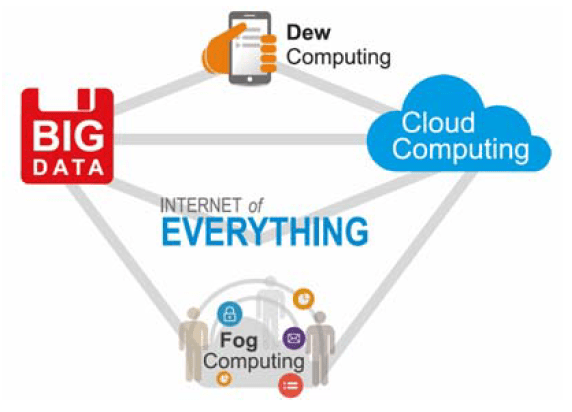
The bibliography contains the following two approaches in terms of BD considerations: Under the first approach, BD is perceived as “analytical workloads that are associated with some combination of data volume, data velocity and data variety that may include complex analytics and complex data types“ [30] while the other perceives BD as data volumes necessary to filter, store, transform to practical use in place of their generation and, if necessary, send some part to cloud [31].
Big Data growing exponentially can be illustrated by a number of wireless devices going to grow from 2015 to 2020 from 10 billion to 40 billion, and John Chalmers (CISCO Systems chairman) predicts that the IoT will grow to be a $19 trillion global market (“the GDP of the entire world is currently just a little more than $100 trillion”) [3]. It implies the need to protect data against cyberattacks. “Chris Bronk, a cybersecurity expert and professor of computer and information systems, perceives cybersecurity as one of the fastest growing industries in the world” [3].
5. Informatics Tools and SG
Informatics tools consists of two main groups: hardware with devices containing integrating circuits (IC) and software with a big number of programs written in different languages necessary for operation of IC devices. It means that SG using SCADA and/or PMU use informatics tools from both groups controlling power systems (PS).
In this context we should now consider whether IoT/IoE or CC could be used as new soft informatics tools from the SG point of view.
Due to a high velocity of the electromagnetic wave (order velocity of light) SG cannot use CC to control PS. As a result of application of SCADA and/or PMU, SG supports sensor networks which will be able to collaborate based on detailed comparison of sensor parameters and functions in both sensor networks (Fig. 1); as a result of these comparisons application of interfaces might turn necessary.
6. Final remarks
The above considerations present results of researches and practical solutions developed recently, however we have also taken into account intensive researches supported by tests in real environment, new products enabling new solutions in many areas as well as more accurate prediction. For example in paragraph 2 we discussed a change in management systems in power from traditional hierarchical to dispersed, whereas in May “A Hierarchical EMS for Aggregated BESSs in Energy and Performance-Based Regulation Markets” [32] was published (BESS means battery energy storage systems installed in power systems as a result of development of renewable energy sources). Also in May another paper presenting “Distributed Generation Monitoring for Hierarchical Control Applications in Smart Microgrids” [33] was published. Another power-related problem has been considered in the paper entitled “A Robust Linear Approach for Offering Strategy of a Hybrid Electric Energy Company” [34] (Hybrid means that company has both energy generation and energy retailing businesses. In my opinion this approach can be considered as a kind of Transactive energy solution [32]). “Multi-Linear Probabilistic Energy Flow Analysis of Integrated Electrical and Natural-Gas System s”is an example of the paper that considers common solving problem in electric and gas system.
The above mentioned cases must be considered before trying to apply any of the above-mentioned new methods. This is likely to provide a new insight into contemporary solutions.
The author wishes to thank Mr Piotr Czerwonka, PhD, for his support in editing the work.
REFERENCES
1. Zieliński JS. (2017) New Informatics Tools in Data Management, The Xth SIGSAND/PLAYS EuroSymposium’2017.
2. CISCO WHITE PAPER: FOG Computing and the Internet of Things: Extend the Cloud to Where the Things Are. Access 06.05.2017.
3. Ross A.: The Industries of Future. Simon & Schuster, 2016,
4. Hatziargyriou N. (Ed) (2014) Microgrids.. Architecture and Controls. Wiley, IEEE Press, 2014.
5. Matusiak B., Zieliński JS. (2011) Renewable Energy Sources Intrusion into Smart Grids – Selected Problems. Przegląd Elektrotechniczny 9a/2011, . 206-209.
6. Matusiak B.E, Zieliński JS. (2014) Internet of Things in Smart Grid Environment. :Rynek Energii 3/(112)-2014, . 115-119.
7. Zieliński JS. (2012) Smart Distribution Grids Importance in SG Development. Rynek Energii, 1/2012, 179-182.
8. Zieliński JS. (2015) Internet of Everything (IoE) in Smart Grid. Przegląd Elektrotechniczny 3/2015, pp. 157-159
9. Zielinski J.S.: Microgrids and Resilience. Rynek Energii 2/216, 108-110
10. Bush S.E. (2014), Smart Grid. Wiley, IEEE Press
11. Xu X., Jia H., Chiang H.-D., Yu D.C., Wang D.: Dynamic Modeling and Interaction of Hybrid Natural Gas and Electricity Supply System in Microgrid. IEEE Transactions on Power Systems vol.30 No.3 2015. pp 1212-1221.
12. Case Study Electromagnetic Interference Between Transmission Lines nd Buried Pipelines. POWERSYS marketing@powersys.fr Access 11.02.2016
13. Bućko P.: Perspektywy wykorzystania gazu ziemnego do produkcji energii elektrycznej w Polsce. Rynek Energii 3/2015, 17-22.
14. Chen S., We Z., Sun G., Cheung K.W., Sun Y.: Multi-Linear Probabilistic Energy Flow Analysis of Integrated Electrical and Natural-Gas System. IEEE Transactions on Power Systems vol. 32 No. 3, May 2017, 1970-1979.
15. Gil M., Dueňas P., Reneses P.: Electricity and Natural Gas Interdependency: of Comparison of Two Methodologies for Coupling Large Market Models Within the European Regulatory Framework. PWRS vol.31 No.1. January 2016, pp 361-
16. Meegahapola L., Flynn D.: Characterization of Gas Turbine Lean Blowout During Frequency Excursion in Power Networks. IEEE Transactions on Power Systems vol. 30, No. 4, July 2015. 1877-2997
17. Qiu J.,Yang Dong Z., Zhao J.H., Xu Y.,Zheng Y., Li Ch., Wong K.P.: Multi-Stage Flexible Expansion Co-Planning Under Uncertainties in a Combined Electricity and Gas Market. IEEE Transactions on Power Systems, vol. 30 No. 4, July 2015, 2119-2129.
18. Zhang X., Shahidehpour M., Albfulwahab A., Abusorrah A.; Hourly Electricity Demand Response in the Stochastic-Day-Ahead Scheduling Of Coordinated Electricity and Natural Gas Networks / IEEE Transactions on Power Systems vol. 31,No. 1, January 2016, pp 592-600.
19. Valenzuela-Valdes J. F., Angel López M.,, Padilla P., Padilla J.L, Minguillon J. Human Neuro-Activity For Securing Body Area Networks: Application of Brain-Computer Interfaces To People-Centric Internet Of Things. C. Feb 2017,62-67.
20. Vermesan O., Friess P. (2014) Internet of Things – From Research and Innovation to Market Deployment. River Publishers, Denmark
21. Akyildiz I.F., Pierobon M., Balasubramanian S., Koucheriavy Y.: The Internet of Bio-Nano Thing. CS March 2015, 32-40.
22. Communication Standards. September2015, December 2015, September 2016. A Supplement to IEEE Communication Magazines.
23. Czerwonka P.(2016) Zastosowanie chmury obliczeniowej w polskich organizacjach. Biblioteka, Łódź
24. Hao H., Corbin ChD. Kalsi K., Pratt R. (2017), Transactive Control of Commercial Buildings for Demand Response. IEEE Transactions on Power Systems vol.32 No.1 January 2017, pp 774-783.
25. Kazemi M., Zareipour H., Ehsan M, Rosehartr WE.D.: A Robust Linear Approach for Offering Strategy of a Hybrid Electric Company. IEEE Transactions on Power Systems vol. 32 No. 3, May 2017, 1940-1959
26. Olszak C.M., Mach-Król M., Big Data: How to Gain Value for Organizations. In: M. Themistocleous, V. Morabito, A. Ghoneim (Eds.), Online Proceedings of the 13th European Mediterranean & Middle Eastern Conference on Information Systems (EMCIS), , p. 7-15. 2016, Kraków, Poland. ISBN 978-960-6897-09-2.
27. Rindos A., Wang Y.: Dew Computing: the Complimentary Piece of Cloud Computing, @016 IEEE International Conferences on Big Data and Cloud Computing (BDCloud),Social Computing and Networking (SocialCom),Sustainable Computing and Communication(SustainCom). DOI 10.1109BDCloud-SocialCom-SustainCom.2016.14
28. Ross A.: The Industries of Future. Simon & Schuster, 2016,
29. Seyedi Y., Karimi H. Grijalva S.: Distributed Generaion Monitoring for Hierarchical Control Applications in Smart Microgrids. IEEE Transactions on Power Systems vol. 32 No.3#, May 2017, 2305 -2314.
30. Sun X., Ansan N.: EdgeIoT: Mobile Edge Computing for the Internet of Thing. IEEE Communications Magazine December 2016, pp 22-
31. Zhang T., Chen S.X., Gooi H.B., Maciejowski J.M.: A Hierarchical EMS for Aggregated BESS in Energy and Performance Base Population Markets. IEEE Transactions on Power Systems vol. 32 No. 3, May 2017, 1751-1781.
32. Zieliński JS. (2017) Transactive Energy and Internet of Everything. Rynek Energii 2/2017 pp. 92-94.
33. Zieliński JS. (2017) New Informatics Tools in Data Management (in preparation)
34. http://di.com.pl/nb-iot-nowe-możliwosci-i-wyzwania-interneturzeczy-57114
35. JEFF-DORSCH: Where are The IoT Industry Standards? http://semiengineering.com/where-are-the-iot-industrystandards/accesss 2016-10-11
36. McRock: Industrial Internet of Things. Access 21.05.2017.
Author. Prof. dr hab. inż. Jerzy Stanisław Zieliński, Uniwersytet Łódzki, Wydz. Zarządzania, Katedra Informatyki. E-mail: jzielinski@wzmail.uni.lodz.pl
Source & Publisher Item Identifier: PRZEGLĄD ELEKTROTECHNICZNY, ISSN 0033-2097, R. 94 NR 4/2018. doi:10.15199/48.2018.04.08
 Power Quality Blog