Published by Electrotek Concepts, Inc., PQSoft Case Study: Transformer Derating, Document ID: PQS0324, Date: October 10, 2003.
Abstract: A principal effect of harmonic distortion is to increase losses and heating in almost every component in the electric power system. While contributing almost no useful work, harmonic components of voltage and current increase the RMS value of voltages and currents. Interaction of harmonic quantities and resistive loss mechanisms in power system components generates excess heat.
Power transformers are also affected by harmonic distortion. Distortion of transformer load current is the most significant impact, leading to higher than normal temperatures at “hot spots” within the windings.
This case presents an evaluation of transformer derating due to harmonic current.
PROBLEM STATEMENT
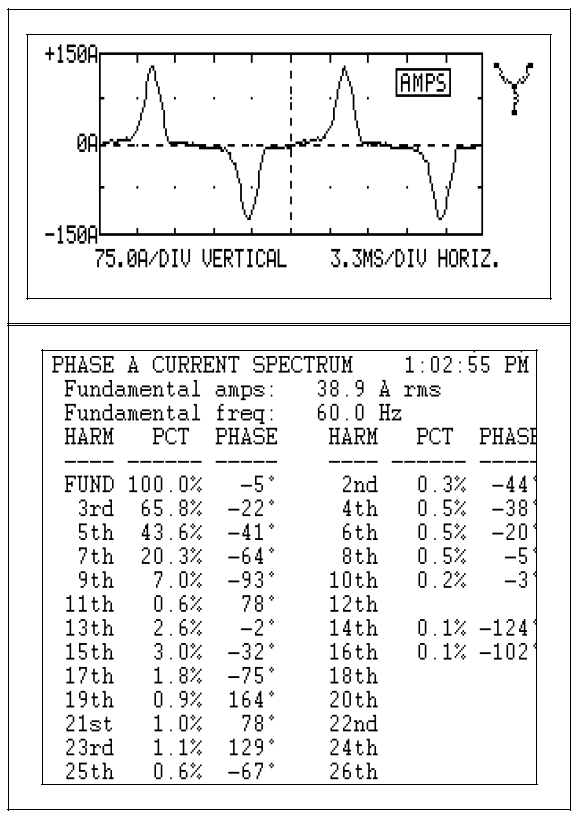
120 Volt, 75 kVA Transformer supplying computer workstations was running very hot at an office building. A check of the load current that the transformer was supplying showed that the amperage level was below the transformer rating. A spectrum analyzer was used to record the following waveform (Figure 1).
TRANSFORMER DERATING
A principal effect of harmonic distortion is to increase losses and heating in almost every component in the electric power system. While contributing almost no useful work, harmonic components of voltage and current increase the RMS value of voltages and currents. Interaction of harmonic quantities and resistive loss mechanisms in power system components generates excess heat. Some losses are actually sensitive to frequency, so that the power loss per ampere of harmonic current is actually greater than that for fundamental frequency currents.
Power transformers are also affected by harmonic distortion. Distortion of transformer load current is the most significant impact, leading to higher than normal temperatures at “hot spots” within the windings. If harmonic distortion of the load current is high, transformers must be derated to account for the increased heating effect of the distorted current. Guidelines for transformer derating are detailed in ANSI/IEEE Standard C57.110.
K-Factor Definition
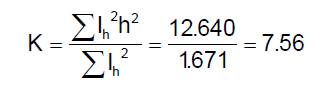
K-Factor is defined in UL Standards 1561 (low voltage) and 1562 (medium voltage) as:

where:
h……………………………………………………………..harmonic number
Ih……………………………………………………harmonic current (amps)
Transformer Derating Using C57.110
ANSI/IEEE Standard C57.110 applies to general-purpose transformers that are subjected to a load current with a total harmonic distortion greater than 5%. The object of the standard is to determine the value of nonlinear current which results in transformer heating equal to that produced when the transformers is supplying rated linear load. Transformer derating can be determined using:

where:
PEC-R ……….Eddy current loss at hot spot under rated conditions
Transformer derating depends upon the per-unit rated eddy current loss factor at the hot spot (PEC-R). This factor can be determined by:
1. Obtaining the factor from the transformer designer
2. Using transformer test data and the procedure in C57.110
3. Typical values based on transformer type and size
Table 1 – Typical Values of PEC-R
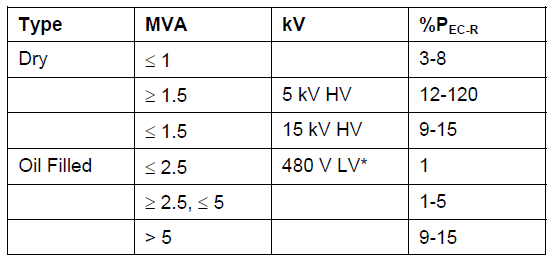
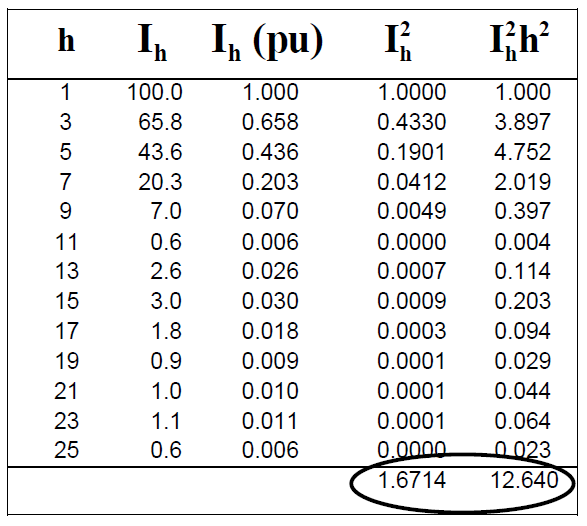
Table 2 summarizes the calculations required to determine the transformer derating and K-Factor for the load waveform illustrated in Figure 1.
Table 2 – Transformer Derating Calculations
The K-Factor for the illustrated waveform is determined to be
and the transformer derating value is

Note: PEC-R assumed to be 8% for this case
Effect of PEC-R
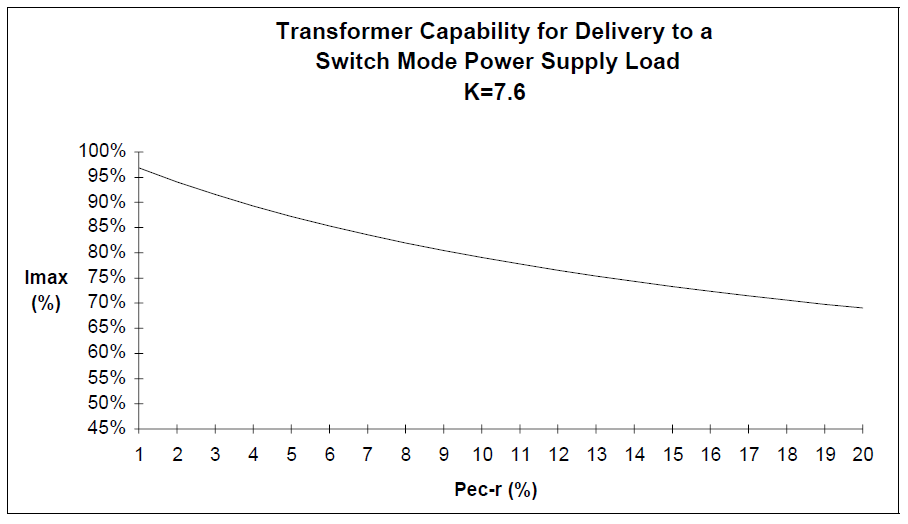
The impact of PEC-R on transformer capability is summarized in Figure 2. As can be seen from the figure, as the eddy current loss factor increases the load current that can be supplied is reduced.
SUMMARY
The K-Factor for the load current illustrated in Figure 1 was determined to be 7.56 and the transformer derating value was found to be 82% of it’s rated load current.
This means that the customer has several options when purchasing a transformer to supply this load:
− A 75kVA transformer with a K-13 rating (next standard size chosen)
− A K-1 transformers with a 91.5kVA (75/0.82) rating
REFERENCES
Reference: “Adjustable-Speed Drive and Power Rectifier Harmonics. Their effects on Power System Components”, D. E. Rice, IEEE No. PCIC-84-52.
IEEE Recommended Practice for Electric Power Distribution for Industrial Plants (IEEE Red Book, Std 141-1986), October 1986, IEEE, ISBN: 0471856878
IEEE Recommended Practice for Industrial and Commercial Power Systems Analysis (IEEE Brown Book, Std 399-1990), December 1990, IEEE, ISBN: 1559370440
 Power Quality Blog